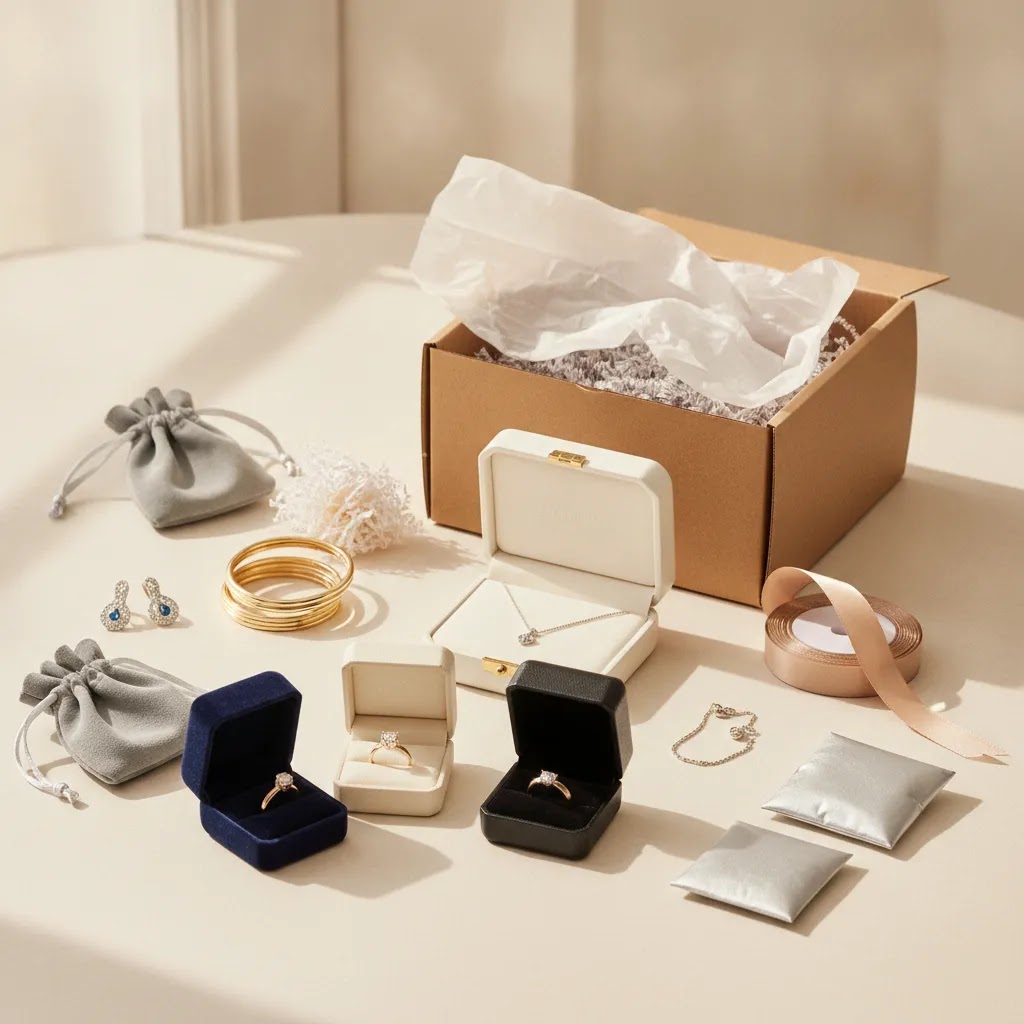
Why Packaging Carries Brand Weight in Jewelry
Jewelry packaging sits at the intersection of brand identity, logistics, and perceived quality. In many B2B settings, the piece itself is only one part of the buyer experience. Retail partners may assess how presentation supports shelf appeal, gift readiness, storage, and handling. Direct-to-consumer brands that manufacture through a wholesale partner often face a similar challenge: they need packaging that feels intentional without creating avoidable cost or operational friction.
That is why wow factor should not be confused with excess. A larger box, heavier insert, or more elaborate print treatment does not automatically create stronger brand value. In many cases, the most effective packaging is the format that protects the piece, presents it cleanly, reinforces the brand story, and moves efficiently through shipping and fulfillment.
Packaging decisions also need to match the production reality of the jewelry itself. If your line is still evolving, your packaging system should leave room for assortment changes. If your collection depends on strong visual identity, packaging may need tighter coordination with the product development stage, including jewelry design planning and visual concept review. Brands that want presentation and product to feel aligned often benefit from developing both tracks in parallel rather than treating packaging as a last-minute add-on.
Five Packaging Branding Solutions That Create Wow Factor
1. Structural packaging that matches the product format. A ring, necklace, or multi-piece set may need very different internal layouts. The right structure helps the jewelry sit correctly, reduces movement in transit, and improves the reveal moment. Poor structural fit can make premium jewelry look disorganized before the buyer even touches it.
2. Brand cues that are consistent, not crowded. Logos, colors, inserts, and message cards work best when they support a single visual direction. Packaging that tries to communicate too many ideas can look less premium than a simpler system. If your assortment is being built through custom jewelry packaging planning, consistency across boxes, pouches, cards, and shipping components matters more than adding more components.
3. Unboxing flow designed for photography and retention. Wholesale buyers and end customers often share packaging images internally or publicly. A strong unboxing sequence may improve brand recall and help your pieces feel more giftable or retail-ready. This usually comes from ordering the reveal steps well, not from adding unnecessary layers.
4. Packaging sized for storage and fulfillment efficiency. Wow factor that creates warehouse problems usually stops being a benefit. Packaging should stack, store, and ship in a manageable way. Oversized formats can increase freight burden, packing time, and damage risk if the exterior carton design is not planned carefully.
5. Product and packaging developed as one brand system. The strongest presentation usually happens when packaging is considered during product development, not after production is complete. For brands investing in digital concept work, early visual planning such as 3d jewelry box design may help stakeholders review proportion, brand fit, and presentation logic before committing to production samples.
Packaging Components Checklist: What Goes Into a Complete Jewelry Packaging System

“Packaging” is usually not a single item. It is a stack of components, and each layer has a job. If you define those jobs up front, you can build a system that creates wow factor without paying for layers that do not improve protection, presentation, or pack-out speed.
Your primary box is typically the hero presentation and the first brand signal a buyer recognizes on a desk or in a boutique back room. The insert is usually the control layer, it holds the piece in a repeatable position and reduces movement. A pouch or protective sleeve can be a friction buffer, especially for styles that could rub against hard surfaces or each other, and it can also act as a secondary presentation format for boutique display or storage. Printed cards handle the message layer, which could include your brand story, care guidance, authenticity or collection notes, and operational information like returns or reorder references. Then there is the outer shipper, which is often the real protector in transit. It does not need to be beautiful, it needs to arrive intact, stack well, and reduce damage risk.
Channel differences, the component choices should change with the route to market. A boutique wholesale delivery may prioritize clean presentation, easy inventory handling, and consistency across styles so the store can merchandise efficiently. A shipment-heavy model may prioritize movement control, closure security, and outer-carton performance because your packaging is exposed to more handling steps. In both cases, the goal is the same: protect the piece, present it cleanly, and make it easy for your team to pack it the same way every time.
Consider this before you add more layers: ask which components you should standardize across SKUs and which you should vary by collection. Standardization usually helps with buyer confidence because the brand feels controlled across repeat orders. It can also help your operations, because fewer box types and inserts typically means faster pack-out and fewer errors. Variation can make sense where it is visible and meaningful, such as a limited collection card, a seasonal color direction, or a special insert geometry for a specific product format. The key is to avoid varying the parts that drive complexity, like box footprints, closure methods, or assembly steps, unless the value is measurable in your channel.
How to Evaluate Packaging Before You Approve Production
Business buyers often focus first on appearance, but packaging approval should cover more than aesthetics. Start with protection. The box or insert should hold the piece securely enough for the shipping path you expect. If the jewelry shifts too much, tangles, or presses awkwardly against the insert, the packaging may create returns, repacking labor, or avoidable presentation issues.
Next, review branding consistency. Ask whether every component feels like it belongs to the same collection and the same company. This includes the outer box, internal insert, printed card, pouch, and shipping layer if applicable. Mixed visual language can make a collection look pieced together, even if the jewelry itself is well designed.
Then check scalability. A packaging solution might look excellent for a sample batch and still create problems in volume. Look at pack-out speed, storage footprint, replacement risk, and how easy it would be to maintain consistency across repeat orders. This matters even more if your business is balancing multiple stock keeping units, seasonal drops, or wholesale account requirements.
Finally, test packaging against your actual sales channel. Boutique wholesale, ecommerce fulfillment, and private label programs may need different priorities. A boutique-focused line might emphasize presentation on display, while a shipment-heavy model may need stronger transit logic. Packaging should support the route to market, not fight it. Broader manufacturing context from jewelry manufacturing decisions can help you judge where packaging belongs in the overall budget and workflow.
Unboxing Experience Design: How to Engineer the Reveal Without Adding Complexity
A strong unboxing experience is rarely about adding steps. It is about controlling the sequence so the first view communicates quality and the piece is presented correctly on first contact. The best unboxing designs are the ones your team can pack consistently at volume, with minimal interpretation.
Start by mapping the opening steps like a repeatable process. What does the buyer see first, and is that the message you want? Where is the brand cue placed so it is visible without needing to remove multiple layers? When the box opens, does the jewelry sit in the correct orientation, centered, and ready for inspection or photography? Small choices like where the card sits, how the insert frames the piece, and how the closure opens can shape whether the reveal feels controlled or improvised.
Social-ready considerations can still matter in B2B, just in a different way than consumer marketing language suggests. Wholesale buyers, merchandising teams, and brand stakeholders often evaluate packaging by how consistently it presents across multiple units. They may take quick photos for line reviews, vendor approvals, store training, or product pages. Packaging that produces inconsistent placement, skewed inserts, or varying fit can look unreliable even if the jewelry itself is consistent.
The unboxing moment can also fail for operational reasons. Damaged corners, scuffed surfaces, or crushed closures erase the intended impact immediately. Too many layers can also slow fulfillment, increase packing mistakes, and create a mismatch between sample presentation and real shipments. The most effective approach is usually to engineer the reveal with fewer, better-controlled components, so you get a premium first impression without building an assembly project into every order.
Strengths and Considerations

Strengths
- Well-planned packaging may increase perceived value without requiring changes to the jewelry design itself.
- Consistent branding across packaging components can help boutiques and private label brands look more established.
- Packaging that fits the jewelry properly may reduce movement, tangling, and presentation issues during shipping.
- A clear unboxing sequence can support stronger buyer recall and make the collection easier to merchandise or gift.
- Early packaging planning often improves coordination between product development, sampling, and fulfillment teams.
- Standardized packaging systems can simplify repeat orders and support more reliable scaling.
Considerations
- Custom packaging may require added development time, especially if structural changes or multiple branded components are involved.
- Sampling rounds could increase if the first packaging concept does not fit the product securely or align with the brand direction.
- More elaborate packaging may raise storage and shipping complexity, depending on box dimensions and packing requirements.
- Packaging that looks impressive in a mockup may not perform well in real fulfillment conditions unless tested carefully.
Protection and Transit Testing: What to Validate Before You Scale Packaging
Packaging can look perfect on a table and still fail in transit. Before you commit to a larger run, it helps to validate packaging with the same discipline you use for product sampling. The goal is to catch movement, scuffing, and closure issues early, while changes are still manageable.
Start with movement control. Pack the jewelry exactly as it would ship, then check whether it can shift inside the insert during realistic handling. If the piece can rotate, slide, or lift, it may arrive misaligned, tangled, or pressed into the wrong surface. Next, look at friction and scuff risk. If the jewelry contacts the insert, pouch, or internal walls in a way that could rub during transport, you may see avoidable presentation defects. Closure security matters too. If the box can open under pressure, or if a magnetic or friction closure is too weak for handling, the internal layout may not hold up in real shipping conditions.
Outer-carton performance is another common miss. Your primary box might be designed for presentation, but the shipper is what typically takes the impact. Validate that the outer carton size is appropriate, the boxes do not rattle, and the pack-out does not rely on guesswork. In practice, you want a pack-out that a fulfillment team can repeat quickly while still protecting corners, edges, and closures.
A simple pre-production test plan can be enough for most brand teams. Run sample pack-out trials with the actual jewelry and the exact packaging stack you plan to use. Simulate handling, which could include drops from realistic heights, compression from stacking, and vibration from basic transport movement. Then document pass or fail criteria you can repeat, such as no internal movement beyond an acceptable amount, no visible corner crush, no print scuffing, and no closure opening. If you cannot define what “good” looks like, it is hard to keep packaging consistent across reorders.
When packaging arrives from production, inspect it like a component of the product, not like a marketing extra. Check print alignment, sizing consistency across cartons, and assembly tolerances so lids close correctly and inserts seat properly. A small dimensional shift can turn a secure fit into a loose one, and a slight print misalignment can make a premium system look unprofessional. Catching these issues before the packaging is committed to live orders can help you avoid preventable damage, repacking labor, and rework costs.
Who Should Invest More Heavily in Packaging
Higher packaging investment often makes the most sense for brands selling on presentation, gifting, launch storytelling, or premium positioning. Boutique collections entering competitive retail settings may benefit if packaging helps the line stand out on arrival and supports in-store handling. Private label founders may also need stronger packaging if they are trying to look established early in the brand journey.
That said, not every business needs the most elaborate format. If your order model depends on lean fulfillment, frequent assortment testing, or lower-volume experimentation, a simpler packaging system may be the better commercial choice. The right level of wow factor depends on your channel, reorder pattern, and how much brand value the packaging actually adds to the selling experience.
A Practical Royi Sal Jewelry Perspective

Royi Sal Jewelry approaches custom development as a collaboration between business goals, design direction, and manufacturing execution. That matters for packaging because presentation works best when it is planned alongside the collection rather than after production is locked. Led by Royi Gal, whose background spans both jewelry design and manufacturing, the company is positioned to speak to the operational side of brand presentation as well as the creative side.
For brands that are shaping a collection from the ground up, Royi Sal Jewelry may be a useful resource for aligning product concept, presentation standards, and production readiness. If your project includes custom forms, visual prototyping, or collection-level coordination, reviewing bespoke 3d jewelry modeling services could help you think through product and presentation decisions earlier. You can also explore adjacent manufacturing considerations, including brass jewelry manufacturing, if your assortment planning is still being finalized. Readers ready to discuss a project can visit royisal.com to explore the company’s collaborative custom design and manufacturing approach.
Selection Guide for Jewelry Brands
1. Judge packaging by business function first. Ask what the packaging must do in your actual sales model. Does it need to survive parcel shipping, support boutique display, reinforce private label positioning, or streamline repeat fulfillment? A box that photographs well but slows warehouse handling may not be the right choice for a growth-stage brand.
2. Review fit between jewelry and packaging development. Packaging should not be isolated from the product brief. If product dimensions, closures, or assortment counts are still moving, packaging approvals may need to wait or stay flexible. This is especially true in custom development programs where sampling changes are still possible.
3. Evaluate communication and revision control. Strong packaging outcomes usually come from clear specifications, visual approvals, and disciplined revision management. Business buyers should confirm who owns dielines, mockups, insert fit decisions, and final sign-off. Misalignment here can lead to expensive rework or packaging that arrives usable in theory but awkward in practice.
4. Test operational realism. Review stacking, storage, outer-carton packing, and the effort needed to assemble the final pack-out. If your team or fulfillment partner has to add tissue, cards, pouches, stickers, and multiple inserts by hand, labor requirements may rise quickly. Sometimes a cleaner packaging system produces a better margin outcome.
5. Match wow factor to brand maturity. Emerging brands sometimes over-invest in elaborate packaging before they have product-market clarity. Established brands sometimes under-invest and look flat next to competitors on a buyer’s desk. The right move depends on whether packaging is helping you launch, validate, retain, or scale.
One useful way to assess options is to rank them against the same standards you would use for any manufacturing partner: craftsmanship, custom service range, communication reliability, order flexibility, lead-time realism, and logistics support. Packaging may be a branding asset, but it still needs to perform inside a production system.
Frequently Asked Questions
Does premium jewelry packaging always improve sales?
Not necessarily. Premium packaging may improve perceived value and buyer recall, but the result depends on your market, product positioning, and sales channel. If packaging costs outpace the value it adds, margins can tighten. The best packaging investment usually supports both brand presentation and operational efficiency.
Should packaging be developed before or after jewelry samples are approved?
In many cases, packaging should start earlier than brands expect, even if final approval comes later. Early planning helps align dimensions, presentation goals, and brand direction. Final production approval often works best after jewelry samples are stable enough that insert fit, spacing, and pack-out structure can be checked accurately.
What creates wow factor without making packaging excessive?
Clear brand consistency, strong structural fit, and a smooth reveal sequence usually matter more than visual complexity. A packaging system can feel premium without using multiple layers or oversized formats. Buyers often respond better to packaging that looks controlled and intentional than packaging that feels busy or inefficient.
How should wholesale buyers evaluate jewelry packaging from suppliers?
Wholesale buyers should review protection, consistency, stackability, display readiness, and how closely the packaging reflects the claimed brand position. They should also ask whether the packaging can be repeated reliably across future orders. A strong sample matters, but repeatability across production runs matters just as much.
Is custom packaging worth it for smaller jewelry brands?
It may be, depending on brand strategy. Smaller brands often benefit from packaging that helps them look more established, especially in boutique or gifting channels. Still, custom packaging should be sized to the business stage. A simpler branded system may be more practical than a highly complex format during early testing.
Can packaging decisions affect fulfillment costs?
Yes. Box dimensions, assembly steps, storage requirements, and outer-carton efficiency may all affect fulfillment cost. Packaging that looks compact in a concept review can still be labor-intensive once scaled. That is why operational testing should be part of packaging approval, not something left until after production.
What role does 3D planning play in packaging development?
3D planning may help teams visualize proportion, opening sequence, insert placement, and overall brand presentation before committing to physical samples. It can be useful when a collection has custom forms or when stakeholders need clearer review materials. It does not replace physical testing, but it may reduce early-stage uncertainty.
How much should packaging align with the jewelry collection itself?
Alignment should be close enough that the packaging feels native to the collection, not borrowed from another brand direction. That does not mean matching every visual detail. It means the product, box, inserts, and printed materials should communicate the same level of quality and the same brand tone.
What mistakes cause jewelry packaging to disappoint after launch?
Common issues include approving visuals without transit testing, choosing oversized boxes, ignoring pack-out labor, and treating packaging as separate from the jewelry development process. Another frequent problem is building for a sample presentation rather than for repeat orders. Launch packaging needs to work under real operating conditions.
What should I include inside jewelry packaging (insert cards, care cards, authenticity info, returns or warranty instructions)?
Include what your buyer and your operations team actually need, then keep it consistent. Many brands use a small set of inserts that can scale across SKUs, such as a brand or collection card, basic care guidance, and clear instructions for returns or service policies if you offer them. Some brands also include authenticity or product identification information, especially if wholesale accounts need to match pieces to SKUs quickly. The main goal is clarity: inserts should support confidence and reduce back-and-forth questions after delivery.
What is the best jewelry packaging for shipping so items do not move or get damaged in transit?
The best shipping-friendly packaging usually controls movement at the insert level and protects the primary box with a suitable outer shipper. You want the piece held in place so it cannot shift, tangle, or press into the wrong surface during handling. Then you want a shipping layer that reduces corner crush and prevents the box from rattling inside the carton. Testing a real pack-out sample through realistic handling is often the fastest way to confirm whether your packaging is stable enough for your shipping path.
How do I choose the right jewelry box size for different SKUs (rings vs. necklaces vs. sets) without increasing shipping costs?
Start by separating what must change from what can stay consistent. Some product formats may require different internal geometry, but you may still be able to standardize the outer footprint across multiple SKUs to simplify storage and shipping. In many cases, a controlled range of box sizes, paired with inserts designed for specific jewelry formats, keeps the system efficient without forcing you into a unique box for every item. The best answer depends on your assortment mix and your shipping method, so sizing decisions should be reviewed with both presentation and fulfillment in mind.
Should jewelry brands use eco-friendly or reusable packaging, and how do you evaluate it without sacrificing protection?
Reusable or lower-waste packaging concepts can be a strong fit if they support your brand position and still perform under real shipping conditions. The evaluation should be practical: confirm the packaging still protects the piece, holds its structure during handling, and maintains a clean appearance after transit. If a reusable concept looks good but scuffs easily, collapses, or increases damage risk, it may create higher replacement and customer service burden. The most effective approach is to test the packaging like any other production component and choose the option that matches your brand story without weakening protection.
Key Takeaways
- Wow factor in jewelry packaging comes from fit, clarity, consistency, and operational logic, not from excess alone.
- Packaging should be evaluated as part of the full product and fulfillment system.
- Brands often get better results when packaging planning starts during collection development, not after production is complete.
- Strong packaging can raise perceived value, but only if it can be repeated reliably across future orders.
- For B2B growth, the best packaging supports both presentation and scalable execution.
Conclusion
Jewelry packaging earns its place when it strengthens your brand story, protects the product, and holds up under real production and fulfillment conditions. That is the standard business buyers should use. If the packaging looks impressive but creates friction in storage, assembly, or repeat ordering, the wow factor may not last past the first shipment. Royi Sal Jewelry brings a collaborative B2B perspective to custom design and manufacturing, which can be valuable for brands trying to align product presentation with production reality. If you are planning a new collection or refining an existing one, visit royisal.com to explore the design and manufacturing process and contact the team to discuss your project requirements.
Share this post