
Eco Friendly Metals For Your Jewelry Business

What This Topic Really Covers
For a B2B jewelry company, eco friendly metals usually refer to metals sourced, recovered, or documented in a way that may reduce environmental impact compared with less transparent supply routes. The challenge is that “eco friendly” is not a universal production term. Different suppliers may mean recycled input, lower-impact processing, traceable sourcing, or simply a general marketing position.
That ambiguity creates risk for an emerging or scaling brand. If your internal team, your factory partner, and your wholesale customers all define the term differently, your product story can become inconsistent. This is especially relevant if you operate a growing jewelry business with multiple stock keeping units, varied production runs, and a mix of direct and wholesale channels.
A better approach is to evaluate each metal option through a business lens:
- Can the sourcing claim be documented clearly enough for your brand use?
- Can the manufacturer work with that metal consistently across sampling and production?
- Could the material choice affect lead time, revision cycles, or reorder planning?
- Will the claim remain accurate as you expand into wholesale jewelry accounts?
- Does the material fit your positioning without creating sourcing complexity your team cannot manage?
That is why the strongest sourcing decisions are rarely based on a single material label. They come from matching the metal option to your business model, documentation needs, and manufacturing process.
Eco Friendly Metals: Documentation Types, Chain of Custody, and Claim Language
Most problems with eco friendly metal claims are not caused by bad intent. They come from unclear paperwork, inconsistent terminology, and marketing language that gets ahead of what can actually be proven. If you are building a collection for wholesale or multi-channel growth, you need a documentation standard you can repeat, not a one-time explanation that only lives in an email thread.
From a business standpoint, brands typically ask for a few types of documentation. A supplier declaration or letter is the most common starting point. It may confirm that the supplier considers the input recycled, recovered, or responsibly sourced within their own system, but it does not automatically prove chain of custody beyond that supplier. Batch-level paperwork, when available, can be more useful because it ties a claim to a specific lot, purchase order, or production window. The more the document connects to a specific batch, the easier it is for your team to keep product pages and line sheets consistent across reorders.
Chain-of-custody records, when a supplier can provide them, are meant to show how material moves through multiple steps. In practice, this is where many brands discover gaps. Metals often pass through multi-tier suppliers, can be pooled with other inputs, and may be re-melted. Those realities do not automatically invalidate a claim, but they do change what you can say with confidence. Third-party statements may exist in some supply routes, but the key question remains the same: what does the document actually confirm, and what does it leave unanswered?
That leads to claim language. Your goal is not to write the most aggressive sustainability statement. Your goal is to create controlled language your sales team can use consistently across product pages, wholesale decks, and account conversations. If your documentation supports a supplier-level declaration, your marketing language should stay at that level, for example, “made with recycled metal according to supplier documentation,” or “produced using recycled input as provided by the material supplier.” If your paperwork is batch-linked, you may be able to be more specific in internal records and quality documentation, while still keeping public-facing language restrained and consistent.
When it comes to “traceable,” brands often assume it means end-to-end visibility back to origin. In many metal supply chains, traceable may simply mean traceable to a supplier, a refiner, or a defined program, not necessarily to every upstream step. Traceability commonly breaks down when inputs are mixed, reprocessed, or purchased through intermediaries who do not maintain the same record structure. That is why a practical approach is to define what “traceable” means for your business, document that definition internally, and avoid implying more visibility than you can actually support if a buyer asks for details.

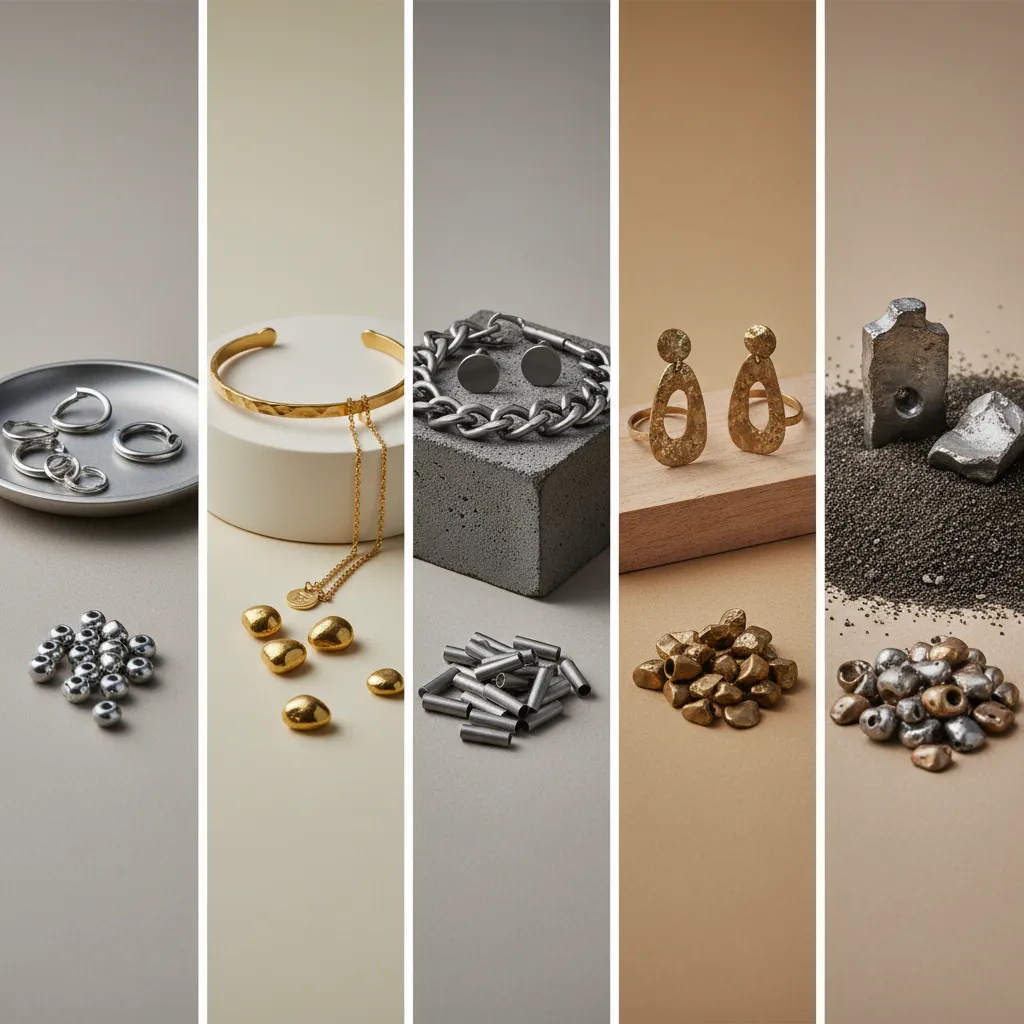
Five Metal Options to Evaluate
The list below is not a ranking of “best” to “worst.” It is a practical evaluation set for brands comparing eco positioning with production realities. Depending on your collection strategy, one option may fit far better than another.
1. Recycled silver
Recycled silver is one of the most commonly discussed options in responsible jewelry sourcing conversations. For many brands, its appeal is straightforward: it may support a clearer sustainability narrative than newly mined input, provided the sourcing and chain of custody are documented well enough for business use.
Why it stands out: It is often easier for a brand to explain than a more technical metal sourcing claim, and it may align well with modern buyer expectations.
- May support simpler storytelling for product lines positioned around lower-impact sourcing.
- Could fit established categories where silver-toned collections already perform well.
- Often works best when paired with clear supplier documentation rather than broad marketing language.
- May help a small jewelry business create a more defined sourcing position early.
Considerations:
- Documentation quality can vary widely between suppliers.
- Not every manufacturer handles sustainability-related claims with the same level of precision.
- Brand teams still need to confirm how the metal choice affects finishing, sampling, and repeat production.
Who it may suit: Brands that want a recognizable starting point for responsible sourcing claims and are prepared to verify records before launch.
2. Recycled gold
Recycled gold is often considered by brands aiming for a higher-value positioning or a more premium line architecture. It may strengthen your sourcing story, but it also tends to require tighter claim control and stronger communication between brand and manufacturer.
Why it stands out: It may support a premium brand narrative while helping reduce dependence on newly extracted material inputs.
- Can fit brands that need eco messaging without moving away from classic precious metal positioning.
- May be useful for capsule lines, limited wholesale ranges, or signature pieces.
- Could support stronger perceived value in buyer conversations if claims are supported correctly.
- Often benefits from disciplined product documentation and specification management.
Considerations:
- Claim accuracy matters more as perceived product value rises.
- Sampling and approval processes may need closer oversight.
- Brands should avoid overstating environmental benefits beyond what records support.
Who it may suit: Private label or boutique brands with a premium direction and a willingness to manage sourcing claims carefully.
3. Reclaimed or recovered metals from existing supply streams
This category can include metals recovered from prior jewelry, manufacturing scrap, or other existing industrial streams. The appeal is obvious: it may reduce reliance on newly introduced raw input. The difficulty is consistency. Recovered material programs can differ a great deal in traceability, quality controls, and communication standards.
Why it stands out: It may offer a meaningful circularity angle if your manufacturer can explain the input source and production controls clearly.
- Can strengthen a circular design narrative for brand positioning.
- May help differentiate a collection if the recovery process is documented and credible.
- Could appeal to wholesale buyers who want stronger sourcing stories.
- Often works best in close coordination with the manufacturing partner.
Considerations:
- Traceability may be harder to communicate than simple “recycled” claims.
- Input consistency may vary depending on the recovery stream.
- Brands need disciplined approval language to avoid vague sustainability messaging.
Who it may suit: Businesses with a focused sourcing narrative and enough operational maturity to manage more complex claim review.
4. Lower-impact alloy strategies
Sometimes the most practical move is not a single headline metal but an alloy strategy that balances durability, sourcing documentation, and production fit. For brand owners, this is less glamorous than a bold marketing statement, but it may be more workable over time.
Why it stands out: It shifts the conversation from a simple label to a broader product development decision tied to manufacturing realities.
- May improve design-to-production consistency across a collection.
- Could reduce rework if the chosen alloy performs more predictably in production.
- Can help match sourcing goals with wear expectations and finish requirements.
- Often leads to more honest product positioning than broad eco claims alone.
Considerations:
- Requires strong technical communication between brand and manufacturer.
- May be harder to explain in marketing unless the story is simplified well.
- Not every supplier will document alloy decisions with enough clarity.
Who it may suit: Brands that prioritize repeatability, lower operational friction, and realistic sourcing messaging.
5. Mixed metal collection planning with verified sourcing rules
Some brands try to solve sustainability goals by selecting one hero metal. In practice, a mixed metal collection with clear sourcing rules may be more resilient. This approach focuses on standardizing what documentation is required for every approved metal input rather than relying on one broad claim.
Why it stands out: It reflects how many real collections are built, especially for brands balancing design variety with supply chain control.
- May offer more flexibility for line planning and future collection expansion.
- Can reduce dependence on a single sourcing stream.
- Could support better reorder continuity if one input becomes harder to source.
- Often fits brands that are still refining their long-term sustainability position.
Considerations:
- Needs a documented approval framework to stay credible.
- Internal communication across design, sourcing, and sales must stay aligned.
- Brand messaging can become messy if each product line uses different language.
Who it may suit: Growing brands that need flexibility and want a sourcing system, not just a marketing phrase.
Comparison Table
| Option | Main Business Benefit | Primary Risk | Best For |
|---|---|---|---|
| Recycled silver | Clearer market-facing sustainability story | Uneven documentation quality | Emerging brands building a defined sourcing message |
| Recycled gold | Premium positioning with responsible sourcing potential | Higher claim scrutiny and tighter approval needs | Boutique and private label premium lines |
| Recovered metals | Circularity narrative with differentiation potential | Traceability complexity | Brands with stronger internal sourcing oversight |
| Lower-impact alloy strategy | Operational fit and repeatability | More technical explanation required | Businesses prioritizing production consistency |
| Mixed metal sourcing framework | Flexibility across collections | Message inconsistency if unmanaged | Growing brands planning broader assortments |
Ethical vs Eco Friendly Metals: How to Position the Difference for Wholesale Buyers
A factor that many brand owners underestimate is that wholesale buyers often use “eco friendly” and “ethical” interchangeably, even though they point to different risk categories. Eco claims usually relate to environmental impact factors, for example recycled input, recovery streams, and processing choices. Ethical claims usually relate to people and governance, for example labor conditions, responsible business practices, and the transparency you can provide about the supply chain.
This matters because the proof structure is different. A recycled or recovered metal claim is typically supported by material documentation, supplier declarations, and sometimes chain-of-custody style records depending on your sourcing route. An ethical sourcing position typically requires broader supplier oversight, clearer expectations around who is making the product, and a realistic view of what you can verify across tiers. Many brands can support an eco claim at a product level while still needing time to strengthen ethical sourcing controls across the wider supplier network.
For wholesale conversations, a useful positioning framework is to answer three questions in plain language. First, what exactly are you claiming about the metal input, and where does that information come from? Second, what can you verify with documentation, and what sits outside your current visibility? Third, what is your process for maintaining consistency in production and reorders, including what happens if an input changes? Buyers do not need perfection. They need clarity, and they need confidence that your team is not using vague “green” language to avoid specifics.
This is also where it helps to keep your internal alignment tight. Your sourcing notes, your product copy, and your wholesale sales language should not be three separate stories. If you are building an ethical sourcing foundation alongside eco-friendly metal decisions, treat them as connected operational systems. The article on ethical sourcing jewelry goes deeper on the ethical side. This article focuses on the eco friendly metal decision, but the same discipline applies in both: define the claim, define the evidence, and make sure your manufacturing workflow can repeat it.
How to Vet Metal Claims Before Production
If you are evaluating eco friendly metals for your jewelry business, your best protection is a repeatable review process. A metal claim should be checked the same way you would review a design file, a sample approval, or a shipment specification.
Start with documentation. Ask what the claim actually means inside the supplier’s system. “Recycled,” “recovered,” or “responsibly sourced” may sound similar in sales language but can refer to very different sourcing paths. If you are also assessing cost exposure in cross-border purchasing, broader supply issues such as tariffs on jewelry can affect how practical a sourcing route remains over time.
Next, test manufacturing fit. A metal option may support your brand story but still create difficulties in sampling, revisions, or repeat orders. That is where collaboration with a capable partner matters. Royi Sal Jewelry works in custom jewelry design and manufacturing, with a collaborative consultation approach and global fulfillment support. For brands exploring broader sourcing and production decisions, their Jewelry Sourcing and Jewelry Manufacturing resources are useful starting points.
Use this checklist before approving a metal direction:
- Define the exact sourcing claim your brand plans to make.
- Confirm what evidence your supplier can provide for that claim.
- Review whether the material fits your sampling and production workflow.
- Check whether the same sourcing standard can be maintained for reorders.
- Align product copy, wholesale sales language, and internal sourcing notes.
Brands that skip this step often create problems later. The issue is not always the metal itself. It is the gap between what the team assumes and what the production system can actually support.
From a Production Standpoint: How Metal Choice Changes Sampling, QC, and Reorder Consistency
From a production standpoint, eco-focused metal requirements can introduce friction in development even when everyone agrees on the goal. The most common pressure points are sample iteration cycles, finish matching expectations, tolerance stack-ups across components, and reject rates that increase when the brief is not specific enough. The metal claim itself is rarely the issue. The issue is that “eco friendly” requirements can add another variable to a process that already depends on controlled inputs and repeatable steps.
In practice, you can reduce that friction with a tighter brief and clearer approvals. Define the claim you want to make, the documentation you expect to receive, and how that requirement should be treated during sampling. If your team approves a sample based on visual finish, weight feel, and functional fit, document those approvals in a way your factory partner can repeat. That includes recording what was accepted and what was rejected, and why. If a detail changes later, your reorder can drift without anyone noticing until units are already produced.
A practical quality control approach is to separate what you check at each stage. At sample stage, focus on design accuracy, visible finish expectations, functional performance, and the exact product story your sales team plans to use. At first production, focus on consistency across the batch, whether the finish matches the approved sample, and whether the same documentation and sourcing notes are still valid for that run. At reorder stage, focus on repeatability. Confirm that the factory is using the same approved reference, and that any process changes are flagged before production starts, not after goods are complete.
When it comes to eco claims, you also need a plan for substitutions. Inputs can become unavailable, programs can change, and suppliers can switch sub-suppliers. That does not mean you cannot scale. It means you need a controlled process. Many brands use pre-approved alternates for certain components or metal inputs, along with an internal sign-off rule for when claim language must change. Decide who can approve a substitution, and who can approve a change in marketing language. If the metal input changes and your claim stays the same, you may create a compliance risk. If your claim changes and your sales team is not informed, you may create a wholesale trust problem.
Royi Sal Jewelry Perspective
For brands evaluating sourcing-sensitive collections, a collaborative manufacturing partner may be more valuable than a broad sustainability claim on its own. Royi Sal Jewelry is led by Royi Gal, whose background combines jewelry design and manufacturing. That matters because eco-focused sourcing decisions do not stop at concept level. They have to be translated into a workable design brief, reviewed during development, and managed through production and fulfillment.
The company focuses on custom jewelry design and manufacturing for B2B clients, with consultation and global shipping support built into the service model. If you are planning a private label line and need to pressure-test how sourcing choices could affect development, communication, and production planning, Royi Sal Jewelry can be a useful resource to explore. You can review the broader process at royisal.com and contact the team to discuss how your sourcing goals fit your collection brief.

Strengths and Considerations
Strengths
- Eco-oriented metal choices may help a jewelry brand create more credible differentiation if sourcing claims are specific and documented.
- They can support stronger conversations with wholesale buyers who increasingly ask how products are sourced and described.
- A careful metal strategy may improve internal discipline by forcing clearer documentation, approval rules, and cross-team communication.
- For some brands, responsible sourcing choices can align product development with long-term brand positioning rather than short-term trend messaging.
- Working through sourcing criteria early may reduce the risk of rewriting product claims after sampling or launch planning has already begun.
Considerations
- Eco language is easy to overstate, so unsupported claims can create trust issues with buyers or retail partners.
- Some material paths may add complexity to sampling, supplier review, or repeat-order consistency depending on your production model.
- Not every manufacturer will explain sourcing inputs at the level a growing brand needs for clear compliance and brand messaging.
- Collection planning can become more difficult if the sourcing rule works for one product family but not the rest of your line.
Frequently Asked Questions
What makes a jewelry metal “eco friendly” in a business context?
For a business buyer, the term usually depends on how the metal is sourced, recovered, or documented. It is less about a simple label and more about whether the claim can be supported across development, production, and sales. A useful standard is whether your team can explain the claim clearly and keep that explanation consistent across product pages, wholesale materials, and buyer conversations.
Should a small jewelry business start with one metal or a broader sourcing policy?
Many smaller brands benefit from starting with one clear rule they can actually manage, then expanding into a broader sourcing policy as operations mature. A narrow start may reduce confusion during development. A broader policy can work well later, but only if your brand has enough documentation discipline to keep sourcing claims accurate across the collection.
Are recycled metals always the best option?
Not always. Recycled inputs may support your brand positioning, but they are only one part of the decision. The better option is the one that your supplier can document clearly and manufacture consistently. If the claim is attractive but difficult to verify or repeat at production scale, it may create more operational pressure than value for your business.
How do eco-focused metal choices affect wholesale readiness?
Wholesale buyers may appreciate stronger sourcing narratives, but they also tend to value consistency and clarity. If your claim is easy to understand and backed by documentation, it may strengthen your selling story. If the language is vague or changes from style to style, it can create hesitation. Wholesale readiness depends on operational credibility as much as marketing appeal.
Can sourcing claims affect production lead times?
They can, depending on the sourcing route, the need for documentation review, and the number of approval stages involved. In many cases, the effect comes less from the metal itself and more from the communication process around it. Projects with unclear sourcing expectations may require extra back-and-forth before development or production can move ahead confidently.
How should brands brief a manufacturer on eco metal requirements?
A strong brief usually states the sourcing goal, the exact claim language your brand wants to use, any required documentation, and how that claim should be maintained in reorders. It also helps to define who approves changes if the original input becomes unavailable. The clearer the brief, the easier it may be to avoid misalignment during development.
Do eco friendly metals automatically protect a brand from scrutiny?
No. They may attract more scrutiny, especially if your messaging becomes a visible part of product positioning. Buyers, stockists, or internal stakeholders may ask follow-up questions about what the claim means. That is why many brands benefit from using restrained, evidence-based language rather than broad promises that could be hard to support later.
Is this mainly relevant for online jewelry business models?
No. It matters across online, boutique, and wholesale channels. Online brands need clear product messaging, while wholesale brands need sourcing language that sales teams and buyers can understand quickly. The channel changes how you present the information, but the underlying need remains the same: a claim that is accurate, manageable, and aligned with production reality.
Why should a manufacturer be involved early in metal selection?
Because the material decision affects more than sourcing copy. It can influence development workflow, production planning, revision handling, and reorder consistency. A manufacturer with design and production experience can help identify whether a sourcing idea is workable before your team commits too heavily to the concept in line planning or sales preparation.
What are the most sustainable metals for jewelry, and how should a business validate that claim?
There is rarely a single “most sustainable” answer that applies to every brand, because sustainability depends on what you can document, what your manufacturer can repeat, and what impacts you are actually trying to reduce. Many businesses start by evaluating recycled or recovered inputs because they can sometimes be supported with clearer paperwork than broader, undefined claims. The validation step is to require specific documentation, align internal claim language to that evidence, and confirm the choice does not break sampling or reorder consistency.
What is the difference between “eco-friendly jewelry” and “ethical jewelry” for a brand selling wholesale?
Eco-friendly positioning usually focuses on environmental impact factors, for example recycled input, recovery programs, or lower-impact processing choices your supplier can document. Ethical positioning usually focuses on people and governance, for example labor conditions, responsible practices, and how transparent your supply chain is. For wholesale, the most important part is to separate the two in your sales language, so buyers understand what you can verify today and what your process is for strengthening oversight over time.
Are certifications required to market recycled or responsibly sourced metals, and what can brands say without them?
Certifications are not always required, but some brands and retailers may prefer them as part of their internal standards. Without certifications, you can still use controlled, evidence-based language tied to supplier documentation, as long as you avoid implying independent verification you do not have. A practical approach is to state the claim, state the basis for it, and keep internal records that match what your public-facing copy says.
How can a brand reduce the environmental impact of jewelry manufacturing beyond choosing a “sustainable metal”?
Metal choice is only one lever. Brands can also focus on reducing iteration waste through clearer briefs, making products that are built for longevity and repeat wear, and tightening quality control so fewer units are rejected or reworked. Operationally, it often comes down to better sampling discipline, fewer last-minute changes, and more consistent specifications so production can run with less waste and fewer corrections.
Methodology
This evaluation uses a B2B decision framework rather than a consumer shopping lens. The main criteria are manufacturing quality and craftsmanship, design capability and service range, trust and communication, order flexibility, lead-time implications, and logistics practicality. Those factors matter because a metal choice only becomes valuable if it holds up across development and repeat production.
The article also reflects the realities of custom manufacturing. Material claims need to be interpreted inside actual workflows involving consultation, briefing, sample review, and fulfillment planning. That is why the strongest options in this article are not presented as universal winners. They are presented as sourcing paths that may fit different brand stages and operational needs.
Key Takeaways
- Eco friendly metals for your jewelry business should be evaluated as a sourcing and manufacturing decision, not just a marketing label.
- Recycled, recovered, and mixed-metal strategies each offer different tradeoffs in documentation, flexibility, and production fit.
- The best option for your brand may depend on claim clarity, repeat-order consistency, and how well your manufacturer can support the brief.
- Clear sourcing rules can strengthen both wholesale communication and internal operational discipline.
- A collaborative manufacturing partner can help translate sourcing goals into a workable product development process.
Conclusion
Choosing eco friendly metals for your jewelry business is rarely about finding one perfect material. It is about selecting a sourcing path your brand can explain honestly, produce consistently, and maintain as your line grows. For some businesses, that may mean recycled input. For others, it may mean a more structured sourcing framework across multiple product families. The better decision is usually the one that survives real-world production pressure, not the one with the most attractive label. If you are weighing sourcing priorities alongside custom development, Royi Sal Jewelry offers a collaborative B2B approach shaped by design and manufacturing experience. Visit royisal.com to learn more about the process or contact the team to discuss your collection brief and sourcing considerations.