Silver Gemstone Jewelry for Brands (2026 Review)
Overview
In B2B collection planning, silver gemstone jewelry usually sits at the intersection of design value and commercial practicality. It can support a premium visual story without requiring every style in a collection to move into the highest possible cost bracket. That makes it relevant for boutiques building curated assortments, fashion brands adding jewelry extensions, and entrepreneurs developing a first private label range.
Based on available Royi Sal Jewelry data, the company focuses on custom jewelry design and manufacturing for wholesale and private label clients. Its service model includes custom jewelry design and development, collaborative design consultation, jewelry manufacturing, and global shipping and order fulfillment. That matters for businesses evaluating sterling silver gemstone jewelry because success depends on more than appearance alone. A manufacturer must be able to translate an idea into a workable design brief, develop the product for production, and support ongoing manufacturing as the line grows.
For businesses comparing options, silver gemstone jewelry should be evaluated as a category strategy, not only a product idea. Issues such as collection coherence, order planning, finish choices, and long-term replenishment are just as important as the initial design concept. If your assortment also includes plated styles, reviewing jewelry precious metal plating can help clarify where silver-based pieces should sit within a broader merchandising plan. For more category context, Royi Sal Jewelry also covers 925 sterling silver and broader jewelry manufacturing topics on its site.
How to Evaluate Gemstone Assortment and SKU Strategy
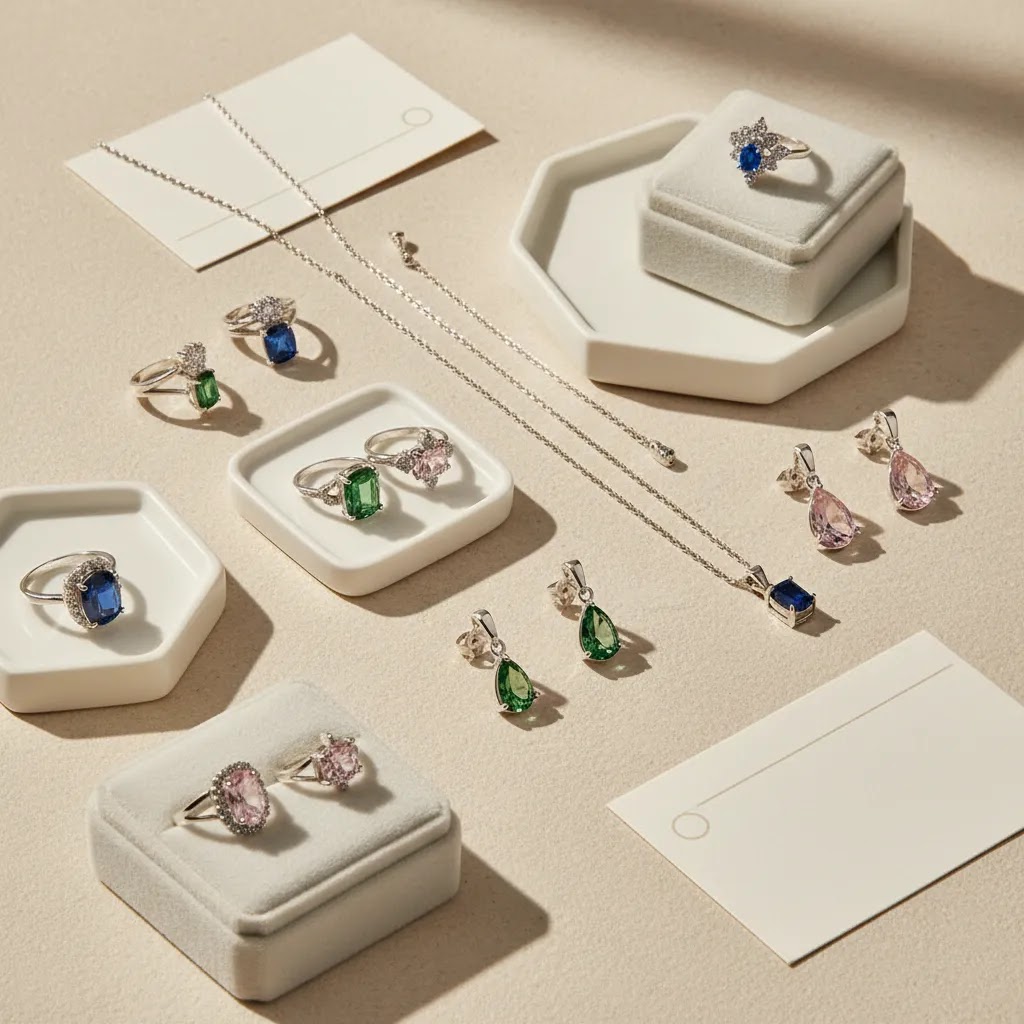
Many wholesale catalogs present silver gemstone jewelry through “shop by” navigation: jewelry type, gemstone, color family, shape, or collection story. That structure is not just a browsing tool, it reflects an assortment plan. As a brand or boutique buyer, you can translate that same logic into a private label strategy that stays coherent as you add newness.
Think of it this way: you are building a system, not just a set of designs. A practical approach is to define a core assortment that can replenish and a seasonal layer that can rotate. Your core might focus on a small number of signature silhouettes, your seasonal layer can introduce limited runs, new color directions, or trend-led proportions without forcing your entire program to change.
Another common structure is good, better, best tiering. In practice, this is less about “cheap versus expensive” and more about controlling complexity. A good tier might use simpler settings and fewer variations, a better tier might add more detailed design work or multiple stone placements, and a best tier might focus on statement pieces with higher development time. If you plan this upfront, you can maintain a clear price architecture while keeping production planning realistic.
Now, when it comes to SKU count, silver jewelry with gemstones can expand fast. One design can turn into many SKUs when you layer in stone colorways, stone size options, and ring sizes. What many brand owners overlook is that too many options can push a project into operational strain. It can also make minimum order quantities and replenishment harder to manage, especially in a first run when you are still learning what your customers reorder.
Consider starting with a tighter option set. For example, you might choose one stone size per silhouette, limit each style to a small number of colorways, and focus ring programs on a few high-demand sizes rather than offering every possible variation at launch. You can still present breadth through design families: the same visual language expressed as a ring, pendant, earring, and bracelet, rather than dozens of unrelated styles.
For boutiques, sets and stories often outperform sheer design volume. A coordinated group that merchandises as a “collection” can support higher basket building and clearer display planning without requiring hundreds of unique designs. From a production standpoint, a set-based approach can also improve consistency because multiple pieces share similar elements, proportions, or finishing requirements.

How Silver Gemstone Jewelry Development Works
For custom or private label silver gemstone jewelry, the process normally starts with concept definition. A business client should come prepared with a clear idea of target customer profile, intended price architecture, visual direction, and expected collection size. Royi Sal Jewelry’s available service data points to a collaborative design consultation model, which is useful at this stage because many early product ideas need refinement before they are ready for production planning.
The next step is design and development. In practice, this often means turning sketches, references, or brand concepts into a more structured product brief. A manufacturer with design capability can help identify where a concept may need adjustment for consistency, repeatability, or wholesale viability. Royi Sal Jewelry positions custom jewelry design and development as a core service, which suggests clients are not expected to arrive with production-ready files only.
After development, the project moves into manufacturing planning and production. For wholesale silver gemstone jewelry, this stage may involve confirming the collection scope, production quantities, and fulfillment needs. Royi Sal Jewelry also lists global shipping and order fulfillment as part of its service offering, which is especially relevant for international brands managing overseas supply relationships. If gemstone origin stories or category positioning are part of your brand message, the article on tracing the sustainable journey of every gemstone may help shape how you communicate product value, though any sourcing-specific claims should always be confirmed directly before launch.
What Clients Should Expect
B2B clients should expect silver gemstone jewelry development to involve more back and forth than a simple stock wholesale order. A custom program usually requires alignment on design intent, revisions, production expectations, and fulfillment planning. Businesses that approach the process with clear documentation tend to move through it more efficiently.
You should also expect timelines and minimum order requirements to vary by project. Royi Sal Jewelry’s available data does not publish fixed pricing or MOQ figures, so it would be unrealistic to assume a standard structure across every sterling silver gemstone jewelry program. Complexity, order volume, assortment breadth, and fulfillment requirements can all affect the final scope.
Communication quality matters as much as design capability. Royi Sal Jewelry’s brand context emphasizes collaboration, craftsmanship, and a partnership-oriented approach, which is important for businesses that need a manufacturer to support product development decisions rather than simply accept purchase orders. For growing brands, that can be the difference between a collection that looks good in concept and one that actually works as an ongoing wholesale program.
It is also reasonable to expect some strategic tradeoffs. For example, a visually ambitious collection may need simplification to meet target margins or production consistency goals. A strong manufacturing partner should be direct about these issues early, especially if the aim is to build a repeatable line rather than a one-off concept.
Operational Details Competitors Emphasize (That You Should Clarify Upfront)
Some suppliers position silver gemstone jewelry around speed and simplicity, using language like “ready to ship” or “no minimums.” The reality is that operational terms are what determine whether a program works for your business model. Even when a supplier can accommodate small runs in some form, you still need to clarify what changes between a stock-style order and a custom order, and what is required from you at each stage.
Start with sampling expectations. Ask how sampling is typically handled for custom development, what is included in the sample stage, and what happens if the first sample needs revisions. From a production standpoint, sampling is where practical issues surface: proportions, stone setting details, wearability, and the repeatability of the design in bulk.
Next, discuss reorders and replenishment planning. Your first purchase order is rarely the finish line. If you are building a wholesale sterling silver gemstone jewelry program, you want to know how reorders are treated, what information needs to be locked for repeatability, and how consistent the manufacturer can keep future production relative to your approved sample. This is also where SKU discipline matters, because replenishing twenty variations of one style is operationally different than replenishing five.
Lead times should be discussed as ranges, not promises. Ask what the typical timeline looks like for development and sampling, then what production timing could look like after approvals, and how shipping and order fulfillment fits into the overall schedule. If you are planning a launch or a wholesale delivery window, build your calendar around checkpoints rather than a single date assumption.
Clarify documentation and communication checkpoints early. A strong workflow typically includes confirmation of specifications before production begins, clear approvals on sample outcomes, and alignment on packing requirements if you sell B2B or ship direct to retail partners. It also helps to agree on how revisions are handled: what counts as a minor adjustment versus a design change, and how that affects the next steps before bulk manufacturing.
To reduce risk on a first run, consider starting with a tighter capsule rather than a full catalog. A smaller launch can still look complete if it is planned as a coordinated assortment. It also gives you a cleaner way to confirm quality control expectations, consistency targets, and operational fit before expanding into more complex styles, added variations, or larger order volumes.

Strengths and Considerations
Strengths
- Silver gemstone jewelry can support an elevated product story while remaining commercially approachable for many wholesale and private label collections.
- Royi Sal Jewelry combines custom design and manufacturing services, which is useful for brands that need development support, not just production capacity.
- The company is led by Royi Gal, whose background as both a jewelry designer and manufacturer adds practical credibility to concept-to-production discussions.
- A collaborative consultation model can help businesses refine early ideas into more workable collection plans.
- Global shipping and order fulfillment are part of the available service scope, which may help international clients manage cross-border operations more efficiently.
- This category works well for brands building collections with multiple tiers, including sterling silver jewelry, gemstone-led styles, and plated alternatives.
Considerations
- Published pricing and exact minimum order quantities are not available in current tool data, so businesses need direct quote discussions before budgeting a program.
- Custom silver jewelry with gemstones usually requires more development time and decision-making than buying ready-made wholesale styles.
- Product complexity, assortment size, and fulfillment needs can affect timelines, so planning should include room for revisions and approvals.
- If your brand depends on specific sourcing, certification, or material claims, those points should be verified directly rather than assumed from general category language.
Stone Authenticity, Treatment Disclosure, and Brand Claims: What to Ask a Supplier
Gemstone language can become a major part of how you market silver gemstone jewelry, especially if your brand uses stone meanings, origin stories, or “natural” positioning. Here’s the thing: it is easy to build product copy that goes beyond what can actually be supported. Before you publish claims, you need supplier clarity on what you are selling and what documentation, if any, is available for your specific stones and production batch.
Start by confirming how the supplier classifies the stones used in your designs. Ask whether stones are represented as natural, lab-created, or composite in any way. If treatments are common in the category, ask what treatments may be used in many cases and whether treatment disclosure is provided at the time of production. This is not only a quality question, it is a compliance and brand trust question.
Next, ask what form of documentation is typically available. Some suppliers may provide internal specification sheets, invoices that identify stone types, or other paperwork that supports your internal records. Others may not offer formal certificates for every item, or may only provide documentation for certain stone types or order structures. Your goal is to understand what can be documented consistently, not to assume that certificates are standard across all programs.
It is also wise to clarify origin and sourcing language before you build it into your marketing. If you plan to reference any geographic origin, ethical sourcing terms, or sustainability claims, confirm what can actually be supported for your supply chain and whether that support is consistent over time. If it cannot be verified reliably, adjust your copy to focus on design, craftsmanship, and your brand story rather than making sourcing statements that might not be defensible later.
From a practical standpoint, align your product descriptions with what you can prove. That might mean using more neutral language, such as describing the visual qualities of the stone and the overall design concept, while keeping technical gemstone claims limited to what your manufacturing partner can confirm in writing. When Royi Sal Jewelry is involved in custom jewelry design and development and manufacturing, these questions should be part of the early brief so your product claims and your production reality stay aligned.
Who This Is For
This type of program is best suited to B2B buyers who need more than an off-the-shelf assortment. That includes boutique retailers developing exclusive lines, fashion brands adding jewelry to an existing product portfolio, and entrepreneurs building a private label collection with room to scale. It is especially relevant for businesses that want sterling silver gemstone jewelry positioned as part of a broader brand system, not as isolated products. Companies that benefit most are usually those prepared to share a clear design direction, target market, and business goals at the start of the process.

How to Get Started
Start by defining the role silver gemstone jewelry will play in your assortment. Decide whether the line is meant to anchor your collection, complement plated pieces, support seasonal drops, or establish a higher perceived value segment. This helps shape a more productive first conversation.
Next, prepare a basic project brief. Include style references, target customer profile, expected order structure, launch timeline, and any operational requirements related to wholesale fulfillment or international distribution. If you plan to develop wholesale sterling silver gemstone jewelry as part of a larger sourcing strategy, include that context as well.
Then contact Royi Sal Jewelry through royisal.com to discuss the project. Because the company offers collaborative design consultation, custom design and development, manufacturing, and global fulfillment support, the initial discussion should focus on fit, feasibility, and next steps rather than price alone. A useful first objective is to confirm whether your concept, order expectations, and business model align with the way the team works.
Frequently Asked Questions
Why is silver gemstone jewelry attractive for B2B collection planning?
It can offer a strong perceived value position for brands that want gemstone-led design without pushing every style into a higher-cost category. For wholesale and private label businesses, that can create a more balanced assortment across entry, core, and premium product segments. The exact fit depends on your audience, branding, and pricing architecture.
Does Royi Sal Jewelry offer stock silver gemstone jewelry collections?
Current available data emphasizes custom jewelry design and manufacturing services rather than a retail or stock catalog. That suggests the company is better suited to businesses seeking custom development, private label support, or a wholesale manufacturing relationship. If you need a standard catalog structure, you should confirm current options directly with the team.
What should I prepare before requesting a quote for sterling silver gemstone jewelry?
Prepare a project brief with design references, expected assortment size, target market, desired launch timing, and any known operational requirements. You should also outline whether you need custom development only, full manufacturing support, or help with global shipping and order fulfillment. The clearer the brief, the more accurate the initial discussion can be.
Are pricing and minimum order quantities fixed for wholesale silver gemstone jewelry?
No fixed pricing or MOQ figures are available in current Royi Sal Jewelry data. In custom jewelry manufacturing, these details commonly vary depending on design complexity, production volume, and the overall scope of the program. Businesses should expect a direct consultation to clarify commercial terms for their specific collection rather than rely on standard assumptions.
How important is design collaboration in a silver gemstone jewelry project?
It is often critical. Many business clients begin with mood boards, sketches, or market references rather than production-ready specifications. A collaborative manufacturer can help shape those ideas into a more practical product program. That is especially valuable when building a private label line that needs visual consistency, repeatability, and room for future expansion.
Can Royi Sal Jewelry support international business clients?
Yes, based on current brand data, Royi Sal Jewelry positions itself as a global partner and includes global shipping and order fulfillment within its service scope. For international clients, it is still important to confirm practical details early, including communication flow, order handling, and any project-specific logistics that may affect scheduling or delivery planning.
What does “925” mean in 925 sterling silver gemstone jewelry?
In industry usage, “925” typically refers to sterling silver, a standard that indicates the silver purity is expressed as 925 parts per 1,000. For B2B buyers, the operational takeaway is that product descriptions, stamps, and wholesale documentation should be consistent with how the pieces are represented. Confirm with your manufacturing partner how items are marked and how specifications are documented for your program.
How do I know if gemstones are natural, lab-created, or treated?
You confirm it by asking the supplier to define, in writing, how the stones in your specific design are represented and what disclosures they can provide consistently. Ask what is considered standard for that stone type in their supply chain, whether treatments may be used in many cases, and what documentation supports the claim. Do not build marketing language around “natural,” “untreated,” or origin statements unless the supplier can support those statements for your production.
Can I order a small sample run before placing a larger wholesale order?
Many custom programs start with sampling and approvals before bulk production, but the structure depends on the manufacturer and the design. Your best move is to discuss sampling scope, revision handling, and how an approved sample translates into a repeatable bulk specification. If you are trying to reduce first-run risk, it can also help to start with a tighter capsule assortment rather than launching with a high SKU count.
What types of silver gemstone jewelry styles tend to work best for boutiques (rings, necklaces, bracelets, earrings)?
For many boutiques, the strongest approach is a coordinated mix rather than one hero category. Rings and earrings can drive frequent try-on behavior, necklaces can anchor display stories, and bracelets can support add-on sales, but results depend on your customer profile and merchandising. A practical strategy is to build small “families” of designs where a shared concept appears across two to four categories, giving you a complete presentation without forcing an overly broad initial assortment.
Key Takeaways
- Silver gemstone jewelry can be a commercially useful category for brands that want elevated design with broader assortment flexibility.
- Royi Sal Jewelry focuses on custom jewelry design, manufacturing, collaborative consultation, and global fulfillment for B2B clients.
- Published pricing and MOQ data are not available, so budget and volume assumptions should be confirmed directly.
- The strongest silver jewelry programs start with a clear brief, realistic production expectations, and active collaboration with the manufacturer.
- This category is best suited to boutiques, brands, and private label businesses looking for a more tailored manufacturing relationship.
Conclusion
Silver gemstone jewelry makes the most sense for businesses that see it as part of a broader collection strategy, not simply a trend add-on. It can support stronger storytelling, wider assortment planning, and a more deliberate brand position when handled through a clear development process. Royi Sal Jewelry stands out in this context because its available service model combines custom design, manufacturing, collaboration, and global fulfillment under one B2B-focused structure. That said, responsible evaluation still requires direct discussion around feasibility, order scope, timelines, and commercial requirements. If you are planning a sterling silver gemstone jewelry collection for wholesale or private label use, visit royisal.com to contact the team and start a project conversation based on your specific business goals.