
8 Brilliant Classification Of Stone Settings

Why Setting Classification Matters in Wholesale Development
For a jewelry business, a stone setting is not just a design detail. It is part of the production specification. Different settings create different demands for modeling, stone fit, finishing, quality control, and fulfillment consistency. A design that looks simple in a sketch may require several adjustments before it becomes production-ready.
Brands that source wholesale jewelry often discover that setting choice affects product performance after launch. A high-exposure setting may photograph well and help a stone look larger, but it could also require tighter quality checks and more careful handling in production. A more protective style may reduce visual lift while improving wearability and reorder stability.
This matters even more if you are planning related SKUs across a collection, working from a custom design brief, or evaluating options such as loose grown diamond programs and other center-stone formats. The stronger your understanding of setting classifications, the easier it becomes to communicate with your manufacturing partner and avoid preventable revision cycles.
Setting Terminology and Classification, How to Avoid Mismatched Language
In real development conversations, “setting type” and “setting method” are often used interchangeably. That is not always a problem, but it can create avoidable confusion when you are approving CAD, reviewing a sample, or comparing quotes across vendors. For wholesale and private label work, your goal is not perfect vocabulary. Your goal is shared understanding that translates into a repeatable production spec.
One useful way to think about it is that a setting can be described on two levels. The first level is the overall style family, such as prong, bezel, channel, pavé, or flush. The second level is the construction detail, such as whether the center is held in a head or basket, whether the stone is secured with prongs or claws, and whether a bezel is full or partial.
Manufacturers may also separate the “mounting” from the “setting.” For example, a ring may use a basket-style head to hold a center stone, while the band uses a channel row for accents. If your brief only says “bezel ring,” you might get very different interpretations, a full bezel around the center, a semi-bezel that only covers two sides, or a bezel-like look created by a different method.
A detail that is easy to underestimate is how small wording shifts change production assumptions. Saying “bezel” when you mean “semi-bezel” can affect how much metal coverage is expected, how the rim is finished, and what tolerances are acceptable around the stone. Saying “pavé” when you actually mean “bead-set” can also matter, because some teams use “pavé” as a broad category while others use it to describe a specific look and stone spacing approach. Those differences can influence labor planning, inspection focus, and how many sampling iterations you may need to get the surface texture you want.
In practice, it helps to specify a few details in writing, even if you are using reference photos. You may want to confirm stone size consistency for any multi-stone areas, the target profile height (how high the stone should sit off the finger or surface), and what “clean finishing” means for your brand (for example, how visible the metal edge should be around the stone, and whether small gaps are acceptable). If a piece includes multiple stones, you can also clarify whether you want a perfectly uniform look or whether minor variation is acceptable within your quality standard.
Clear terminology does not replace sampling. It reduces the odds that you and your manufacturing partner are approving different interpretations of the same design.
Quick Picks by Business Use Case
- Best for maximum stone visibility: Prong setting
- Best for protection and everyday wear: Bezel setting
- Best for visual impact in merchandising: Halo setting
- Best for sleek band-based designs: Channel setting
- Best for sparkle-forward assortment building: Pavé setting
- Best for minimal, modern styling: Flush setting
- Best for statement engineering: Tension-style setting
- Best for value perception through composition: Cluster setting
Comparison Table
| Setting Type | Visual Effect | Production Considerations | Best For |
|---|---|---|---|
| Prong | Open, elevated, light-driven look | Requires accurate stone fit and secure finishing | Center-stone styles and classic assortments |
| Bezel | Clean outline with strong containment | Needs precise metal-to-stone proportion control | Durable collections and everyday wear lines |
| Halo | Larger visual footprint and added brilliance | Higher assembly and alignment sensitivity | Statement designs and bridal-inspired concepts |
| Channel | Orderly row of stones in a structured band | Consistency across multiple stones is critical | Bands, repeatable programs, and paired styles |
| Pavé | Dense surface sparkle | Labor intensive and detail sensitive | Fashion-led, sparkle-focused collections |
| Flush | Subtle, integrated stone appearance | Works best with carefully planned form and depth | Minimalist and contemporary product lines |
| Tension-style | Floating or suspended visual effect | Engineering and tolerance control are essential | Distinctive design-led launches |
| Cluster | Composite impact from grouped stones | Layout balance affects final perception heavily | Merchandising range and price architecture strategies |
More Setting Types Brands Reference in Development
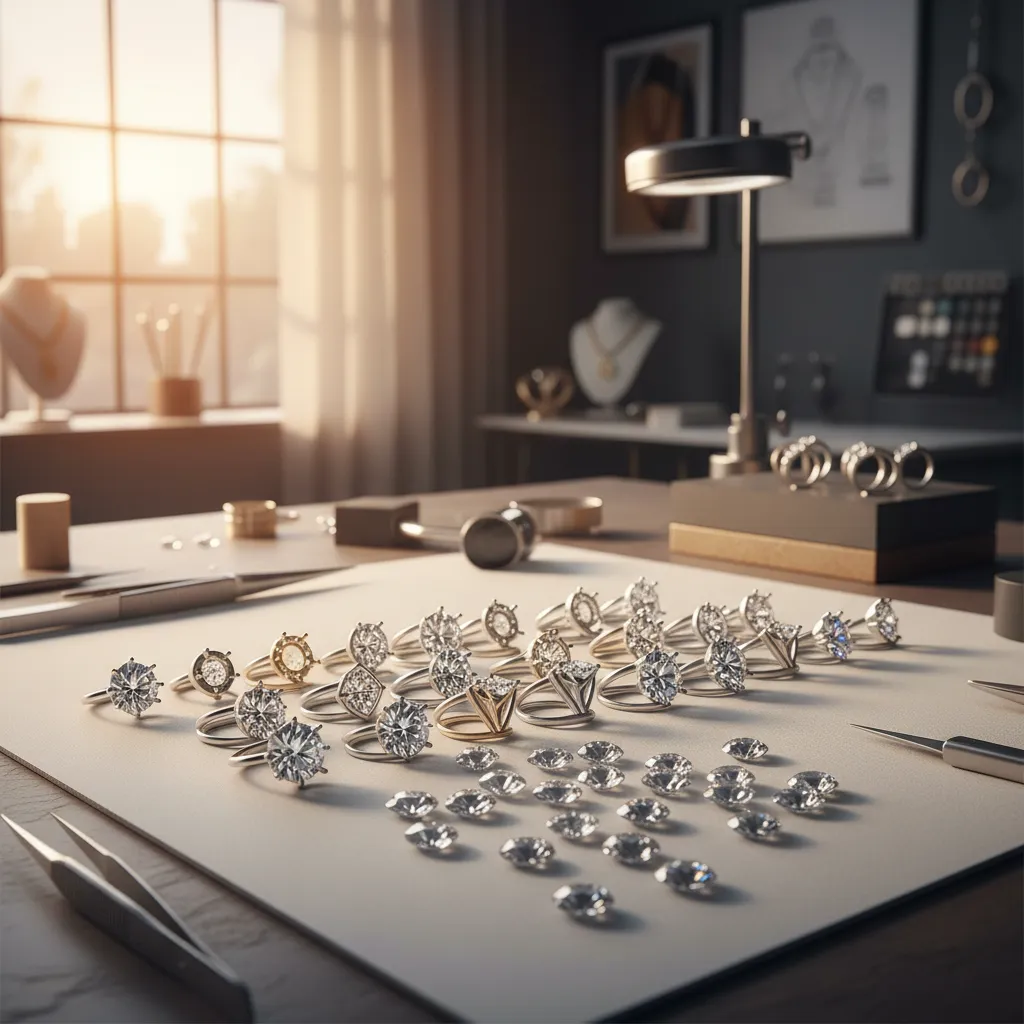
The eight classifications above cover many of the most common commercial formats, but you will likely hear additional setting terms in sourcing conversations. Competitors often present these as separate “types,” while many manufacturers treat them as sub-variations of the major families. Either way, recognizing the terms helps you brief more accurately and avoid a sample that is technically correct but not what you intended.
Bar setting: Stones are held between parallel metal bars, typically with open sides. From a merchandising perspective, it can read cleaner and more modern than a full channel while still creating an orderly row. From a production standpoint, bar spacing and alignment are sensitive, and the uniformity of the gaps tends to be a key inspection point across multiple units.
Bead setting: Small beads of metal are raised and used to secure smaller stones, often in dense layouts. Some teams use bead setting as the technical method behind pavé, while others use “pavé” as the visual category and “bead-set” as the manufacturing callout. For wholesale programs, it matters because bead size, spacing, and finishing consistency can change the surface look and the perceived quality level.
Invisible setting: Stones appear to sit edge-to-edge with minimal visible metal. This can create a strong, uninterrupted stone surface, but it is typically tolerance-sensitive and alignment-sensitive. In production, even small shifts can show as uneven seams or inconsistent face-up lines, so sampling and inspection usually focus heavily on fit accuracy and visual uniformity across the layout.
Tube setting: A stone sits inside a metal tube, sometimes used as a clean alternative to a standard bezel look for smaller stones. Brands often choose it when they want consistent, repeatable minimal settings for multiple stones across a band or earring program. From a production standpoint, tube height consistency, edge finishing, and stone seat depth can make the difference between a sharp, premium look and a rim that feels uneven from unit to unit.
Micro-claw and micro-prong variants: You may also see calls for very fine prongs or claws, especially on halo and micro-stone layouts. These can support a delicate visual, but they tend to be more sensitive to finishing quality and handling. From a production standpoint, the inspection lens often shifts to prong uniformity, symmetry, and whether the finishing process leaves any rough edges that could affect wear or create snag points.
From a development standpoint, these variations matter because they change where the manufacturing risk sits. Prong, channel, pavé, and flush each have familiar quality checkpoints. Bar, invisible, tube, and micro-variants can introduce additional tolerance sensitivity, alignment risk, and higher expectations for consistency across multiple units. If your line is built for repeat orders, it is worth deciding early which details are core to your brand identity, and which details you can simplify to improve scalability.
1. Prong Setting
Prong settings remain one of the most commercially recognized formats because they expose more of the stone and support a classic center-stone presentation. For brands working with round brilliant diamond aesthetics or similar stone-focused concepts, this setting often aligns well with familiar market expectations.
Why it stands out: It helps the stone remain the focal point while allowing a relatively open visual profile.
- Supports strong stone visibility from multiple angles.
- Works well across solitaire-inspired designs and collection extensions.
- May adapt efficiently to different stone sizes within a shared design family.
- Often suits brands looking for a timeless, easy-to-merchandise appearance.
Considerations:
- Prong finishing quality has a direct effect on perceived craftsmanship.
- Stone security may depend heavily on precise fit and careful final setting.
- Higher-exposure profiles could be less forgiving in active-wear use cases.
Best for: Brands developing recognizable center-stone pieces, especially where visual openness is part of the sales story.
2. Bezel Setting
Bezel settings surround the stone more fully, which may offer a cleaner outline and a greater sense of protection. This classification tends to appeal to brands that want a modern profile or a practical everyday-wear direction.
Why it stands out: It balances design clarity with wearability, making it a useful option for collections where durability matters.
- May reduce snag-related concerns compared with more exposed styles.
- Creates a neat silhouette that can suit minimalist collections.
- Often performs well in pieces designed for frequent wear.
- Can support a consistent visual identity across rings, pendants, and earrings.
Considerations:
- The surrounding metal edge changes the visual proportion of the stone.
- Production tolerances may need close control for a clean finished rim.
- Some brands may find it less light-driven in appearance than open settings.
Best for: Product lines that prioritize protection, streamlined shape, and a modern commercial look.
3. Halo Setting
Halo settings use surrounding accent stones to enlarge the visual impression of the center. In merchandising terms, this classification can create a strong display presence and a more elaborate look without relying only on center-stone scale.
Why it stands out: It can deliver immediate visual impact and support premium-looking assortment architecture.
- Enhances perceived size and presence of the center stone.
- Works well for statement SKUs and gift-driven categories.
- Can help create family-based collections with coordinated variations.
- Photographs strongly for catalogs and digital selling channels.
Considerations:
- Alignment and spacing are detail-sensitive during sampling and production.
- More components may increase revision needs before approval.
- Repair and after-sales servicing could be more involved than simpler formats.
Best for: Brands that want visible impact, layered brilliance, and stronger showroom presence.
4. Channel Setting
Channel settings place stones in a defined row between metal walls, creating a structured appearance that suits bands and repeat-pattern designs. This is often a practical classification for brands planning coordinated ring lines or clean geometric programs.
Why it stands out: It offers order, continuity, and a secure-looking layout that can scale well across related SKUs.
- Useful for band-focused products and paired collections.
- Creates a tidy, linear visual effect.
- May support more consistent styling across multiple pieces.
- Often aligns well with a polished, formal assortment direction.
Considerations:
- Stone size matching is critical for an even finish.
- Any inconsistency along the row may be visually obvious.
- Design adjustments may be needed if the band dimensions change across sizes.
Best for: Structured bands, matching sets, and programs that depend on visual uniformity.
5. Pavé Setting
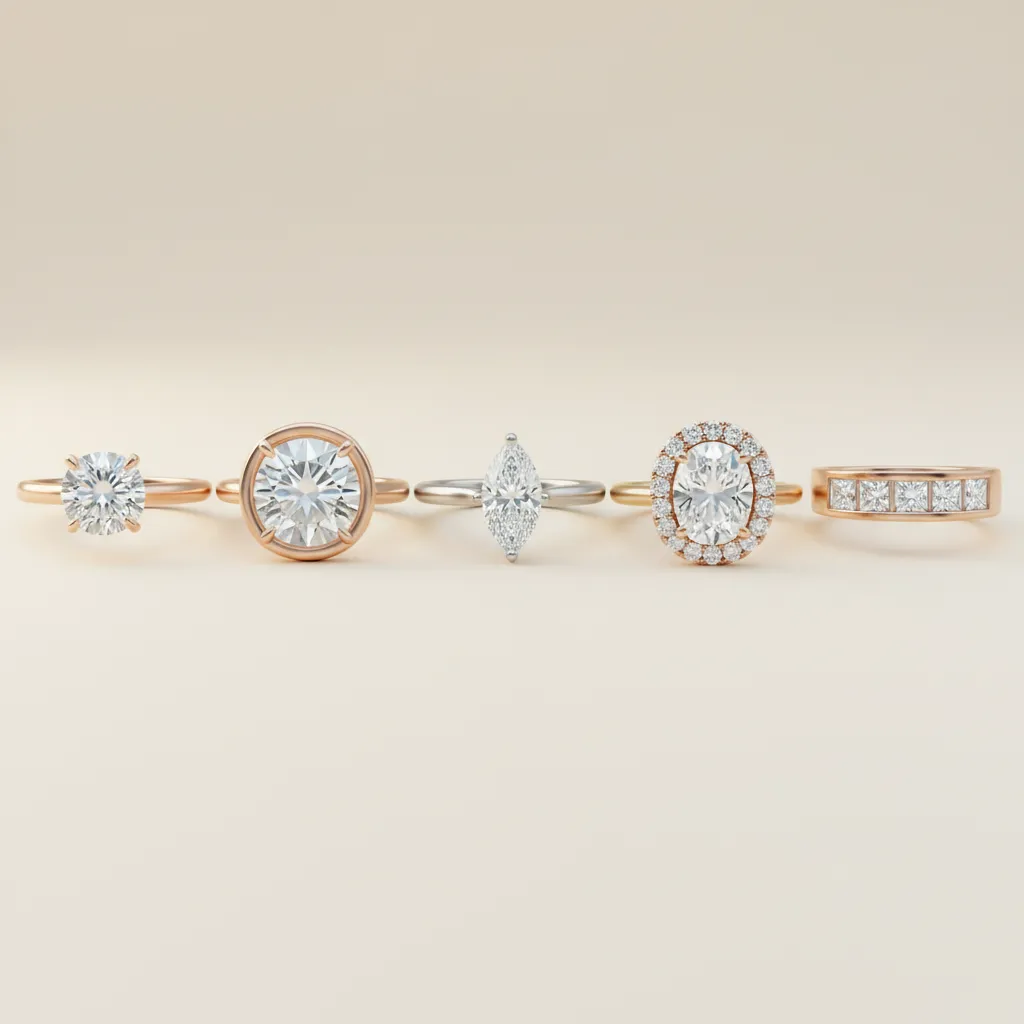
Pavé settings use many small stones placed close together to create an almost continuous surface of sparkle. For brands building fashion-driven stone jewelry assortments, pavé can be commercially attractive because it communicates detail and richness at a glance.
Why it stands out: It delivers high visual texture and helps smaller stones produce a strong overall effect.
- Excellent for sparkle-forward fashion assortments.
- Can turn simple forms into more premium-looking pieces.
- Works well in accent zones, surfaces, and framing details.
- May support layered merchandising with complementary plain-metal SKUs.
Considerations:
- This setting style may require more labor-intensive finishing.
- Small-stone consistency is especially important for quality perception.
- Sampling may take longer if the first iteration needs refinements.
Best for: Collections built around high sparkle, decorative detailing, and fashion-oriented presentation, including lines that may also reference wholesale moissanite stones or other small-stone programs.
6. Flush Setting
Flush settings seat the stone into the metal so the top appears nearly level with the surface. This classification has a restrained, integrated look that often fits modern or unisex assortment planning.
Why it stands out: It favors subtlety and wearability over maximum exposure.
- Creates a smooth profile that may suit daily-wear collections.
- Supports understated design language.
- Can work well in compact or streamlined forms.
- Often appeals to brands seeking a contemporary minimal aesthetic.
Considerations:
- The stone is less visually elevated than in open settings.
- Design proportions must be planned carefully to avoid a heavy look.
- Not every concept benefits from a more subdued presentation.
Best for: Minimal collections, modern branding, and pieces where a smooth profile is commercially useful.
7. Tension-Style Setting
Tension-style settings create the appearance that the stone is suspended between two sides of the mounting. This can produce a dramatic modern look, though the engineering demands are usually more exacting than simpler formats.
Why it stands out: It offers strong differentiation for brands that want a more architectural identity.
- Creates a memorable floating-stone effect.
- Can strengthen a design-led brand position.
- Appeals to clients seeking less conventional visual language.
- May command attention in showroom displays and launches.
Considerations:
- Engineering accuracy is especially important during development.
- Sampling and approval may require more back-and-forth than standard settings.
- This style may not suit every target market or reorder program.
Best for: Distinctive statement pieces and brands willing to trade some simplicity for design impact.
8. Cluster Setting
Cluster settings group several stones together to form a larger visual composition. In B2B merchandising, this can be useful for building price architecture and offering substantial-looking designs through composition rather than relying on one dominant center stone.
Why it stands out: It gives brands flexibility in visual storytelling and assortment planning.
- Can create strong face-up presence through layout and grouping.
- Offers many creative directions for collection design.
- May help brands build recognizable signatures through motif repetition.
- Useful for category expansion across rings, earrings, and pendants.
Considerations:
- Balance and spacing strongly affect the final look.
- Overly busy layouts may reduce perceived refinement.
- Quality control must account for multiple stone placements in one unit.
Best for: Brands that want visual variety, composite styling, and flexible collection development.
Strengths and Considerations
Strengths
- Understanding setting classifications helps brands brief manufacturers more clearly and reduce avoidable revisions.
- Setting choice can improve collection planning by matching visual goals with realistic production methods.
- Different classifications support different merchandising strategies, from minimalist programs to high-impact stone-led assortments.
- Evaluating settings early may improve consistency across related SKUs and reorder cycles.
- Better setting knowledge often leads to more practical decisions about sampling, approval, and quality control.
Considerations
- No single setting is ideal for every business model, target customer, or margin structure.
- More visually complex settings may require longer development cycles or extra sampling rounds.
- Stone setting quality depends heavily on manufacturing precision, communication, and inspection standards.
- A setting that performs well in a sample may still need adjustments before full production, depending on project scope.
Stone Setting Risk and Durability, What to Validate Before Scaling
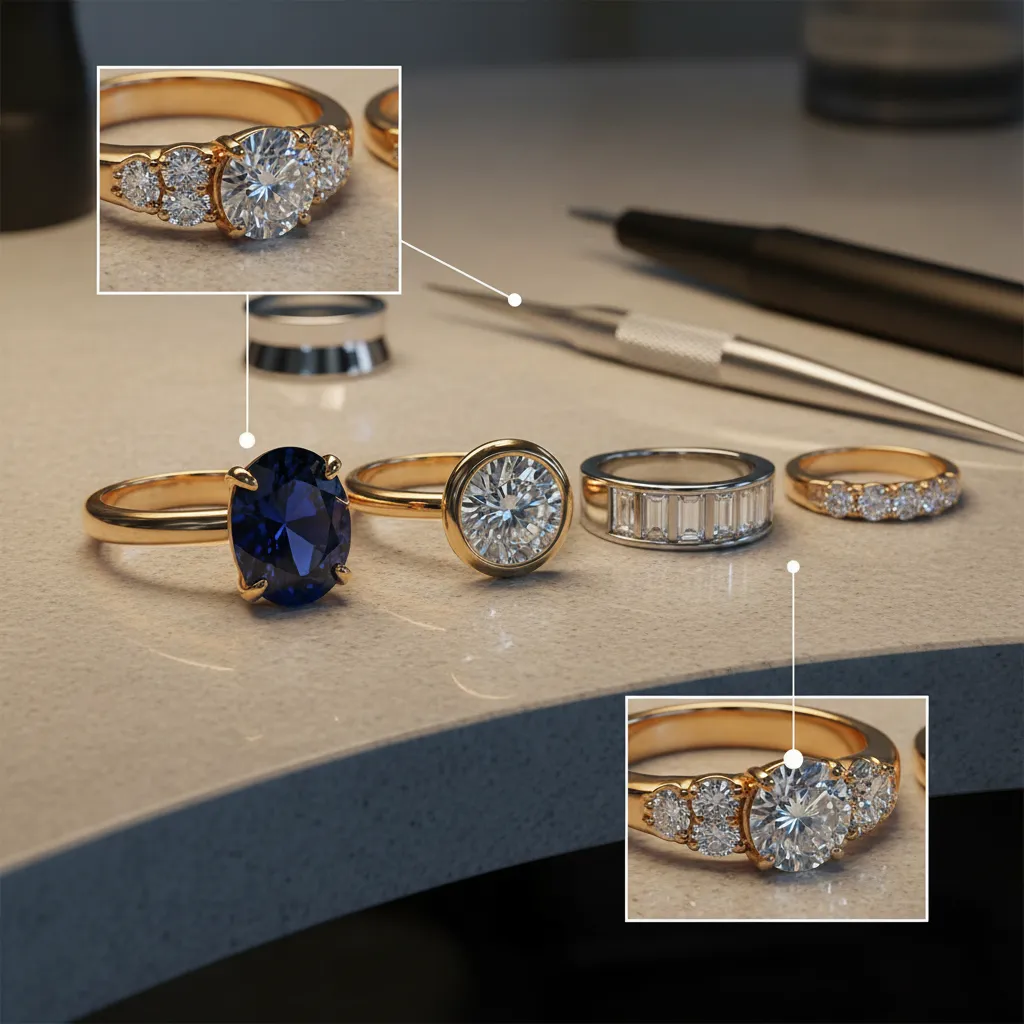
Competitor explanations often imply a durability hierarchy, but the more useful B2B view is risk mapping. You are not only choosing a look. You are choosing where a product is most likely to fail, what needs tighter inspection, and what will cost time to service after launch. That matters more as you scale to repeat orders, multiple retailers, or replenishment-based wholesale programs.
A practical checklist mindset applies during sampling. Start by reviewing snag risk and exposure level. Higher exposure designs, such as taller prong presentations or delicate micro-claw work, may create more handling sensitivity. Low profile approaches, such as flush and many bezel formats, may reduce snag points but can introduce other requirements, like cleaner edge finishing and more controlled stone seats so the result does not feel heavy or uneven.
Next, look at multi-stone loss risk. Settings that depend on many small stones, such as pavé, halos, and some cluster layouts, can create a different operational profile than a single center-stone design. The visual impact can be excellent, but the risk is distributed across many placements. From a wholesale standpoint, even a small percentage of issues can become meaningful when you are shipping volume, supporting retail partners, and managing returns or repairs.
From a production standpoint, you can build validation steps into the sampling process without overcomplicating the project. For example, request a wear-profile review that focuses on how exposed the setting is and where contact points sit. Ask your manufacturer what handling checks they use before packing, especially for prongs, micro-stone surfaces, and any layout that depends on tight alignment. If you are approving a multi-stone design, you can also request consistency inspection across more than one unit before you confirm a full run, so you are not approving a single perfect sample that is hard to repeat.
When scaling, durability becomes an operations conversation. If your assortment is sold through multiple doors or you plan frequent reorders, you will want to align on after-sales servicing expectations. More intricate settings may require more careful repair handling, and they can be more sensitive to slight differences between production batches. That does not mean you should avoid them. It means you should treat them as programs that need tighter specs, clearer inspection standards, and realistic planning for how reorders will match the first approved sample.
How to Choose the Right Setting for Your Line
Start with the commercial role of the piece. If the design is meant to be a hero SKU, a more open or visually dramatic setting may make sense. If the piece is intended for everyday wear, gifting, or reorder stability, protection and consistency could matter more than maximum stone exposure.
Next, assess how the setting fits your broader assortment. A single statement design might justify a more labor-sensitive setting, while a collection that needs reliable repeatability may benefit from cleaner, more structured formats. This is especially relevant if you are planning multiple size variants or coordinated styles.
Quality control should be part of the decision early. Ask how stone fit, alignment, finishing, and final inspection will be handled. A manufacturing partner with a strong process mindset can often flag issues before they become expensive production problems. Brands exploring jewelry manufacturing support should evaluate not only visual output, but also communication discipline and development workflow.
Commercial sourcing factors matter too. If your line depends on imported components or stone programs, adjacent issues such as freight planning and trade costs may affect final viability. That is one reason some brands reviewing settings also pay attention to related sourcing topics like tariffs on gold jewelry, even when the first discussion starts with design.
Finally, match the setting to the stone strategy. A center-stone collection, a grouped-stone concept, and a surface-sparkle line each place different demands on sampling and production. If your concept relies on uniform small stones versus a focal stone look, the right setting choice may shape not only aesthetics but also the rhythm of your production run.
A Practical Manufacturing Partner Perspective
For jewelry brands evaluating stone-set designs, Royi Sal Jewelry is positioned as a collaborative B2B partner focused on custom jewelry design, development, and manufacturing. The company works with boutiques, brands, and entrepreneurs that need more than a transactional supplier relationship. Founder Royi Gal brings experience as both a jewelry designer and manufacturer, which is useful when a design concept has to be translated into a production-ready brief.
If you are refining a setting-heavy collection, it may help to work with a partner who can review design intent alongside production realities such as sampling revisions, consistency, and scalability. You can explore Royi Sal Jewelry’s broader approach through its jewelry design and manufacturing resources, then contact the team to discuss your project requirements, collection goals, and development path.
Frequently Asked Questions
Which stone setting is usually easiest to scale for a wholesale program?
That depends on the design and the consistency required across the line. Simpler and more structured settings may often be easier to standardize, but scalability is also influenced by stone uniformity, finishing expectations, and how many size or SKU variations you plan to launch. Sampling usually reveals whether a setting will translate cleanly into repeat production.
Do more complex settings always mean better perceived value?
Not necessarily. Visual complexity can increase perceived detail, but buyers also respond to proportion, finish quality, and brand positioning. A minimal bezel or flush setting may feel more premium than a busier design if it aligns better with the collection concept. Perceived value is usually a mix of design clarity, execution, and merchandising context.
Are prong settings riskier for production than bezel settings?
They can be more exposure-sensitive because stone visibility is higher and finishing details are easier to notice. That does not make them unsuitable for wholesale. It means the manufacturer’s stone-setting precision and inspection standards matter. In many cases, both setting types can perform well if they are developed and quality-checked properly.
How should a brand choose between halo and cluster styles?
Halo styles usually emphasize a clear focal center, while cluster styles tend to distribute visual interest across a grouped composition. If your merchandising strategy depends on center-stone storytelling, halo may fit better. If you want more layout flexibility and varied silhouettes, cluster could be the stronger option for your line architecture.
Can the same collection mix multiple setting classifications?
Yes, many brands do that successfully. The key is having a coherent design language so the assortment still feels intentional. You might use prong settings for hero pieces, channel settings for matching bands, and pavé for accent details. A manufacturing partner can often help determine whether the mix remains commercially and operationally practical.
How do stone settings affect sampling timelines?
Settings with tighter tolerances, multiple stones, or more detailed finishing may require additional review and revision. Sampling timelines can vary based on project complexity, design changes, and approval speed. A clear initial brief usually helps, but stone-set products often benefit from careful back-and-forth before a production run is confirmed.
Should brands choose settings based on stone type first or design concept first?
Usually both need to be considered together. The design concept establishes the visual goal, while the stone program influences feasibility, fit, and consistency. If the setting and stone strategy are developed separately, revisions may increase. Many brands get better results by aligning the setting choice with the sourcing and collection plan from the start.
What should be included in a stone-setting design brief?
A useful brief may include reference images, target dimensions, the intended visual effect, expected SKU range, and notes on wear profile or collection positioning. It also helps to define whether the style is meant for high-volume reorder, showroom impact, or a limited launch. Clearer briefing often leads to fewer production misunderstandings.
Are pavé and channel settings suitable for the same brand?
They can be, especially if the brand serves different style needs within one assortment. Pavé may suit sparkle-heavy fashion pieces, while channel settings often align with cleaner, more structured products. The decision should come down to brand identity, target customer, and whether your production partner can maintain consistency across both formats.
What are the different types of stone settings?
Common setting families include prong, bezel, halo, channel, pavé, flush, tension-style, and cluster. In manufacturing conversations, you may also hear variations such as bar setting, bead-set terminology for micro-stone work, tube settings for small stones, and invisible-set layouts. The most useful approach for a brand is to define the visual family you want, then confirm the construction details and finishing expectations in the production brief.
What are the classification of stones?
“Stone classification” can mean different things depending on who is speaking. In jewelry development, stones are often grouped by factors such as whether they are natural or lab-created, whether they are treated or untreated, and how they are cut and graded for consistency. From a wholesale standpoint, what matters is that your stone program is defined in a way your manufacturer can repeat across units, including size matching, cut style, and any quality or appearance range you consider acceptable.
Is AA or AAA better in gemstones?
AA and AAA are commonly used as informal quality labels in parts of the supply chain, but they are not always standardized across vendors. “AAA” is often presented as higher than “AA,” but the definition can vary depending on the stone category and the supplier’s internal grading language. If you are sourcing for wholesale, it is usually safer to align on measurable criteria, such as size tolerances, color range, clarity expectations, and sample approvals, rather than relying only on letter grades.
What is a poor man’s diamond called?
You may hear various trade nicknames used in the market, often referring to diamond alternatives or diamond-look stones. The challenge is that these terms are not precise and can create confusion in product descriptions and sourcing conversations. For a brand, the more practical approach is to specify the exact stone type you intend to use, confirm its visual target through approved samples, and align on how it will be named in your line sheets and retail partner materials.
Methodology
This classification review uses a B2B lens rather than a retail shopping lens. The settings were assessed based on factors that matter to jewelry brands and private label buyers: visual merchandising potential, likely production complexity, durability considerations, assortment flexibility, and communication clarity during development. Weight was also given to how each setting may affect sampling, quality control, and reorder consistency.
The goal is not to rank every setting universally. A style that works well for one brand may be inefficient for another, depending on target customer, design direction, and manufacturing plan. That is why the strongest choice is usually the one that aligns design intent with production reality.
Key Takeaways
- Stone settings should be evaluated as production specifications, not only aesthetic choices.
- Prong, bezel, halo, channel, pavé, flush, tension-style, and cluster settings each support different commercial goals.
- More visual complexity may create stronger merchandising impact, but it can also increase development and quality-control demands.
- The best setting for your brand often depends on your collection strategy, reorder needs, and design brief clarity.
- A collaborative manufacturing partner may help translate a setting concept into a production-ready collection with fewer avoidable revisions.
Conclusion
Choosing among these eight stone setting classifications is rarely just a style decision. For a jewelry brand, it is part of product strategy, sampling planning, and long-term manufacturing consistency. A setting that looks impressive in concept may still need refinement before it is ready for repeat wholesale production. That is why clear briefing, realistic expectations, and collaborative development matter. Royi Sal Jewelry works with B2B clients on custom jewelry design and manufacturing, with a process shaped around collaboration and craftsmanship. If you are developing a stone-led collection and need help evaluating which setting approach fits your business, visit royisal.com to learn more about the process or contact the team to discuss your custom jewelry brief.