The 3 things that matter most when buying gemstones jewelry gifts: commercial fit for your target customer, reliable sourcing and production planning for your collection schedule, and clear design positioning so the gift concept feels intentional instead of generic.
For a jewelry brand, gift-focused gemstone pieces are not only about appearance. They also affect merchandising, seasonal campaigns, perceived value, and reorder potential. If you are building a giftable line for boutiques, online retail, or private label distribution, the right gemstone direction can shape margins and sell-through.
This article explains how to evaluate gemstone jewelry gift concepts from a business angle, including design brief clarity, production considerations, and assortment planning. If you also sell complementary components, it may help to review beads for jewelry making as part of your broader product mix.
Key Takeaways
- Start with the gift occasion and recipient before you choose stones or colors.
- Necklaces and earrings are often easier gift formats because they reduce sizing issues.
- Keep personalization controlled so sampling, approvals, and fulfillment stay manageable.
- Use a clear quality framework for color, clarity, cut, size, and supplier disclosure.
- Build a tight wholesale assortment with hero SKUs that retailers can explain and reorder.
Choosing gemstones jewelry gifts: what this guide covers
Choosing gemstones jewelry gifts is as much a merchandising decision as a design decision. A strong concept may perform well because it fits a gifting season, supports personalization, or gives retailers an easy story to sell. However, a weak concept may look attractive in sampling and still create problems in production consistency, collection cohesion, or wholesale positioning.
This guide focuses on what B2B buyers and brand founders should evaluate before approving a gemstone gift line. That includes recipient logic, assortment depth, design development, pricing structure, and supplier communication. If your team is still refining visual development, reviewing a 3d jewelry design program can help you understand how concept accuracy may affect sampling and approvals.
Royi Sal Jewelry approaches custom jewelry as a collaborative B2B process centered on design development, manufacturing, and wholesale support. Led by Royi Gal, whose background combines design and manufacturing, the company positions itself as a global partner for brands that need a more structured path from idea to finished collection. You can also explore relevant site resources on wholesale jewelry, wholesale gemstone jewelry, and gemstones & moissanite for broader category context.
Who should buy gemstone jewelry gifts
Gemstone jewelry gift concepts fit boutique owners, fashion brands, and private label founders that need emotionally clear products. These lines often support milestones, family relationships, color symbolism, or seasonal campaigns such as Mother’s Day.
This approach may suit businesses that need:
- Gift-oriented products with a clear sales story
- Personalized jewelry gifts that can sit within an existing collection
- Small themed launches that support repeat seasonal marketing
- Assortments that balance sentiment with commercial structure
This route may not work best if your brand focuses on highly trend-led fashion drops with very short planning cycles. It may also fall short if your team has not yet defined customer segments clearly. In practice, a gemstone gift line works better when your team has already planned the product story, recipient use case, and wholesale presentation. Brands exploring elevated positioning may also want background reading on custom fine jewelry to clarify how giftable pieces fit into a broader product strategy.
Choosing gemstones jewelry gifts by format for gifting
Once you know the occasion and the emotional angle, the next decision is format. For wholesale, “giftable” does not only mean pretty. It means the product is easy to choose for someone else, simple to explain on a sales floor, and less likely to create sizing or preference issues that lead to returns or dead stock.
In many boutiques, gemstone necklaces and earrings tend to be easier gifting formats because the buyer does not need exact sizing and the style cues are visible at a glance. Rings can still be strong gift items, but they usually carry more operational risk because sizing varies by market and the buyer often guesses. Bracelets may sit between the two, depending on whether sizing is adjustable or fixed and how many sizes you plan to carry.
For brands building a new gemstone gifting program, consider a hero format that anchors the story. Then add supporting formats that reuse the same visual and message system. This approach keeps merchandising clean and reduces the number of variants you have to sample, approve, and manage across reorders.
Choosing gemstones jewelry gifts: what to look for in a necklace
Necklaces often carry the story best because they give you space for a recognizable center detail, a consistent silhouette across gemstone colors, and straightforward packaging. They also photograph well for ecommerce, which matters if your retailers sell online or if you support them with product imagery.
From a commercial planning angle, focus on security and repeatability. A gift necklace should feel stable in wear and stay consistent across production, especially if you plan to reorder the same SKU in future seasons. During development, ask your supplier how the setting holds the stone securely, how the piece behaves under normal wear, and how finishing details will stay consistent when you scale production.
Also plan the story assets around the format. Necklaces give you room for a simple message card, a birth-month or milestone callout, or a short product naming system that retailers can use across shelf talkers, line sheets, and online listings. If the story system becomes an afterthought, the product may still sell. However, it often loses momentum because staff and customers do not have a clear reason to choose it as a gift.
Choosing gemstones jewelry gifts with tighter assortment planning
A common wholesale mistake is turning each format into a separate mini collection. If the gift concept is “birth-month color” or “milestone message,” you usually do not need every format in every stone. Start with the format that is easiest to gift and easiest to stock. Then add one or two supporting formats that share the same design language so the collection looks intentional in-store.
In practice, this can mean one hero necklace silhouette that carries the core story, paired with earrings that echo the same stone and shape, and a limited ring option only if your retailers are comfortable managing sizes. That keeps the line readable, reduces sampling load, and can make reorders simpler because retailers know which SKU anchors the program.
Key factors in choosing gemstones jewelry gifts
1. Start choosing gemstones jewelry gifts with the occasion, not the stone list
Many buyers begin with colors or gemstone names. Commercially, the better starting point is often the occasion. Ask whether the line targets birthdays, anniversaries, Mother’s Day, bridesmaid gifting, family keepsakes, or everyday sentiment products.
What to look for: a defined recipient and a clear reason the customer would buy the piece as a gift. What to avoid: selecting gemstones first and trying to force a gift concept afterward. That usually creates mixed messaging and weaker retail presentation.
2. Match gemstone color stories to your existing brand identity
Green gemstones, red gemstones, and other color-led directions can be effective, but only if they fit your current collection language. A gemstone gift program should feel like a natural extension of your brand rather than a seasonal detour.
What to look for: gemstone options that support your established design codes, packaging style, and customer expectations. What to avoid: introducing too many colors or symbolic meanings at once, which may complicate inventory and dilute brand clarity.
3. Confirm how much personalization the line really needs
Personalized jewelry gifts can increase perceived value, but they also may add operational steps. Personalization affects design approvals, production flow, quality checks, and fulfillment planning. The right level depends on your margin structure and how much variation your business can manage.
What to look for: controlled personalization options such as initials, birth-month themes, family grouping concepts, or limited choice sets. What to avoid: unlimited customization without a process for approvals and order tracking.
4. Assess whether the design can scale beyond one season
A gift line is stronger when it can be refreshed rather than replaced. This matters for jewelry gemstones wholesale planning because it reduces redevelopment costs and allows you to build on proven SKUs. A good design may support recurring campaigns with small changes in stone story, engraving, or packaging.
What to look for: adaptable silhouettes and repeatable gift themes. What to avoid: highly specific concepts that only work for one short selling window and become hard to reorder afterward.
5. Review sampling needs before committing to assortment width
Brands sometimes overbuild a first gemstone collection by approving too many variants too early. In custom development, each variation may affect communication, prototyping, and approval cycles. Sampling should help you validate the most important decisions first.
What to look for: a phased approval process with core designs tested before expanding into multiple versions. What to avoid: launching a wide assortment before you know which gift angle, color story, or personalization option is commercially strongest.
6. Make sure your supplier can collaborate, not just produce
Giftable gemstone jewelry often depends on nuance. The piece needs to communicate meaning clearly while still working as a manufacturable product. That is why supplier selection should include design collaboration, not only factory capacity. Businesses evaluating custom development may benefit from reading about custom jewelry design services anniversary gifts because occasion-based products often succeed or fail on how well the brief is translated into final form.
What to look for: a manufacturer that can discuss design intent, revisions, production planning, and wholesale realities in one conversation. What to avoid: a partner that treats your brief as a simple file transfer without strategic input.
7. Plan the assortment for wholesale presentation
Wholesale jewelry gemstones programs need a clear line architecture. Retailers usually respond better when the assortment is easy to understand, easy to display, and easy to reorder. Your line sheet should show how pieces group by occasion, color family, or personalization route.
What to look for: a concise, structured assortment with clear hero pieces and supporting styles. What to avoid: a scattered mix of gemstone concepts that require too much explanation on the sales floor.
Choosing gemstones jewelry gifts with meaning-driven stories
Many gifting collections rely on meaning. Birth-month themes, milestone associations, and symbolic color language can help customers choose quickly, especially when they are buying for someone else. For a brand, the goal is to build a story system that retailers can repeat accurately across channels, without leaning on claims you cannot verify or language that creates customer service problems later.
Keep your meaning hooks grounded. You can use tradition, color association, and life events as merchandising structure, but avoid positioning gemstones as guarantees of outcomes. That protects your brand voice, keeps retail staff confident, and reduces the risk of inconsistent copy across retailer websites, social posts, and in-store signage. For example, the GIA Gem Encyclopedia is a useful reference for standard gemstone descriptions, while the FTC Jewelry Guides help brands think about accurate product claims and disclosure.
Story systems retailers can execute consistently
Retailers do best when you give them a clear framework rather than a long list of meanings. A birth-month edit is one of the most straightforward systems because the customer already understands the shopping logic. A milestone capsule can work similarly, for example “first job,” “new baby,” “graduation,” or “anniversary,” as long as you define the set of moments and keep the product range controlled.
Color-family stories can be another strong structure. This works well when your brand already has a recognizable palette or design language and you want to group options visually. You can also map messages by starting with the occasion, then pairing it with a simple emotional cue and a design cue. For example, “thank you” might map to a clean silhouette and calm colors, while “celebration” might map to brighter color contrast and more visible center detail. The point is to make the selection feel intentional, not random.
Wholesale assets to plan for: story cards, naming, and line sheet grouping
Meaning-driven lines sell better when the assets are built at the same time as the products. Plan for story cards or short inserts that explain the occasion hook in one or two sentences, plus a naming system that stays consistent across packaging, line sheets, and product listings. Retailers should not have to rewrite your meaning from scratch, because that usually creates inconsistent claims and uneven presentation across accounts.
Line sheet grouping matters as much as the story itself. If the collection is organized by birth-month, keep that structure visible in your wholesale presentation. If it is organized by milestones, group by milestone first and format second. Clear grouping makes it easier for buyers to build assortments and for store staff to merchandise without extra training.
Choosing gemstones jewelry gifts with a wholesale quality framework
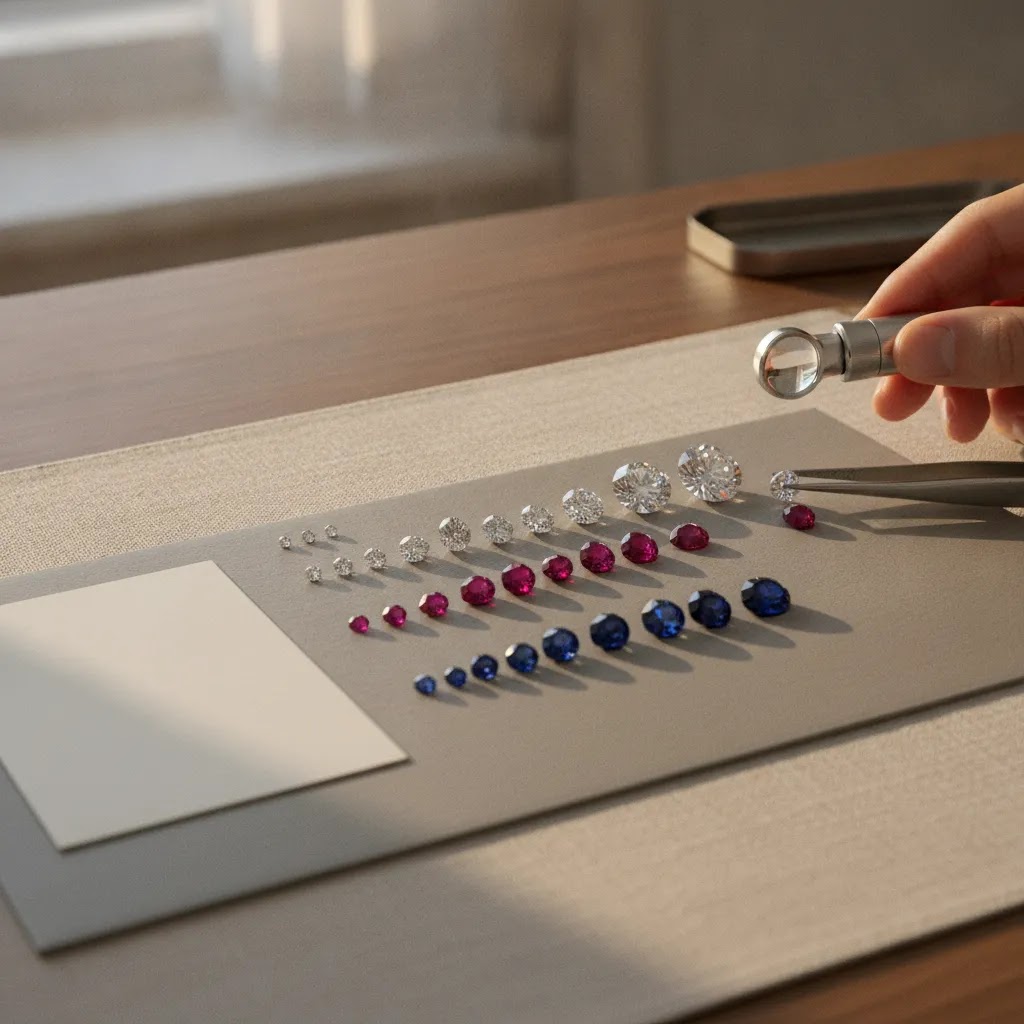
In B2B sourcing, “quality” is not one thing. It is a combination of how the stone presents visually, how it performs in production, and how consistently your supplier can repeat the look across pairs, sets, and reorders. If your brand is planning a gemstone gifting program that needs reliable repeat orders, you need a shared language for quality that goes beyond general descriptions.
One practical way to structure this conversation is a five-part framework. In the trade, you will often hear quality discussed as a set of “C’s.” Different teams define them slightly differently depending on stone type and product category, but the sourcing purpose stays the same. You are aligning on what can be assessed by photos and samples, what needs documentation, and what must remain consistent in production.
A B2B “5 C’s” framework you can actually use
Color: define the target hue, tone, and saturation in plain terms your supplier can match, and confirm what variation is acceptable across units. If you are selling pairs or sets, color matching becomes a commercial requirement, not a nice-to-have.
Clarity: clarity is about visible inclusions and overall appearance. For many gifting lines, the key is not perfection. It is predictable appearance at viewing distance, with clear rules for what is acceptable so your reorders do not drift.
Cut: cut impacts brilliance, symmetry, and how the stone reads in product photography. Your supplier should be able to confirm the cut style you are approving in sampling and whether there are constraints that could affect repeatability.
Carat (or size): in a production environment, size tolerance affects the setting, the silhouette, and how pieces match across a collection. Define the size target and your allowable tolerance, especially if you plan to scale the same design across multiple stone options.
Confidence: this is the operational “C.” It includes supplier documentation, disclosure practices, and how changes are communicated. If treatments or origin details are relevant to your merchandising, they should be disclosed clearly and consistently, and your team should know how that information will be provided for line sheets and retailer copy.
Comparison table: practical wholesale checks for gemstone gift lines
| Quality factor | What to define | Why it matters for gifting |
|---|---|---|
| Color | Target hue, tone, saturation, and acceptable variation | Helps pairs, sets, and reorders stay visually consistent |
| Clarity | Visible inclusion rules and acceptable viewing appearance | Keeps the product presentation predictable for retail |
| Cut | Approved cut style and repeatability limits | Supports strong photo readability and visual consistency |
| Carat (or size) | Size target and allowable tolerance | Protects the setting, silhouette, and collection matching |
| Confidence | Documentation, disclosure, and change communication | Supports accurate wholesale copy and retailer trust |
What to request and confirm during sampling for commercial consistency
Sampling is where quality becomes measurable. Ask for samples that reflect real production, not one-off best-case stones. If you sell earrings, request a matched pair sample and confirm what “matched” means for your brand. If you sell sets, confirm how matching is controlled across the full set, not just the hero piece.
Also confirm how reorders will be managed. Your goal is to avoid the situation where the first run looks one way and the second run shifts in color or overall look because the quality target was never formalized. If your supplier anticipates changes due to availability or sourcing realities, define how those changes will be proposed, reviewed, and approved before production moves forward.
If your brand requires treatment disclosure or origin disclosure for merchandising reasons, build that requirement into your sampling conversation early. The point is not to demand information for its own sake. It is to ensure your product descriptions remain accurate and consistent across wholesale accounts.
How to translate quality targets into a brief and purchase order language
Many quality problems happen because the brand brief describes the look emotionally, but the purchase order does not define execution rules. Your design brief should include the target color range, size tolerance, cut style expectations, and matching requirements for pairs and sets. Then align on a sign-off process, for example sample approval, pre-production confirmation, and what happens if the supplier needs to substitute within an agreed range.
For wholesale, the most useful language is specific without being unrealistic. Define what variation is acceptable so your supplier can execute consistently, and specify which attributes require written approval if they change. This makes it easier to scale the line, maintain consistency across reorders, and protect retailer trust when the product is presented as a gift.
Choosing gemstones jewelry gifts across budget, mid-range, and premium tiers
Specific price points vary by design scope, production method, order volume, and collection requirements. For that reason, the most useful way to evaluate price is by development tier rather than by fixed promises.
Budget
At the budget end, brands typically get a narrower concept, fewer variations, and simpler assortment planning. This tier may suit first tests, capsule launches, or limited wholesale trials. Expect tighter decision-making and less room for broad personalization or extensive design iteration.
Mid-range
Mid-range programs often give brands more flexibility in collection structure, better room for sampling refinement, and a stronger visual story across the line. This is often the most practical range for brands that want giftable gemstone pieces to become a recurring category rather than a one-off launch.
Premium
Premium development usually supports a more strategic program, with stronger emphasis on brand-specific design language, polished assortment building, and more involved collaboration across concept, sampling, and production readiness. This tier may make sense for established brands or boutiques positioning gemstone gifts as a signature offer.
Instead of asking only for unit cost, ask what each pricing level includes in terms of development support, number of variants, sampling rounds, and production planning. That usually gives a more accurate picture of value.
Strengths and Considerations
Strengths
- Gemstone gift concepts can give your collection an immediate emotional hook, which often helps retailers explain the product quickly.
- They may support recurring seasonal campaigns, allowing brands to reuse successful frameworks for different occasions.
- Personalized jewelry gifts can raise perceived value without requiring an entirely separate product category.
- Color-led gemstone programs may help create clear merchandising stories for boutiques and online collections.
- Well-structured gemstone lines often lend themselves to line extensions, which may support reorders and assortment growth over time.
Considerations
- Custom gemstone gift lines may require more sampling and approval discipline than a basic non-themed assortment.
- Too many personalization options can complicate production flow, order tracking, and fulfillment accuracy.
- A gift concept that feels strong creatively may still underperform if the wholesale story is unclear or too narrow.
- Seasonal launches usually require earlier planning than many first-time brand founders expect.
Common mistakes to avoid when choosing gemstones jewelry gifts
- Building the line around gemstone names without defining the recipient or occasion first
- Approving too many color or personalization variants in the first production cycle
- Confusing symbolic storytelling with actual assortment strategy
- Skipping sample-stage feedback from wholesale buyers or retail partners
- Focusing only on piece aesthetics and not on line-sheet clarity, reorder logic, or display grouping
- Choosing a manufacturing partner based only on quoted cost instead of communication quality and design collaboration
How to evaluate your options for gemstones jewelry
If you are comparing manufacturers or development partners for gemstones jewelry, focus on five areas. First, assess design capability. Occasion-based jewelry needs a manufacturer that can understand sentiment, silhouette, and practical production requirements at the same time. Second, review communication quality. For custom work, delayed answers or vague approvals often lead to preventable mistakes.
Third, examine how sampling is handled. A thoughtful sampling process may help you test gift concepts before expanding into broader wholesale runs. Fourth, ask about order flexibility and scaling. A supplier might be suitable for a pilot launch but less effective once you need larger repeat orders or line extensions. Fifth, evaluate global coordination and fulfillment readiness, especially if your business serves multiple markets. If you are mapping development stages, this overview of the jewelry manufacturing process concept creation can add useful context.
Royi Sal Jewelry may be a useful resource for brands that want a collaborative path through custom jewelry design and manufacturing rather than a simple transactional order process. The company focuses on custom design development, wholesale production, and global fulfillment support for business clients. Because Royi Gal’s background spans both design and manufacturing, the conversation can stay grounded in real production considerations while still protecting the product vision. If you are planning a gemstone gift collection and need support shaping the brief, sampling priorities, or manufacturing route, explore Royi Sal Jewelry’s approach at royisal.com and contact the team to discuss your project.
Frequently Asked Questions
How do I know if gemstone jewelry gifts fit my brand?
They usually fit best when your customer responds to meaning-driven purchases, milestone gifting, or personalized product stories. For a B2B brand, the question is not only whether the piece looks appealing. You also need to know whether retailers can explain it easily, whether the assortment fits your current collection, and whether the product can support repeat campaigns over time.
Should I launch many gemstone colors at once?
In many cases, a tighter launch is easier to manage. Starting with a smaller color story may improve product clarity, simplify sampling, and reduce inventory complexity. If the first launch performs well, you can often expand later. A broad first assortment sometimes creates avoidable confusion in wholesale presentations and makes it harder to identify which concepts actually drive reorders.
Are personalized jewelry gifts harder to manufacture?
They can be, depending on how much variation you allow. Limited personalization options are often easier to manage than open-ended customization. The more variables you introduce, the more attention your team may need to give approvals, tracking, and fulfillment checks. Personalized lines can work well, but only when the workflow is planned carefully from the start.
What matters most in a gemstone gift design brief?
A strong brief usually explains the recipient, occasion, collection role, intended price positioning, and the level of personalization required. It should also clarify whether the piece is a hero launch item or part of a broader assortment. Manufacturers can generally respond more accurately when the emotional purpose and business purpose of the design are both stated clearly.
How early should I plan a seasonal gemstone gift collection?
Earlier than many brands expect. Custom development often involves concept review, sampling, revisions, and production scheduling, all of which may take longer if the brief changes midstream. Seasonal launches such as Mother’s Day or holiday gifting typically benefit from advance planning so retailers have enough time for buying, merchandising, and promotion.
What is the biggest sourcing mistake new brands make?
Many first-time founders choose suppliers based almost entirely on quoted cost. That may overlook communication quality, sampling discipline, and the supplier’s ability to translate a concept into a repeatable production run. A slightly lower initial quote can become expensive if revisions, delays, or quality inconsistencies disrupt your launch calendar or retailer relationships.
Can a gemstone gift line work for wholesale and private label?
Yes, it often can, provided the collection is structured clearly. Gift-oriented gemstone concepts are frequently adaptable across boutique wholesale and private label development because the storytelling is easy to localize. The key is controlling the assortment so it remains commercially coherent instead of turning into too many one-off variations for different accounts.
Why does design collaboration matter so much for gift jewelry?
Gift jewelry usually depends on emotional clarity. The product has to communicate meaning, fit your brand style, and still be practical for production and wholesale display. A collaborative manufacturer may help refine that balance earlier in the process. That can reduce misunderstandings and support better decisions during sampling, revisions, and final production planning.
What are the 5 C’s of gemstones?
For wholesale buying, the “5 C’s” are a practical way to align with your supplier on quality expectations. They are commonly discussed as color, clarity, cut, carat or size, and confidence, meaning the documentation and disclosure practices that keep your product descriptions consistent. The value is not the label itself. The value is using a shared framework to define acceptable variation, matching rules for pairs and sets, and how changes are approved on future reorders.
What should I look for when buying a gemstone necklace?
For a gifting-focused wholesale program, start with repeatability and presentation. Confirm the silhouette works across multiple stone colors, verify the setting is designed for secure wear, and make sure the necklace reads clearly in product photography. Also plan how the story will be communicated, for example with a consistent naming system and a short story card, so retailers can sell it as a gift without rewriting your messaging.
What is a poor man’s diamond?
This phrase is sometimes used in casual retail language to describe a stone that gives a diamond-like look at a different price point. For a brand, it is usually better to avoid that positioning in wholesale copy. It can create customer confusion, invite comparisons you do not control, and weaken your product story. A clearer approach is to name the stone you are using and describe the design intent, the visual effect, and the collection role without implying it is a substitute for another category.
What’s the best crystal to give as a gift?
In a B2B gifting assortment, “best” usually means easiest to merchandise and easiest for customers to choose. Crystals or crystal-like stones can work well when they fit your brand aesthetic, photograph consistently, and have a clear occasion hook such as birth-month edits or milestone capsules. If you plan to reference symbolism, keep it grounded in tradition or color association rather than promising outcomes, and make sure your retailers have consistent language they can use across channels.
Buying Checklist
- Confirm the exact gift occasion or recipient for the collection
- Check that the gemstone color story aligns with your existing brand identity
- Define how much personalization is operationally realistic
- Approve core designs before expanding into multiple variants
- Review how the assortment will be presented in wholesale line sheets
- Ask how sampling, revisions, and production communication will be handled
- Make sure your manufacturing partner can support both design development and scale planning
- Confirm that the collection can extend beyond one selling season if performance is strong
Conclusion
Choosing gemstones jewelry gifts for a brand or wholesale collection means building a product story that works commercially, not just picking appealing stones. The best programs usually begin with a clear occasion, a disciplined assortment, and a manufacturer that can help translate concept into production reality.
If you are weighing personalized jewelry gifts, seasonal launches, or a broader gemstone line, it helps to work with a partner that understands both design and manufacturing. Royi Sal Jewelry works with brands, boutiques, and entrepreneurs on custom jewelry development, manufacturing, and fulfillment support. To explore how your gemstone gift concept could be developed into a structured collection, visit royisal.com and contact the team to start a project discussion.