
Gemstone Terms For Starters

Why Gemstone Terminology Matters in B2B Jewelry
For a jewelry business, gemstone language is part of quality control. A clear vocabulary helps you describe what you want, understand what a supplier is offering, and reduce the risk of approving a sample that does not match your commercial goals. This is especially relevant if you are comparing a gemstone supplier, a gemstone wholesaler, or a custom manufacturer that coordinates design and production under one process.
Terms such as cut, clarity, inclusions, calibration, matching, and treatment may shape both appearance and production feasibility. If your team uses vague language like “bright stones” or “premium finish,” you may get very different interpretations from different vendors. B2B communication works better when your terms are tied to measurable expectations, sample review standards, and acceptable variation ranges.
It also helps to separate retail descriptions from wholesale realities. For example, a phrase such as diamond gemstone may be used loosely in consumer channels, while B2B conversations usually need tighter language around stone type, matching requirements, and intended use across a production run. If your sourcing strategy includes multiple geographies, looking at topics such as brazil jewelry manufacturers can give useful context on how supplier communication standards may differ by market.
Royi Sal Jewelry approaches custom jewelry development as a collaboration between brand and manufacturer. Led by Royi Gal, whose background combines jewelry design and manufacturing, the company works with B2B clients that need a more structured path from concept to production. You can also explore broader resources on wholesale jewelry and jewelry sourcing if you are mapping out supplier conversations more carefully.
Core Gemstone Terms Every Starter Should Know
Gemstone identification refers to the process of determining what a stone is and how it should be described in trade communication. For a brand owner, this matters because correct identification supports accurate product development, more consistent vendor discussions, and fewer listing errors across a wholesale catalog.
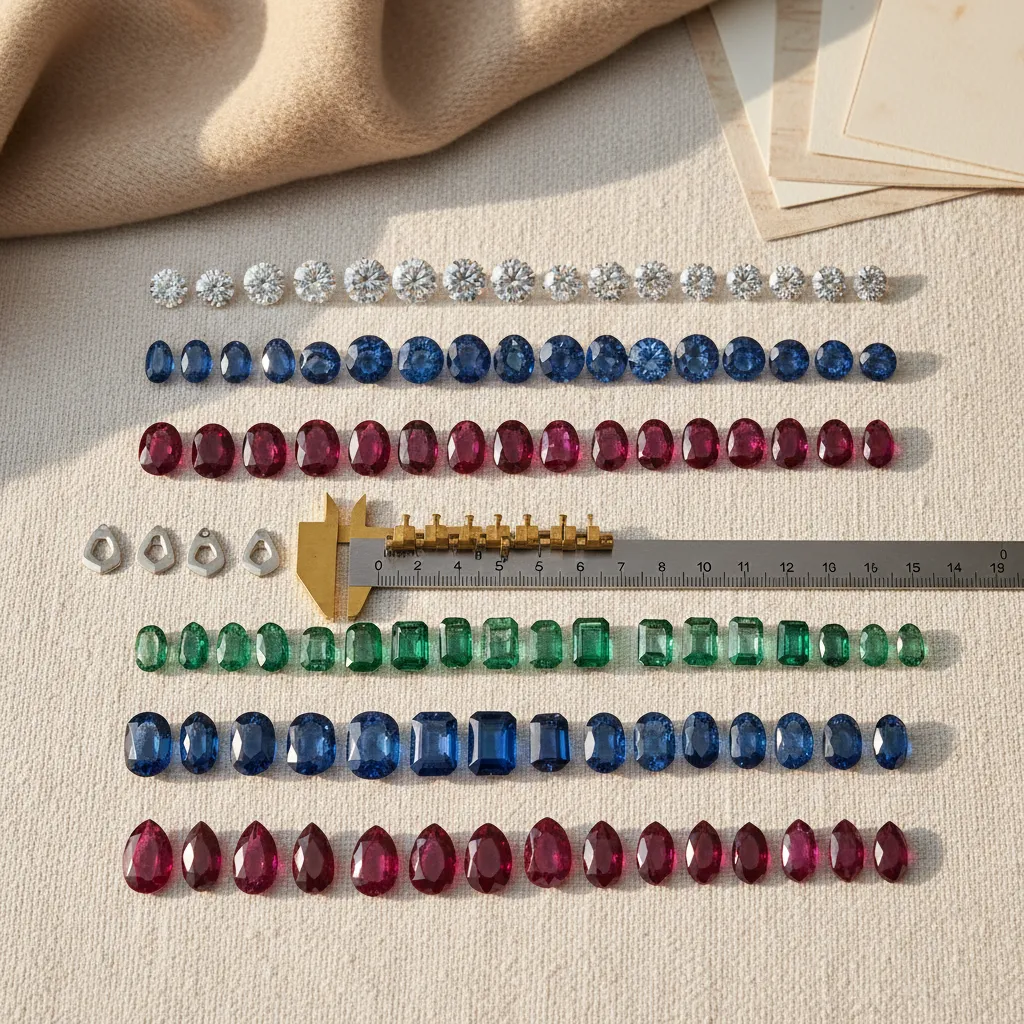
Calibrated stones are stones prepared to standard sizes that may support more repeatable production. This can be helpful if you plan to reorder a design in volume, because consistent sizing may reduce adjustment work during later production runs.
Matched set usually refers to stones selected to appear reasonably consistent in color, size, and overall visual harmony. Matching can be especially important in gemstone necklaces, earrings, or multi-stone pieces where variation is easier to notice across a collection.
Inclusions are internal characteristics visible within a stone. In a B2B context, the key point is not whether inclusions are always good or bad, but whether their presence falls within the visual standard you and your supplier agreed to for that product line.
Clarity describes how clean a stone appears when viewed under agreed conditions. Different suppliers may present clarity differently, so many brands benefit from defining acceptable sample standards rather than assuming everyone uses the same threshold.
Cut describes how a stone has been shaped and finished. In production, cut influences not only appearance but also how consistently stones may fit into repeated settings over time.
Color consistency matters in private label and wholesale orders because one attractive sample does not guarantee full-run uniformity. If your line uses gemstone beads or repeated color stories across multiple SKUs, it is worth documenting tolerance expectations early.
Treatment disclosure is a practical sourcing term. If a stone has undergone a process that affects how it is represented in trade, your supplier communication should be clear and documented. This is one reason many buyers ask questions beyond appearance alone.
Lot variation refers to differences that may appear from one batch to another. For growing brands, understanding lot variation can help with reorders, line sheet accuracy, and customer-facing consistency across seasons.
Fire is often used to describe the visual play of light in a stone. In casual selling language, people may say fire gemstone as a broad description, but in B2B product development it is better to tie this kind of term to sample approval standards rather than subjective marketing language.

Gemstone Shapes, Cuts, and Size Language You Will See in Wholesale Catalogs
Wholesale listings often compress a lot of information into a short phrase. A detail that is easy to miss is that “shape” and “cut” are commonly presented as a combined description, and using the correct combo can reduce quoting delays and sampling confusion. If you ask for an “oval stone” without clarifying cut style, you may receive options that look and set very differently.
In practice, you will see phrasing that combines outline with cutting style, such as round brilliant, oval faceted, baguette cut, or cabochon. Even when a supplier does not use the same naming convention across every listing, the intent is usually the same: to tell you the stone’s outline and the surface style you should expect in photos and samples. For a brand brief, including both terms helps a manufacturer align the stone request with the setting style you are developing.
When it comes to calibration, size language is often expressed in millimeters, not just a general size category. You may see a single measurement, a two-number format, or a range. Depending on the shape, a listing might show one key dimension or multiple dimensions. The point is not the exact formatting, it is that your setting and your stone request must agree on what dimension is being controlled and what amount of variation is acceptable. If you plan to reorder, the “calibrated” expectation should include how tight the size tolerance needs to be for consistent setting fit over time.
From a production standpoint, a request for faceted stones versus cabochon stones can change more than appearance. Faceted stones are typically evaluated for consistency in the way they reflect light and how evenly they present across a set, while cabochon stones are often evaluated for dome height, profile consistency, and surface finish consistency. Those differences affect how a setting is designed, how stones sit visually in a finished piece, and what quality checks matter during assembly. This is why communicating “oval faceted” versus “oval cabochon” is not just a catalog detail, it is a production instruction.
Terms That Matter During Sourcing and Production
Once you move from concept to procurement, gemstone terms become operational. A gemstone store may use descriptive language to support sales, but a gemstone supplier or gemstone wholesaler usually needs more exact instructions tied to production requirements.
MOQ alignment means your stone request should fit the realities of a production run. Even if no fixed minimum is stated upfront, small-volume custom requests, unusual matching demands, or multiple sample rounds may affect feasibility depending on supplier capacity and project scope.
Sample approval standard is the benchmark used to judge later production. This is one of the most important concepts for private label development. If the sample is approved without clear written comments on color range, acceptable variation, or matching, later disputes are more likely.
Stone grading language should be discussed carefully. Not all suppliers use identical terminology in the same way, especially across countries or trading hubs. If you are researching active gem trading regions, chanthaburi gem market thailand and chanthaburi gemstone market are useful subjects to understand because trading culture can influence how descriptions are communicated.
Stringing and layout consistency are often relevant for gemstone beads and necklace programs. A supplier may be able to provide stones, but not every partner will manage layout uniformity the same way. That distinction matters if your brand depends on repeatable visual balance across batches.
Commercial grade versus sample grade is another practical distinction. A sample can look better than the average production lot if expectations are not documented properly. B2B buyers should ask whether the approved sample reflects the standard intended for the full run.
Setting tolerance refers to how closely the stone dimensions need to match the jewelry design. This can affect casting preparation, assembly planning, and quality checks. It may become a bigger issue in designs where even slight size differences create fit problems.
Visual assortment planning matters if you are producing collections that include gemstone rings for women, gemstone necklaces, or statement pieces with several stone sizes. Wholesale buyers often need consistency within a style family, not just one attractive hero sample.
Brands that source and manufacture through a collaborative partner may find these conversations easier to manage because design and production feedback can happen within one workflow. Royi Sal Jewelry is positioned as a B2B custom design and manufacturing partner, which may be useful if you want closer coordination between concept development, sample review, and production planning.
Treatment and Enhancement Language: What to Ask For and How to Document It
Treatment disclosure is often mentioned in passing, but for a brand owner it should be handled as documentation, not a casual conversation. If you cannot trace what was disclosed at sample stage, you can end up with inconsistent appearance across batches, or you may find your product descriptions do not align with what your supplier considers standard trade language.
A practical workflow is to request disclosure in writing, then attach it to the same place you store your SKU spec and sample approval notes. In many cases, the most useful record is simple: the supplier’s description of any treatment or enhancement, the date, and the exact stones or lot the disclosure applies to. If your collection includes multiple stone sizes or multiple suppliers, keeping that disclosure at the SKU level can help your team avoid mixing terms across different products.
Experienced buyers understand that markets may use different shorthand, codes, or internal descriptions for similar processes. Instead of trying to interpret every abbreviation, ask your supplier to translate their terminology into plain trade descriptions you can approve and use consistently. If you work with a manufacturer that coordinates sourcing and production, this is also where alignment matters. Your design brief, your purchase communication, and your marketing copy should all reflect the same disclosures to avoid internal confusion later.
From a quality control standpoint, the goal is not to judge the presence of a treatment, it is to prevent surprises. Undisclosed or poorly documented treatments can contribute to unexpected differences between lots, especially when you are reordering and expecting continuity. Clear documentation at the start supports clearer approvals, clearer line sheet language, and fewer disputes about whether a later batch matches what was approved.
How Gemstones Are Sold in B2B: Lots, Parcels, Strands, and Matching Claims
Wholesale stone buying is often inventory-driven. Many stones are offered as lots or parcels, meaning you are not selecting each individual stone from a large uniform warehouse bin, you are buying a grouped batch that exists as it is. If you are sourcing beads, you may see strands as the standard unit. If you are sourcing for earrings or paired designs, you may see pairs offered as a defined unit. For multi-stone designs, some suppliers offer suites intended to work together visually, although “matched” can still mean different things depending on the supplier and the tolerance you set.
Matching claims in wholesale are usually relative, not absolute. A matched set might mean stones were selected to look cohesive at normal viewing distance, not that every stone is identical under close inspection. Across volume, the practical question is what your supplier considers acceptable variation for your product type, and whether that expectation is consistent from sample to production.
To verify claims without slowing the process, ask operational questions that connect directly to your approval workflow. Request consistent in-house photos of the actual lot or parcel being quoted, not only a representative image. Ask what “selected” means in their language, whether it refers to size control, visual consistency, or a higher screening threshold. Confirm whether the approved sample stones come from the same lot intended for production, and if not, ask how they will align production selection to the sample standard you approved.
Lot-based selling can affect reorders and continuity. If your line sheet is built around a specific look, and the next season’s availability comes from a different parcel, your product may shift in ways your customers notice. This is where early documentation matters. Your sample approval standard, your acceptable variation notes, and your matching requirements should be specific enough that a supplier can either meet them or clearly tell you what will change on the next buy.
Strengths and Considerations
Strengths
- Learning gemstone terms early can improve communication with manufacturers, sourcing agents, and wholesale suppliers.
- Clear terminology may reduce sample revision cycles because expectations are easier to document and review.
- Better stone vocabulary supports more accurate product briefs for private label collections and repeat production runs.
- Understanding terms like calibration, matching, and lot variation can help brands plan more realistic quality standards.
- It becomes easier to compare offers from a gemstone supplier, gemstone wholesaler, or full-service manufacturing partner on a like-for-like basis.
Considerations
- Terminology is not always used consistently across markets, so definitions may still need to be confirmed during supplier discussions.
- Knowing the terms does not remove the need for physical samples, approvals, and documented quality benchmarks.
- Some visual qualities remain subjective, which means written vocabulary alone may not prevent every dispute.
- Early-stage brands may overcomplicate sourcing conversations if they use trade language without connecting it to actual production needs.
Who This Knowledge Is For
This topic is most useful for boutique owners, jewelry startups, fashion brands adding accessories, and wholesale buyers preparing to work with a manufacturer or stone source for the first time. It is also relevant for teams that already sell jewelry but want to tighten their design brief process before expanding into more customized collections.
If you are reviewing gemstone for sale listings, evaluating gemstone art references for inspiration, or comparing inputs from gemstone jewelers and sourcing agents, a stronger vocabulary helps you convert visual ideas into commercial instructions. It is especially valuable once you begin sampling and need your supplier to understand exactly what should stay consistent in production.
How to Evaluate Your Options
A good gemstone vocabulary is useful only if it improves your sourcing decisions. The next step is evaluating how a supplier or manufacturing partner handles gemstone communication in real business terms.
1. Check how they define quality. Ask for practical explanations, not just promotional language. A reliable partner should be able to explain how they review visual consistency, how sample standards are set, and how variation might be managed across orders.
2. Review their sampling workflow. In many cases, the sample stage is where terminology becomes meaningful. If a supplier uses words like matched, calibrated, or selected quality, those terms should connect to something visible in the approved sample and documented in writing.
3. Assess communication clarity. Overseas sourcing often works well when the partner can translate technical requests into production action. Ambiguous answers during early discussions may signal future delays, especially if your collection includes multiple stone sizes or repeated designs.
4. Test reorder readiness. Ask how they approach consistency from one batch to the next. This matters if your business model depends on restocking successful lines rather than placing one-off seasonal orders. A capable partner should discuss batch variation honestly instead of implying that every run will look identical.
5. Look for design and production alignment. If your manufacturer also supports custom jewelry development, gemstone terminology can be integrated directly into design review, sample approval, and production planning. That may simplify the process for emerging brands that do not yet have an in-house technical team.
For businesses that want more support than a basic trading relationship, Royi Sal Jewelry offers custom jewelry design and manufacturing services with a collaborative B2B approach. Royi Gal’s combined experience as a designer and manufacturer is relevant for brands that need help turning reference ideas into a clearer production brief. You can explore how Royi Sal Jewelry approaches sourcing, design development, and wholesale manufacturing through the website before opening a project discussion.
If your assortment also includes complementary components, studying related topics such as crystal beads may help you build a more consistent sourcing vocabulary across the full collection.
Frequently Asked Questions
What does gemstone identification mean for a jewelry brand?
For a jewelry brand, gemstone identification means describing and documenting stones accurately enough for sourcing, sampling, and production use. It supports better communication with suppliers and may reduce errors in specifications, line sheets, and reorder planning. It is less about consumer storytelling and more about making sure your commercial descriptions align with what is actually being supplied.
Why do gemstone terms matter in wholesale jewelry?
Wholesale jewelry depends on repeatability, consistency, and clear approval standards. If your gemstone language is vague, suppliers may interpret quality expectations differently, which can create avoidable sample revisions or production disputes. Shared terminology helps buyers, designers, and manufacturers work from the same reference point, especially in multi-style collections.
Is a gemstone wholesaler the same as a manufacturer?
Not always. A gemstone wholesaler typically focuses on supplying stones, while a manufacturer may handle design development, sampling, assembly, and production coordination. Some businesses overlap in practice, but their core roles can differ. For private label brands, the distinction matters because stone supply alone may not solve design-to-production challenges.
What should I ask a gemstone supplier before approving a sample?
Ask how the sample relates to full production quality, what variation may occur from lot to lot, and how matching is handled for repeat orders. You may also want to confirm how terms such as calibrated, matched, or selected quality are being used. Written comments attached to the sample usually help more than verbal approval alone.
Are terms like fire or clarity enough to specify quality?
No. Those terms can be useful, but they are rarely enough on their own for production planning. They should be supported by sample review, documented tolerance expectations, and visual references where possible. Many sourcing problems happen because a brand assumes trade terms are interpreted identically by every supplier.
How do gemstone beads affect sourcing communication?
Gemstone beads often add concerns around string consistency, size uniformity, hole quality, and overall matching across a strand or set. If your line includes repeated patterns or coordinated necklace programs, your brief may need to be more specific than it would for a single focal stone in one design.
Can learning terminology reduce manufacturing risk?
It may reduce avoidable misunderstandings, but it does not remove the normal risks of custom development. Sample rounds, approval timing, supplier communication, and project complexity still matter. Good terminology works best as part of a disciplined process that includes clear briefs, documented approvals, and realistic production planning.
How does this help a private label jewelry business scale?
As your order volume grows, informal descriptions become harder to manage. Standardized gemstone language can improve internal documentation, vendor consistency, and reorder efficiency. It also helps new team members review products using the same quality framework, which may support more stable growth over time.
What gem means new beginnings?
In retail content, “new beginnings” is usually handled as symbolism rather than a sourcing specification, and different cultures and brands use different associations. For a jewelry business, the practical approach is to treat “new beginnings” as a creative direction and translate it into an internal product brief, for example: the stone look you want, the color range you will approve, the shapes and sizes required, and any matching standard across pairs or sets. If you plan to use meaning-based language in marketing, keep it consistent with how the stone is identified and disclosed in supplier documentation.
What are some cool gem names?
Many “cool gem names” are trade nicknames, regional names, or marketing phrases that may not be consistent across suppliers. In B2B communication, it is usually safer to ask your supplier what name they use on invoices and specs, then standardize on one internal name for your SKU system. If you want to use a more creative consumer-facing name, keep it separate from the sourcing name so purchasing, sampling, and reorders stay accurate.
What are the 9 sacred gems?
The phrase “9 sacred gems” typically comes from cultural and traditional frameworks rather than modern wholesale classification. If your brand is building a concept collection around a nine-gem set, the sourcing task is to define the exact stone identities you intend to use, the shapes and sizes you need, and the matching standard across the full suite. Treat the concept as design direction, then document the trade descriptions clearly so your supplier can quote and supply consistently.
What are the 3 C’s of gemstones?
Many buyers refer to the “3 C’s” as cut, color, and clarity as a simplified way to discuss appearance. In wholesale production, those concepts still matter, but they need to be tied to your approved sample standard and to written expectations around acceptable variation. If you rely on a shorthand like the 3 C’s without documentation, two suppliers can interpret your request differently and deliver stones that do not match across SKUs or reorders.
Key Takeaways
- Gemstone terms for starters are most useful when tied to sourcing, sampling, and production decisions.
- Clear vocabulary may improve communication with a gemstone supplier, gemstone wholesaler, or manufacturing partner.
- Terms such as calibrated, matched, inclusions, and lot variation can affect quality expectations across wholesale orders.
- Written sample standards are usually more reliable than subjective verbal descriptions.
- Brands planning to scale should treat gemstone terminology as part of their operational system, not just product language.
Conclusion
Learning basic gem vocabulary is one of the simplest ways to strengthen your sourcing process. It helps you brief suppliers more clearly, compare offers more fairly, and approve samples with better documentation behind them. For B2B buyers, the goal is not to sound technical for its own sake. The goal is to create fewer misunderstandings and more consistent production outcomes over time. If you are developing a custom jewelry line and want a more collaborative manufacturing conversation, Royi Sal Jewelry may be a useful resource. Visit royisal.com to learn more about the company’s custom design and manufacturing approach, or contact the team to discuss your project requirements and start shaping a clearer production brief.