

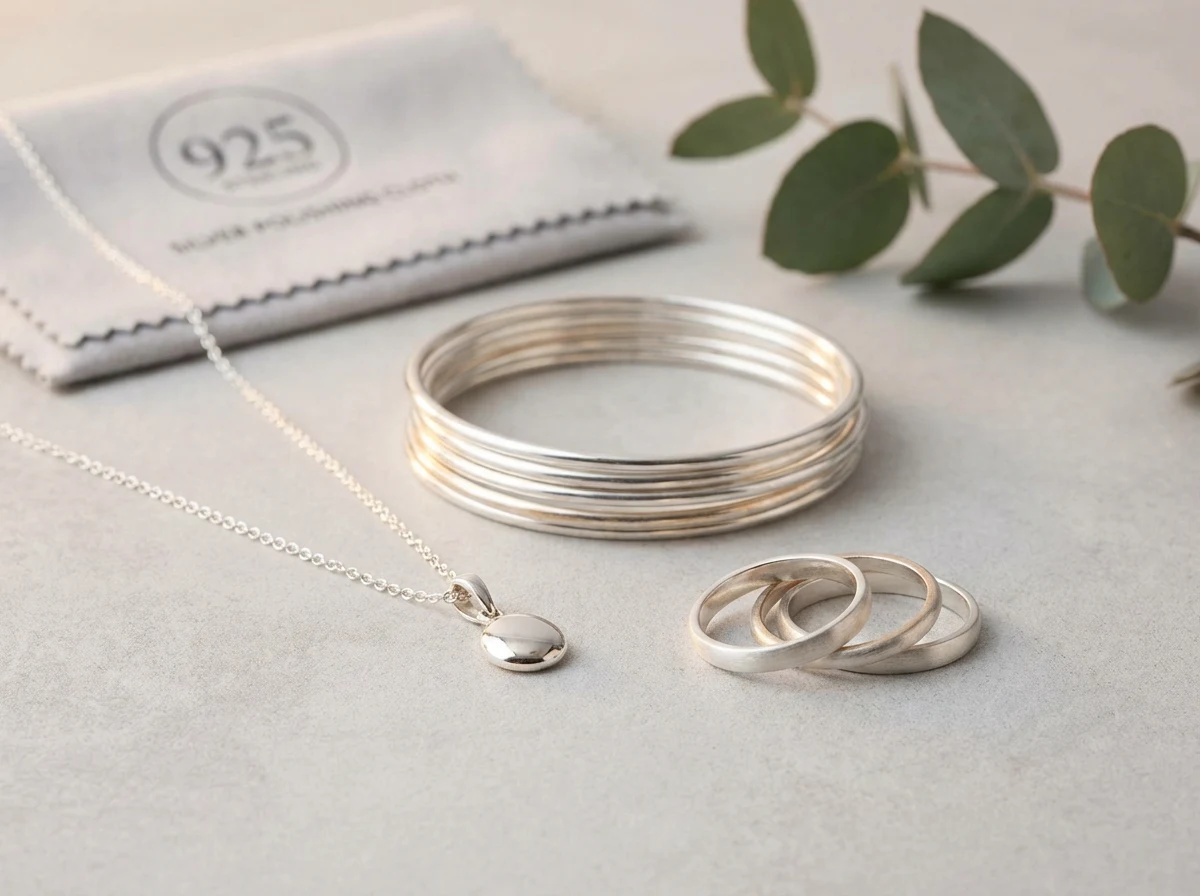
What Tarnish Really Means in 925 Sterling Silver
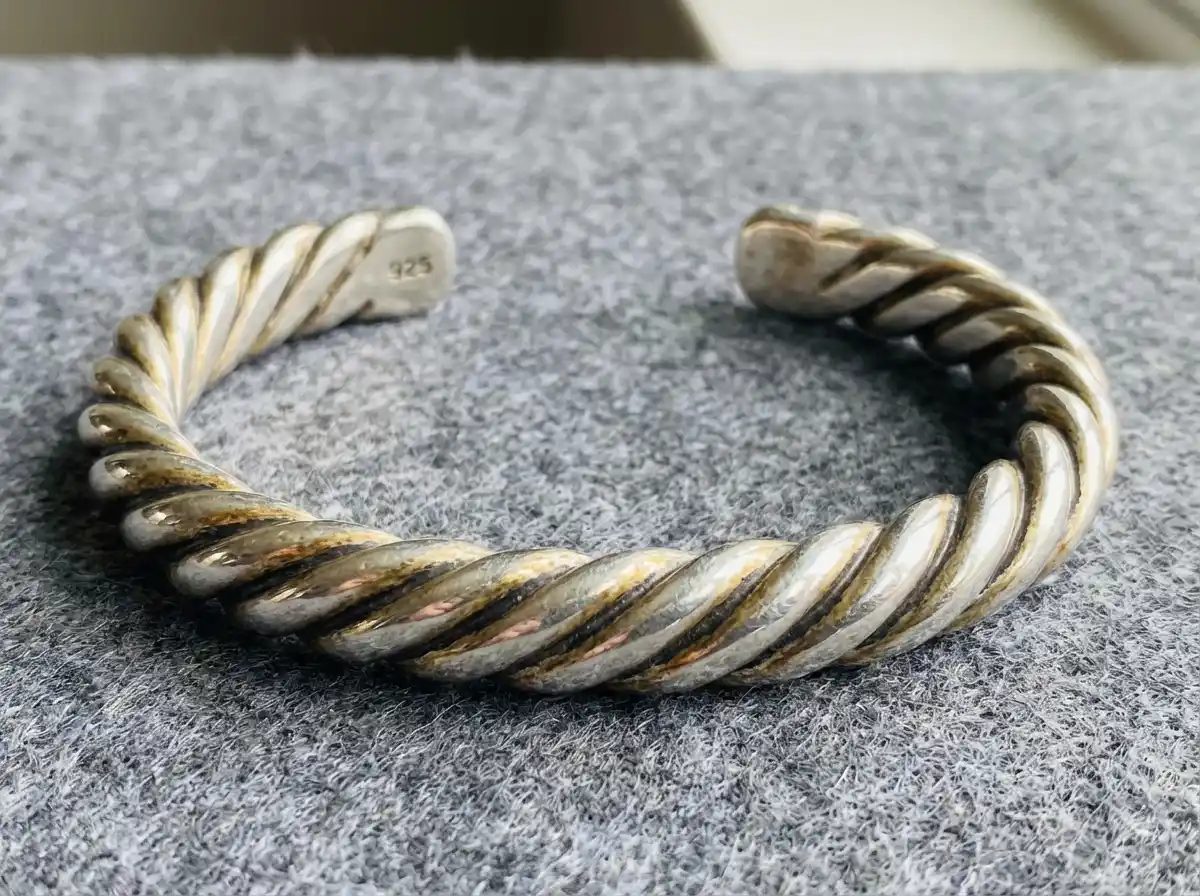
Yes, does 925 sterling silver tarnish has a simple answer: yes, it can. That said, tarnish is not the same as structural damage, plating failure in every case, or evidence that a piece is fake. Tarnish is a surface reaction. It typically appears as yellowing, dullness, gray discoloration, or darker blackened areas over time.
Think of it this way: sterling silver is valued for its look and workability, but its surface reacts to the environment. That is why many business owners eventually compare related questions such as does sterling silver tarnish and does silver tarnish. The answer across these conversations is usually not whether tarnish exists, but how quickly it develops and how well your team manages it.
For B2B brands, this matters because tarnish can affect:
- Perceived product quality during unboxing
- Sell-through for inventory held in storage
- Photography and visual merchandising
- Customer care instructions and return rates
- Packaging and fulfillment standards
In practice, this means tarnish should be treated as an operations issue as much as a product issue.
925 vs. Sterling vs. “Regular” Silver: What the 925 Stamp Actually Means
Many customer conversations about tarnish are really questions about identity: what does “925” mean, is “sterling” the same thing, and what counts as “regular silver.” In most B2B contexts, “925” and “sterling silver” refer to the same sterling standard, and you may also see common stamp variations like “s925” on pieces. For your business, the key is consistency between what is stamped, what is specified in your product documentation, and what is actually being produced.
The reality is that sterling silver is typically an alloy rather than pure, fine silver. From a practical standpoint, this matters because alloyed silver is still silver, but it tends to react to its environment over time, which ties directly to normal surface darkening expectations. This is one reason experienced brands avoid treating tarnish as a surprise. They plan for it in care language, packaging choices, and internal handling standards.
What experienced buyers know is that product claims should be treated like operational specs. Align your product descriptions, line sheets, and care cards to the exact terminology your team and manufacturing partner are using. If your customer service team is left improvising answers about “925 vs. sterling,” it can quickly turn a normal care issue into an “is it fake” escalation. A simple sourcing checkpoint is to confirm how items will be marked and documented before you approve production, then keep that same wording across e-commerce, wholesale materials, and after-sales scripts.
Why 925 Sterling Silver Tarnishes
The main reason 925 silver tarnish develops is exposure to air, moisture, and sulfur-containing compounds in the surrounding environment. This reaction is often described as sterling silver oxidation, even though the chemistry discussed in trade conversations may involve more than simple oxygen exposure. What matters operationally is that the metal surface reacts over time.
Now, when it comes to inventory management, the most common accelerators include humidity, polluted air, skin oils during repeated handling, packaging materials that trap reactive compounds, and long periods of storage without protective wrapping.
Common causes brands should watch closely
Consider this: a business may receive a clean production run, place pieces into low-cost packaging, store them in a humid back room, and then assume the factory caused the discoloration discovered three months later. Sometimes the root issue is actually post-production handling.
- Humidity in stock rooms or shipping routes
- Repeated touching during photography, counting, or merchandising
- Exposure to perfumes, lotions, cleaning chemicals, or airborne contaminants
- Poor packaging choices for long-term storage
- Lack of a stock rotation and inspection process
What many jewelry brands overlook is that tarnish often develops unevenly. A sample that sits untouched in a sealed pouch may look better months later than a showroom piece handled daily under bright lighting and inconsistent climate control.
How Long It Takes for Tarnish to Appear
One of the most common sourcing questions is how long does 925 sterling silver tarnish. There is no single timeline. Tarnish may appear relatively quickly in harsh storage conditions, or it may take much longer in controlled environments with good packaging and minimal handling.
The reality is that businesses should avoid promising customers or internal stakeholders a fixed time frame. A product stored in high humidity near reactive materials may dull faster than the same design stored in dry, sealed packaging with consistent handling standards.
What affects the speed of tarnish
From a production standpoint, appearance over time may depend on several variables working together:
- How the item is stored after manufacturing
- How often it is handled before sale
- The conditions during shipping and warehousing
- Whether the piece is solid 925 sterling silver or described differently in your assortment
- Your cleaning and inspection schedule
This is also why questions like does solid 925 sterling silver tarnish and does 925 sterling silver-plated tarnish need careful handling. Different product constructions may behave differently in wear and storage, so your merchandising and care instructions should match the exact item specification used in your collection.
Water, Storage, and Inventory Risk
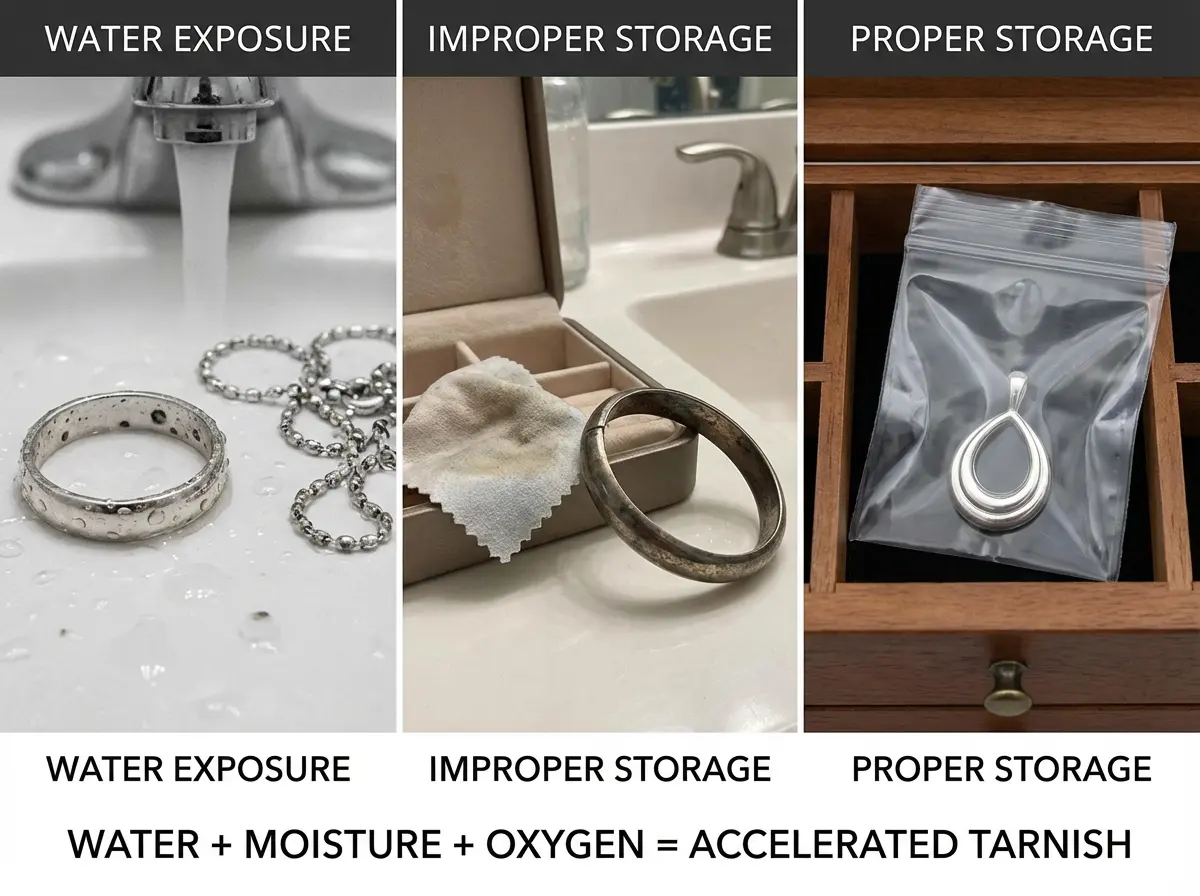
Another frequent question is does 925 sterling silver tarnish in water. Water alone is not always the whole problem. The issue is often what the water contains, how long exposure lasts, and whether the piece is dried and stored properly afterward. Repeated moisture exposure, especially when followed by poor drying or sealed damp storage, may speed up discoloration.
Here’s the thing, many jewelry businesses think only about retail wear conditions, but inventory care creates just as much risk. If your brand attends trade shows, ships internationally, or stores products across different climates, water and humidity control become part of your quality strategy.
Where businesses commonly run into trouble
A growing label may steam, clean, photograph, repack, and transport the same pieces several times before they ever reach a customer. Each step adds environmental exposure. If your team does not document handling procedures, tarnish can seem random when it is actually process-driven.
For a broader operational view, businesses managing larger assortments should review protecting sterling silver inventory essential tarnish prevention cleaning tips for manufacturers. It is especially relevant if you hold seasonal inventory or prepare pieces well in advance of a launch.
Water Exposure, “Waterproof” Claims, and Real-World Use Scenarios
Water questions often turn into marketing questions. Terms like “waterproof” and “water-resistant” are consumer-facing language, and used loosely, they can create returns risk for brands. “Waterproof” can be interpreted by customers as permission to wear jewelry in all water contexts without any care, which may not match real-world outcomes for sterling silver over time.
From an operations standpoint, the highest-risk scenarios are usually not a quick hand wash. They are repeated exposure to chemically treated water, extended time in moisture, and conditions like pools and saltwater where residues can be left on the surface and around details. If you choose to address water on product pages, safer phrasing is typically about “reducing exposure” and “drying after contact,” rather than promising that water has no effect.
In practice, you can also build simple post-exposure handling into your brand guidance without overpromising. If pieces are used for wear testing, content shoots, or influencer seeding, set a standard: rinse with clean water when appropriate, dry thoroughly, and store in a dry place before repacking. That one workflow often reduces avoidable discoloration and cuts down on support tickets that start with, “I wore it once and it changed.”
How Jewelry Businesses Can Prevent Tarnish
If your question is not just does 925 sterling silver tarnish, but how to reduce it at scale, prevention starts with process control. Most brands do not need perfection. They need repeatable handling standards that reduce risk across manufacturing, shipping, warehousing, content creation, and final delivery.
At Royi Sal Jewelry, the broader client conversation around custom jewelry development often includes not only design and production planning, but also practical questions about care expectations, storage, and how a collection should be managed after manufacturing. That kind of early planning can help businesses avoid preventable issues once inventory starts moving through real operations.
A practical prevention framework
- Store pieces in dry, controlled conditions, especially during long holding periods.
- Limit unnecessary handling during photography, sales meetings, and stock checks.
- Use packaging selected for jewelry storage, not just presentation.
- Train staff to dry pieces fully after any cleaning or moisture exposure.
- Inspect inventory on a schedule, not only when a problem becomes visible.
- Separate older stock from newly finished pieces to track storage impact.
In practice, this means tarnish prevention should sit with operations, merchandising, and sourcing together, not with one department alone.
If you are building a silver-based assortment, it also helps to confirm exactly what you are selling and how it is specified. This is where how ensure jewelry business offers authentic 925 sterling silver becomes useful for brand owners reviewing sourcing standards and product claims.
You can also explore the site’s 925 Sterling Silver section for related guidance tied to silver-focused collections and business considerations.
How to Remove Tarnish Without Creating New Problems
Many teams ask how to remove tarnish from 925 sterling silver in a way that preserves finish quality and avoids surface damage. The honest answer is that gentle, appropriate cleaning methods usually work best, while aggressive polishing or untested chemical processes may create new problems.
What many jewelry brands overlook is that overcleaning can become its own quality issue. If your staff polishes too hard, cleans too often, or uses unsuitable cloths and compounds, you may affect surface appearance, consistency across pieces, and final presentation.
Smart cleaning practices for business operations
- Test any cleaning process on a small batch before applying it to sellable inventory
- Document the method so every team member follows the same standard
- Use the least aggressive approach that restores appearance
- Dry completely before repacking or returning items to storage
- Record repeat tarnish cases to identify whether the issue is environmental, packaging-related, or specification-related
For brands with larger stock volumes, cleaning should not be treated as an informal back-room task. It should be part of your product care SOP.
Customer-Facing Pain Points Brands Should Prepare For: “Turns My Finger Green,” Black Tarnish, and Misinterpreted Quality Issues
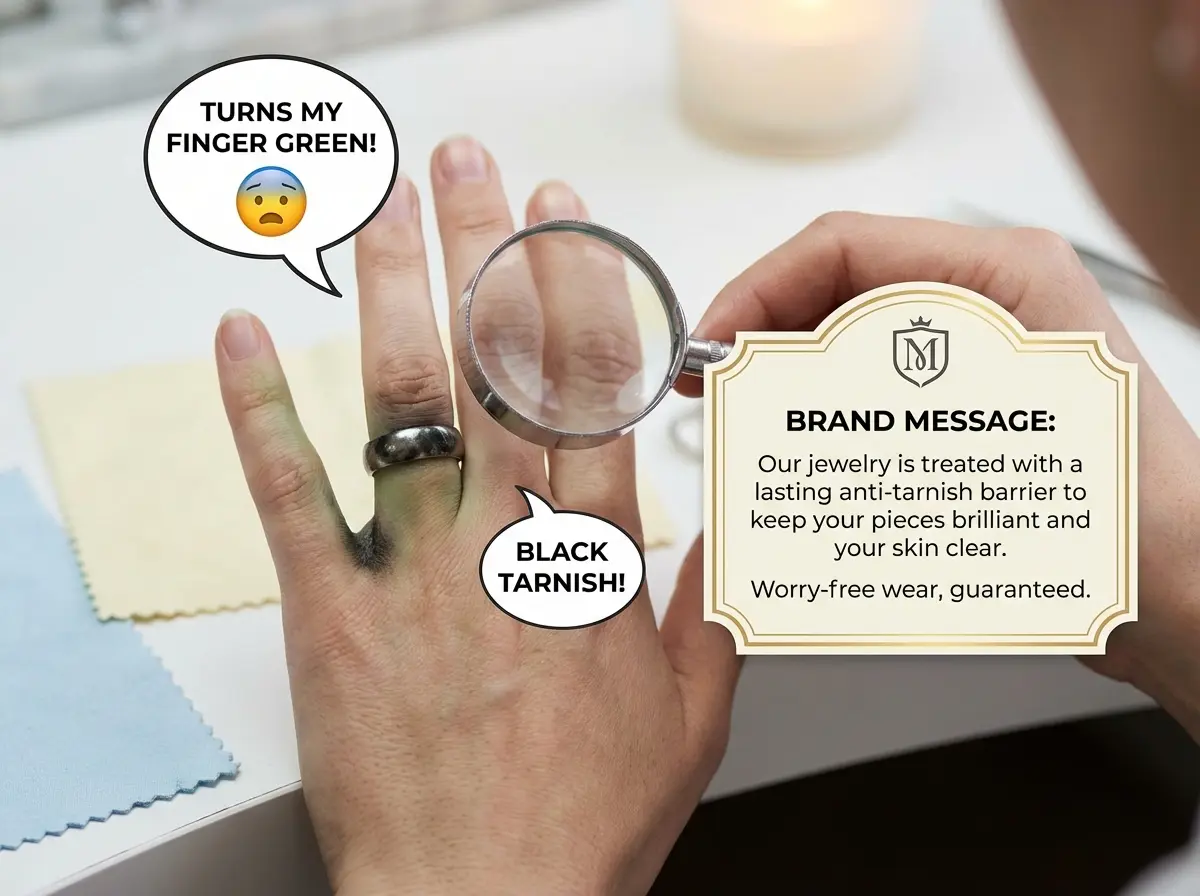
Even if your internal team understands tarnish, your customers may frame it as a quality failure. Two of the most common support tickets are “it turns my finger green” and “it turned black.” Your job as a brand is to treat these as troubleshooting moments first, not automatic defect confirmations or dismissals.
For the “green finger” complaint, start by gathering context: where the item was worn, whether lotions or fragrances were involved, whether it was exposed to water, and whether the customer noticed discoloration on the skin, on the jewelry, or both. Skin chemistry, residues, and environmental exposure can contribute to discoloration complaints, and your team should be prepared with a calm, consistent script that focuses on care steps and inspection rather than implying misuse or admitting a production issue without evidence.
For “black tarnish,” it helps to set expectations that tarnish can present as darkening, sometimes in specific areas first. This can look dramatic in close-up photos, but it is often surface-level and may respond to appropriate cleaning and improved storage. From a brand operations perspective, build a simple internal decision path: if the issue is mild and localized, clean and re-evaluate; if it is widespread across inventory, inspect storage humidity and packaging choices; if patterns repeat by style or batch, re-check your documented spec and confirm consistency with your manufacturing partner before you keep shipping the same risk profile.
Why This Matters When Choosing a Manufacturing Partner
Tarnish questions often surface during sourcing because business owners are trying to separate normal material behavior from avoidable production problems. That is a valid concern. A reliable partner should be able to discuss finishing, handling, packaging considerations, and realistic care expectations without making absolute promises.
Royi Sal Jewelry positions itself as a collaborative B2B custom jewelry design and manufacturing partner, and that matters here. When you work with a manufacturer that treats development as a shared process, you are more likely to discuss downstream realities such as storage, presentation, and post-production handling, not just the sample approval stage. You can learn more about broader operational considerations in the site’s Jewelry Manufacturing resources.
The best sourcing conversations usually include questions like these:
- How should inventory be stored after delivery?
- What care instructions should accompany the collection?
- What handling risks may affect appearance before sale?
- How should teams inspect and clean stored stock?
- How do product specifications affect long-term maintenance expectations?
Think of it this way: a manufacturer is not just producing units. In many cases, they are helping you define whether your product can be managed consistently as your business grows. That is one reason founder-led expertise can be valuable. Royi Sal Jewelry was built around custom development, collaboration, and manufacturing support for businesses building their own collections, which fits the kind of practical planning this topic requires.
Frequently Asked Questions
Is tarnish a sign that 925 sterling silver is fake?
Not necessarily. Tarnish alone does not prove a piece is inauthentic. In many cases, genuine sterling silver can tarnish over time because of environmental exposure, humidity, handling, or storage conditions. For a business, the more useful question is whether the product specification was verified properly during sourcing and whether care protocols were followed after production. If you are evaluating supply quality, compare documentation, product descriptions, and handling conditions before assuming that discoloration means the material claim was false.
Does solid 925 sterling silver tarnish less than other silver product types?
It may behave differently depending on product construction, finishing, and how the item is stored and used. Still, solid 925 sterling silver can tarnish. Businesses should avoid simplifying this into a claim that one format never changes while another always fails. A better approach is to match your care instructions, packaging standards, and product descriptions to the actual item specification in your line. This helps reduce confusion for staff, buyers, and end customers while keeping product expectations realistic.
Does 925 sterling silver tarnish in water during normal use?
Water exposure may contribute to tarnish risk, especially if moisture remains on the piece or if the water contains chemicals or impurities. From a business standpoint, the key issue is cumulative exposure. Products may encounter water during cleaning, photoshoots, wear testing, fulfillment prep, or customer use. If they are not dried properly afterward, discoloration can appear sooner. Brands should build moisture control into both care instructions and back-end operations rather than treating water as a minor concern.
How long does 925 sterling silver take to tarnish in inventory?
There is no universal timeline. Tarnish may develop faster in humid storage, reactive packaging, or high-handling environments, and it may develop much more slowly in dry, well-controlled conditions. For jewelry businesses, this means there should be no blanket promise attached to shelf life. Instead, create storage standards, inspection schedules, and repacking procedures based on your sales cycle, region, and shipping model. A controlled system gives you better consistency than relying on rough estimates.
Can tarnish be prevented completely for wholesale or private label collections?
Usually, the goal is reduction and management, not a promise of complete prevention. Tarnish is a normal material behavior that can often be minimized through better packaging, dry storage, limited handling, and careful cleaning processes. Wholesale and private label businesses benefit most from operational discipline. If your team treats care as part of inventory management rather than as an afterthought, you can often reduce visible tarnish significantly and improve consistency across samples, stock, and shipped orders.
Should jewelry businesses polish all tarnished pieces before shipping?
Not automatically. First identify the scale of the issue and its likely cause. If a few items show mild surface dullness, gentle cleaning may be enough. If many pieces show recurring discoloration, polishing each order without fixing storage or packaging processes only masks the problem. Overpolishing may also affect surface appearance and consistency. The smarter move is to set a documented cleaning threshold, test methods on a sample batch, and address root causes such as humidity, packaging, or repeated handling.
What should a brand ask a manufacturer about tarnish risk?
Ask about realistic care requirements after production, suggested storage conditions, handling precautions, and what internal quality checks are performed before shipment. You may also want to discuss how pieces should be packed for transit and whether certain design choices could affect maintenance expectations. A capable manufacturing partner should speak openly about what is normal, what may vary by environment, and what the brand needs to manage on its side. Clear conversations early in development often prevent confusion later.
How do boutiques and brands reduce tarnish during slow sales periods?
Slow-moving stock often faces more tarnish risk because it sits longer in storage and may be handled repeatedly during merchandising reviews. Boutiques can reduce this by storing backup inventory in controlled packaging, limiting display exposure for reserve stock, rotating older pieces forward, and inspecting items on a set schedule. The goal is to catch minor dulling early rather than waiting until pieces need aggressive cleaning. A simple stock care routine usually performs better than occasional emergency polishing sessions.
Does tarnish affect whether a collection is still sellable?
Mild tarnish usually affects presentation more than structural quality, so it does not always make inventory unsellable. However, it can reduce perceived value, create inconsistency in product photos, and increase the chance of complaints if not corrected before shipment. For brands, the real risk is reputational. If your collection arrives looking poorly maintained, customers may question the quality even when the issue is surface-level. That is why appearance control, storage standards, and final inspection matter so much.
Why is tarnish knowledge important for new jewelry brands?
New brands often focus heavily on design, sampling, and launch timing, then underestimate post-production care. Tarnish knowledge helps you write better care instructions, choose better packaging, create smarter warehouse procedures, and ask better sourcing questions. It also helps your team distinguish between normal material behavior and a true quality concern. For founders building trust in a new market, that clarity supports stronger product presentation and more confident customer communication from the start.
Can 925 sterling silver go in the shower?
It may be exposed to water in the shower, but for brands, the more useful question is what you want to promise. Shower conditions can involve heat, steam, soaps, shampoos, and residues left on the surface. If your product pages address this, it is typically safer to advise reducing repeated exposure and drying thoroughly after any water contact, rather than positioning the item as “shower-safe” in a way customers may interpret as maintenance-free.
Does 925 sterling silver tarnish or turn your finger green?
Yes, 925 sterling silver can tarnish, and some customers may also report skin discoloration in certain wear conditions. For a business, this should be handled as a support workflow: ask about exposure to lotions, fragrances, cleaning products, sweat, and water, then guide the customer through cleaning, drying, and storage steps. If complaints cluster around a specific style or batch, that is when it makes sense to review documentation, packaging, and production consistency with your manufacturer.
How long can 925 sterling silver last?
In many cases, sterling silver jewelry can remain in service for a long time, but longevity depends on wear habits, maintenance, storage, and handling practices. Brands should avoid turning this into a guarantee. A better approach is to provide clear care guidance, set realistic expectations about surface changes over time, and maintain consistent quality controls so customers experience predictable performance from one purchase to the next.
Does 925 sterling silver tarnish black?
It can. Dark or blackened tarnish is a common way surface discoloration presents, and it may appear in certain areas first depending on handling, moisture exposure, and storage conditions. From a brand standpoint, the goal is to prevent avoidable cases through packaging and humidity control, then address visible tarnish with gentle, documented cleaning steps and clear customer care instructions.
Key Takeaways
- 925 sterling silver can tarnish, and that usually reflects surface reaction to environment rather than automatic product failure.
- Humidity, handling, packaging, and storage conditions often influence tarnish more than businesses expect.
- There is no fixed timeline for 925 silver tarnish, so brands should rely on process controls, not assumptions.
- Gentle, standardized cleaning methods usually work better than aggressive polishing across inventory.
- Good manufacturing conversations should include care, storage, and fulfillment realities, not only sample approval.
Conclusion
So, does 925 sterling silver tarnish? Yes, it can, but for jewelry businesses, the better takeaway is that tarnish is manageable when you understand what causes it and build the right operational habits around it. Storage conditions, moisture exposure, handling frequency, packaging choices, and cleaning routines all shape how your inventory performs over time. If your team treats tarnish as part of product lifecycle planning rather than as a surprise defect, you will be in a much stronger position to protect presentation and reduce avoidable losses.
If you are developing or expanding a sterling silver collection, the next practical step is to review your care standards alongside your sourcing and fulfillment process. Visit royisal.com to explore how a custom manufacturing partnership works, or reach out to Royi Sal Jewelry to discuss your collection requirements and the operational details that support long-term product quality.