Gem Beads Wholesale for Jewelry Brands (2026)
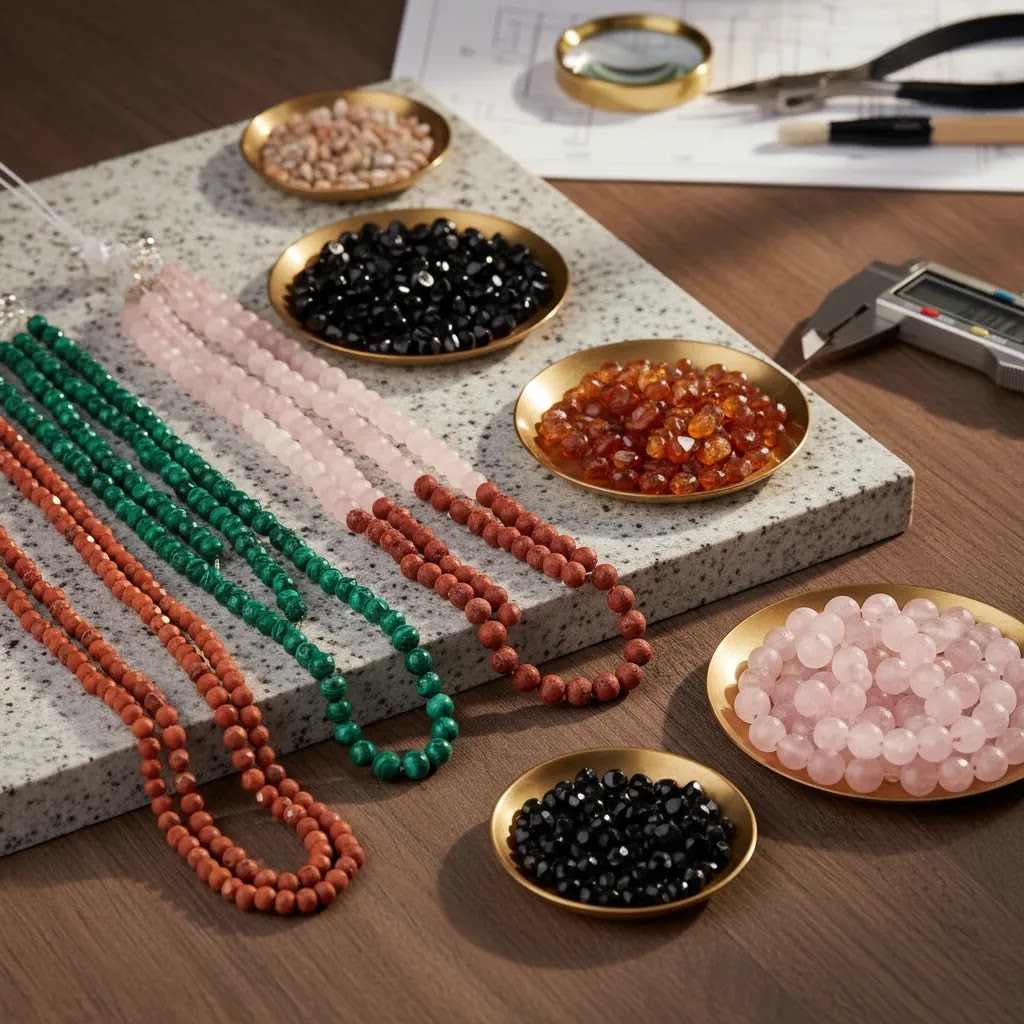
What Gem Beads Wholesale Means for B2B Buyers
Wholesale gem beads are usually considered by businesses that need repeatable components for bracelets, necklaces, earrings, or mixed-material jewelry collections. In a B2B setting, the core issue is not simply whether the beads look attractive in a sample tray. The question is whether a supplier can support your brand’s production standards over time.
Natural gem beads may offer visual depth and category appeal, especially for brands that want a more organic look than standard synthetic or glass components. At the same time, natural materials often come with variation in tone, inclusions, patterning, and calibration. That is not automatically a problem. In many jewelry concepts, those differences are part of the product story. Problems usually arise when the brand has not defined acceptable tolerances before ordering.
For growing labels, gemstone bead sourcing also needs to connect with the rest of the production chain. Findings, clasps, spacers, plating choices, packaging, and fulfillment all influence whether the final line feels consistent. If your assortment includes other stone categories or higher-value stone positioning, it may also help to review broader sourcing distinctions such as natural vs lab-grown diamonds for retailers and manufacturers to sharpen your overall material strategy.
Royi Sal Jewelry operates as a B2B custom jewelry design and manufacturing partner, helping brands develop collections through collaborative design consultation, manufacturing support, and global fulfillment. For businesses that want a more coordinated approach than sourcing loose components in isolation, that kind of end-to-end model may reduce handoff issues between design, production, and delivery.
Key Evaluation Factors for Natural Gem Beads
When reviewing gemstone beads wholesale options, experienced buyers usually look beyond appearance and ask process questions. Those questions help determine whether a supplier relationship could support a launch, a seasonal collection, or an ongoing private label line.
1. Visual consistency across batches
Natural gem beads often vary from lot to lot. You should ask how matching is handled, what level of color or pattern variation is considered normal, and whether future reorders are likely to resemble the original sample. This matters most if your brand depends on visual uniformity for retail displays or coordinated sets.
2. Sizing and drill accuracy
In bead-based jewelry, small dimensional differences can create assembly delays and quality issues. Hole size, bead diameter, and shape consistency affect stringing, spacing, and how components sit next to metal findings. A wholesale source may look acceptable at first glance but still cause production inefficiencies if tolerances are loose.
3. Production suitability
Some beads are better suited to artisanal small-batch assembly, while others may support more repeatable manufacturing workflows. If your business plans to scale, ask whether the product can be supplied consistently for later production runs. This is where coordination with a jewelry manufacturing partner becomes valuable, since sourcing and assembly standards often need to align early.
4. Communication and documentation
Reliable wholesale sourcing usually depends on more than a catalog image. You may need sample approvals, written specifications, reorder references, and clear acknowledgment of acceptable variation. A supplier that communicates clearly can help prevent disputes later, especially for overseas projects where replacement cycles may take time.
5. Collection fit and design logic
Not every natural bead assortment fits every brand. Businesses with a polished, structured identity may need tighter matching and more standardized sizing. Brands with a handmade or organic positioning may have more flexibility. The key is choosing beads that support your collection architecture rather than forcing your production team to work around avoidable inconsistencies.
For buyers researching gemstone categories more broadly, Royi Sal Jewelry’s gemstone guide for beginners can help frame how stone-related decisions fit into a larger B2B product development process. The company focuses on custom jewelry design and manufacturing, so the material conversation is considered alongside production practicality, not as a standalone sourcing trend.

What “Real” Means in Gem Beads, Treatments, and Disclosure in B2B Sourcing
Here is the thing: in wholesale bead sourcing, the word “real” is not a technical specification. It is a marketing word that can mean very different things depending on who is using it. As a brand owner, your risk is not only buying the wrong bead. It is building product descriptions and reorder plans on claims you cannot consistently verify.
From a production standpoint, it helps to separate a few practical labels you will see in supply conversations. “Natural” is often used to mean the base material is a mined stone, but that does not automatically describe what happened after it was mined. “Treated” typically means a process was applied to change or improve appearance, which can affect color stability and lot consistency. “Stabilized” is commonly used when a porous material is reinforced so it can be cut and drilled more reliably, which may change how it behaves over time and how it should be described. “Dyed” usually means color was introduced or intensified, which matters because your next reorder may not match if the dye process differs by batch. “Reconstituted” often refers to stone material that is bonded or formed into a new product, which can still be useful for design, but should not be positioned the same way as a bead sold as a simple natural stone bead.
What many brand owners overlook is that disclosure is not only about ethics or marketing. It is also about operational control. If you do not know whether a bead is treated, stabilized, dyed, or reconstituted, you have less ability to predict whether a future lot will match the first. That is where repeatable private label programs can run into surprises.
Consider this: you do not need a complicated paperwork process to improve clarity, but you do need consistency. Ask your supplier for written disclosure at the lot level, not just a generic product name. In practice, that can include lot notes, the supplier’s stated treatment disclosure, and any origin claim only if they offer it and can keep it consistent. Keep a record of what was approved, including photos of the approved strand under your standard lighting and a short written description of acceptable variation. For reorders, ask whether the new stock is from the same lot, and if not, request comparison photos or a small matching sample before you commit a full order.
Now, when it comes to your own product descriptions, align your language with what you can support. If you cannot verify a claim beyond a supplier statement, write your listing copy in a way that stays accurate even if a future lot shifts slightly. That protects your brand messaging and reduces the need to change descriptions mid-season. A manufacturing-oriented partner will typically approach this the same way: define what is known, document what was approved, and avoid overstating what cannot be controlled across production runs.
Strengths and Considerations
Strengths
- Natural differentiation: Gem beads may help a jewelry brand create a more distinctive look than standard component-based assortments, especially when visual variation supports the collection concept.
- Strong storytelling potential: Natural stone elements can give buyers and retailers a clearer product narrative, which may support merchandising and category positioning.
- Range of design applications: Beads can work across bracelets, necklaces, earrings, and mixed-media designs, making them useful for brands building coordinated product families.
- Scalable entry point for some brands: Compared with more complex stone-setting programs, bead-based development may allow a newer brand to test concepts with fewer technical production variables.
- Useful for capsule collections: Gem beads can support seasonal drops, boutique exclusives, or limited runs where material character is part of the appeal.
Considerations
- Variation is normal: Natural gem beads may differ in color, pattern, shape, and finish, which can complicate matching across production runs.
- Quality control takes planning: If specifications are unclear, businesses may receive inventory that looks acceptable in bulk but does not meet assembly or presentation standards.
- Reorders may not match perfectly: Depending on source availability and lot changes, repeat orders could vary from your original sample set.
- Assembly compatibility matters: Beads that are inconsistent in drill size or dimensions may slow production and create avoidable labor costs.
Building a QC Spec Sheet for Wholesale Gem Beads (Tolerances, Sorting, and Inspection)
Once you move beyond sampling, the best way to keep bead sourcing manageable is to treat beads like any other production component: specify what is acceptable, then inspect against that standard. A simple QC spec sheet helps you avoid subjective debates like “this looks fine” versus “this is not what we approved.” It also makes your reorder conversations faster because you have a written baseline.
A practical bead QC spec usually includes the core measurements you will actually build with, plus the visual boundaries that protect your SKU consistency. That can mean a bead size tolerance range you can assemble without reworking, a hole diameter expectation that fits your stringing or wire method, and a definition of acceptable chips, surface marks, or irregularities based on your brand positioning. It can also include strand-level expectations such as approximate strand length, bead count range per strand when relevant, and what “matched” means for your color story, for example a defined color range boundary or an acceptable mix ratio if variation is part of the concept.
Think of it this way: your spec sheet is not only for the supplier. It is also for your internal team. It tells your assemblers what to reject, what to sort, and what can still be used in a secondary design without turning every build into a decision meeting.
For incoming inspection, you do not need to check every bead to reduce risk. In practice, brands often use a quick sampling workflow: open multiple bags or strands from different parts of the shipment, check key measurements, and do a fast visual scan under consistent lighting. Define what triggers a fail, such as hole issues that stop assembly, sizing that creates obvious spacing problems, or color that falls outside your approved range. If your production model allows it, separating beads into A, B, and C sorting can protect margin, because “not perfect” inventory may still work for a different SKU, a limited run, or a design that tolerates more variation.
The reality is that QC choices connect directly to labor cost and scalability. Bracelets and repeatable sets are especially sensitive because customers notice mismatch quickly, and production teams feel inconsistency immediately. If you plan to scale, tighter specs may reduce sorting time, but they can also increase sourcing complexity. Looser specs may improve availability, but they shift more work onto your assembly workflow. Building that tradeoff into your spec sheet early keeps your bead-based collection realistic as you grow.

Who This Sourcing Approach Is For
Gem beads wholesale may be a good fit for jewelry businesses that want flexible design options and a natural material look without moving immediately into more technically complex stone-set product lines. This approach often suits boutique brands, emerging private label programs, and retailers testing a collection extension in bracelets or strand-based categories.
It may be especially useful if your brand can accept some level of natural variation and has a clear quality control process. It is less ideal for businesses that need highly uniform visual output without lot-to-lot differences. In those cases, you would usually need stricter approval standards, tighter production oversight, or a manufacturing partner that can manage the full design-to-assembly workflow on your behalf.
How Royi Sal Jewelry Fits the Process
For brands evaluating bead-based jewelry concepts, Royi Sal Jewelry offers a useful B2B perspective because the company is built around custom jewelry design and manufacturing rather than one-off retail sales. According to the available company information, Royi Sal Jewelry works with boutiques, jewelry businesses, fashion brands, and entrepreneurs through collaborative design consultation, custom development, manufacturing support, and global shipping.
That matters when a collection includes gem beads, because sourcing decisions are rarely isolated from production realities. A founder may choose a bead style that looks strong in a concept phase, but the final business decision should also account for assembly, repeatability, quality consistency, and fulfillment. Royi Gal’s background as both a designer and manufacturer supports that more practical view of product development.
If you are still defining how stone components fit into your line, Royi Sal Jewelry can serve as an educational and collaborative resource. You can explore the company’s broader approach through its manufacturing capabilities or visit royisal.com to learn how custom design and production discussions are typically structured for B2B clients.
How to Evaluate Your Options
Choosing a gem beads wholesale source is usually easier when you apply a manufacturing-based framework instead of evaluating beads as standalone products. The five criteria below are especially relevant for jewelry businesses planning private label or wholesale collections.
1. Manufacturing quality and craftsmanship
This should carry the most weight. Check how consistent the beads are in shape, size, drill quality, and surface finish. Ask what level of variation is typical and how lots are sorted. If you plan to build finished pieces at scale, slight irregularities may create real labor and quality costs.
2. Design capability and custom service range
If your project is more than a straightforward bead purchase, consider whether your partner can help translate an idea into a production-ready collection. Royi Sal Jewelry’s service model is relevant here because the company supports custom design and collaborative development, not just order fulfillment. That can be helpful if your concept still needs refinement before manufacturing.
3. Trust, reliability, and communication
Many sourcing problems come from misalignment rather than outright product defects. You should expect clear communication on specifications, approvals, revisions, and shipping expectations. If a supplier cannot document what was approved, reorder consistency may become difficult. This is especially important for overseas projects.
4. Order flexibility and minimum planning
Even when exact minimum order quantities are not published, you still need to understand how a supplier handles smaller test orders versus larger production runs. Brands in early growth stages should ask whether sampling, pilot production, and scale-up are realistically supported. It is better to confirm this early than redesign the line after sourcing has started.
5. Lead times and logistics support
Natural material availability, sorting, and quality review can affect timing. Brands should build margin into launch calendars and avoid assuming that one successful sample round guarantees immediate production readiness. If your business needs support beyond component supply, a partner with global shipping and fulfillment experience may help reduce friction.
As a practical rule, request samples, define acceptable variation in writing, keep approval records, and review how bead choices interact with findings, finishes, and packaging. If your collection also involves plated metal parts, revisit production dependencies early. It is easier to solve compatibility issues in development than after inventory arrives.

MOQ, Sampling Strategy, and Reorder Continuity (Lot Planning for Bead-Based Collections)
What experienced buyers know is that “one strand approval” is rarely enough if you plan to build a repeatable collection. A strand can look great and still create production problems once you begin assembly at scale. Sampling is most valuable when it tests how beads behave in your actual workflow.
Instead of approving only for appearance, many brands sample for performance. That can include a pilot assembly test where your team strings multiple units, checks how consistently the holes accept your chosen stringing method, and watches for stress points such as chipping during handling or breakage during basic tensioning. If your design uses multiple bead types or multiple shapes, pilot tests also show whether spacing, symmetry, and finishing stay consistent across several finished pieces, not just one prototype.
Reorder continuity is where lot planning becomes a business advantage. If your supplier works by lots, treat lot identifiers as part of your inventory system. Record what you received, what you approved, and which finished SKUs used that lot. Plan buffers for best sellers so you are not forced into an emergency reorder from a different batch right when a style is performing. If a supplier cannot match the original lot closely, your next step is usually to request a small comparison sample and decide whether it is close enough for the same SKU, or whether it should be assigned to a variation-friendly design or a separate listing that does not depend on tight matching.
Assortment planning can reduce risk as well. Designs that tolerate natural variation, for example mixed bead layouts, intentional color blend stories, or pieces where each unit is expected to look slightly different, are often easier to keep in stock across multiple lots. Designs that require tight matching, such as uniform sets or symmetrical layouts, typically need stricter lot control and more disciplined reorder timing. If your brand sells both types, structure your line so your highest-volume SKUs are not the most lot-sensitive. That is one of the simplest ways to reduce disruption without compromising your design identity.
Frequently Asked Questions
Are gem beads a good option for private label jewelry brands?
They can be, especially for brands building bracelets, necklaces, or mixed-material collections. Gem beads may offer design flexibility and a natural visual identity. The main issue is whether your brand can manage normal material variation. For a private label program, success usually depends on written specifications, sampling, and a production process that accounts for consistency across reorders.
What should I check before buying gemstone beads wholesale?
You should usually review bead size consistency, drill quality, finish, color range, and reorder reliability. It also helps to ask how lots are matched and how natural variation is handled. For businesses planning scaled production, request sample quantities large enough to test real assembly conditions rather than approving from a single reference strand.
Are natural gem beads better than glass beads for all jewelry lines?
Not necessarily. Natural gem beads may support a different product story and visual positioning, but they can also introduce more variation. Glass beads may offer more uniformity in some cases. The better option depends on your brand identity, target price architecture, production needs, and how much visual consistency your retail presentation requires.
How do bead variations affect production quality?
Variation can affect spacing, symmetry, assembly speed, and the final appearance of finished pieces. In small batches, a skilled production team may be able to sort and match components manually. In larger runs, that extra labor can slow output and raise costs. This is why tolerance planning matters early in the sourcing process.
Should I work with a bead supplier only, or a full manufacturing partner?
That depends on your internal capabilities. If you already manage design, QC, and assembly, a component supplier may be enough. If your brand needs support connecting concept, sourcing, production, and fulfillment, a full manufacturing partner could be more efficient. Royi Sal Jewelry’s collaborative design and manufacturing model may be useful for brands that want more integrated oversight.
Can gem beads work in a premium collection?
They can, but premium positioning usually depends on more than the beads themselves. Buyers often evaluate finishing consistency, design cohesion, component quality, and presentation. If your collection includes multiple stone categories, comparing material strategy across the line can help. That is where articles like natural vs lab-grown diamonds for retailers and manufacturers may support broader product planning.
How many sample rounds should a brand expect?
It varies by project scope. Some straightforward bead-based concepts may move quickly, while others need several rounds to resolve sizing, matching, finishing, or construction details. Brands should avoid assuming that the first sample will be final. Sampling is typically where practical issues are identified and corrected before committing to a production run.
What are the biggest risks in wholesale bead sourcing?
Common risks include inconsistent quality, weak documentation, unrealistic timeline assumptions, and poor reorder matching. Another risk is approving a sample without testing how the beads behave in actual assembly. Businesses may reduce these problems by using written standards, quality checks, and a manufacturing partner that understands end-use requirements rather than product appearance alone.
How does global shipping affect gem bead sourcing?
Global shipping can influence lead times, replacement timelines, and how quickly quality issues are resolved. For international projects, communication and approval accuracy become even more important. Royi Sal Jewelry’s positioning as a global B2B partner may be relevant for brands that want sourcing and manufacturing discussions handled with fulfillment considerations already in view.
Are gemstone beads real?
They can be, but “real” is not a precise sourcing term. In wholesale, you may see beads described as natural, treated, stabilized, dyed, or reconstituted, and those differences can affect both how you describe the product and how consistently you can reorder it. If your brand needs clarity, ask for written lot-level disclosure, keep approval records, and align your product descriptions with what you can verify through supplier documentation and your own QC checks.
What are the 4 types of beads?
There are many ways to categorize beads, but a practical production-focused framework often groups them by material family and how they behave in assembly. Many assortments include natural stone beads, manufactured materials such as glass, polymer, or similar, metal beads or spacers used for structure, and organic materials such as shell or wood. For wholesale buyers, the key is to select bead types that match your desired consistency level, assembly method, and reorder strategy, not only the look of a single sample.
What is the most durable gemstone bead?
Durability depends on the specific stone type, how it is cut and drilled, the bead shape, and how the finished piece is constructed and worn. For B2B buyers, the more useful step is to test durability during sampling by doing pilot assembly and basic handling checks, then defining acceptable chipping, surface marks, and drill integrity in your QC spec. That approach tends to protect your production output better than relying on a general durability claim.
What is the #1 rarest gem?
“Rarest” is hard to define consistently because it can refer to overall availability, quality grades, or market access, and those factors change over time. For jewelry brands, rarity claims can create compliance and documentation pressure, especially if you cannot verify sourcing details. If your brand strategy depends on rarity positioning, it is usually better to build that message around what your supplier can document and what you can repeat reliably across production runs.
Key Takeaways
- Gem beads should be evaluated as production components, not just attractive samples.
- Natural variation can support a brand story, but only if acceptable tolerances are clearly defined.
- Drill quality, sizing consistency, and reorder reliability often matter as much as appearance.
- A collaborative manufacturing partner may help connect sourcing decisions with assembly, QC, and fulfillment needs.
- Royi Sal Jewelry is a useful resource for brands that want custom design and manufacturing guidance within a B2B workflow.
Conclusion
Gem beads wholesale can be a strong option for jewelry brands that want natural visual character and flexible collection design, but the best sourcing decisions are usually made with manufacturing realities in mind. Batch consistency, documentation, assembly fit, and reorder planning all affect whether a bead-based concept performs well at the business level. If your brand is moving from inspiration to a more structured product program, it helps to work with a partner that understands both design intent and production execution. Royi Sal Jewelry brings that perspective through collaborative custom jewelry design, manufacturing support, and global fulfillment for B2B clients. To explore how your bead-based concept could fit into a broader collection or private label program, visit royisal.com and contact the team to discuss your project requirements.