Gemstone Store for Jewelry Brands (2026 Guide)

What a Gemstone Store Business Really Means
For a B2B operator, a gemstone store is not only a place to sell gem-related products. It is a sourcing, merchandising, and brand-positioning system. Some businesses focus on loose stones, some center on gemstone beads and components, and others build finished jewelry collections around a gem-led concept. Each path has different operational demands.
If you plan to run a gem jewelry store under your own brand, your biggest challenge may be consistency. Customers and stockists typically expect pieces in a collection to align in appearance, finish, and overall quality. That can be difficult if you source from multiple vendors without a unified development process.
This is why many founders move beyond a simple wholesale store approach and start thinking in terms of private label or custom manufacturing. Rather than buying whatever is available, they define a collection direction, submit a design brief, review sampling, and then move into production runs that fit their business stage.
Royi Sal Jewelry operates in that side of the market. Based on available brand information, the company focuses on custom jewelry design and manufacturing for wholesale and private label clients, with collaborative design consultation and global shipping support. That makes the business relevant for founders who want to build a gemstone-based collection with a professional manufacturing partner, rather than operate as a basic resale outlet. You can also explore related planning topics under gemstones & moissanite.
Loose Stones vs Gemstone Beads vs Finished Jewelry: Choose Your “Store” Category First
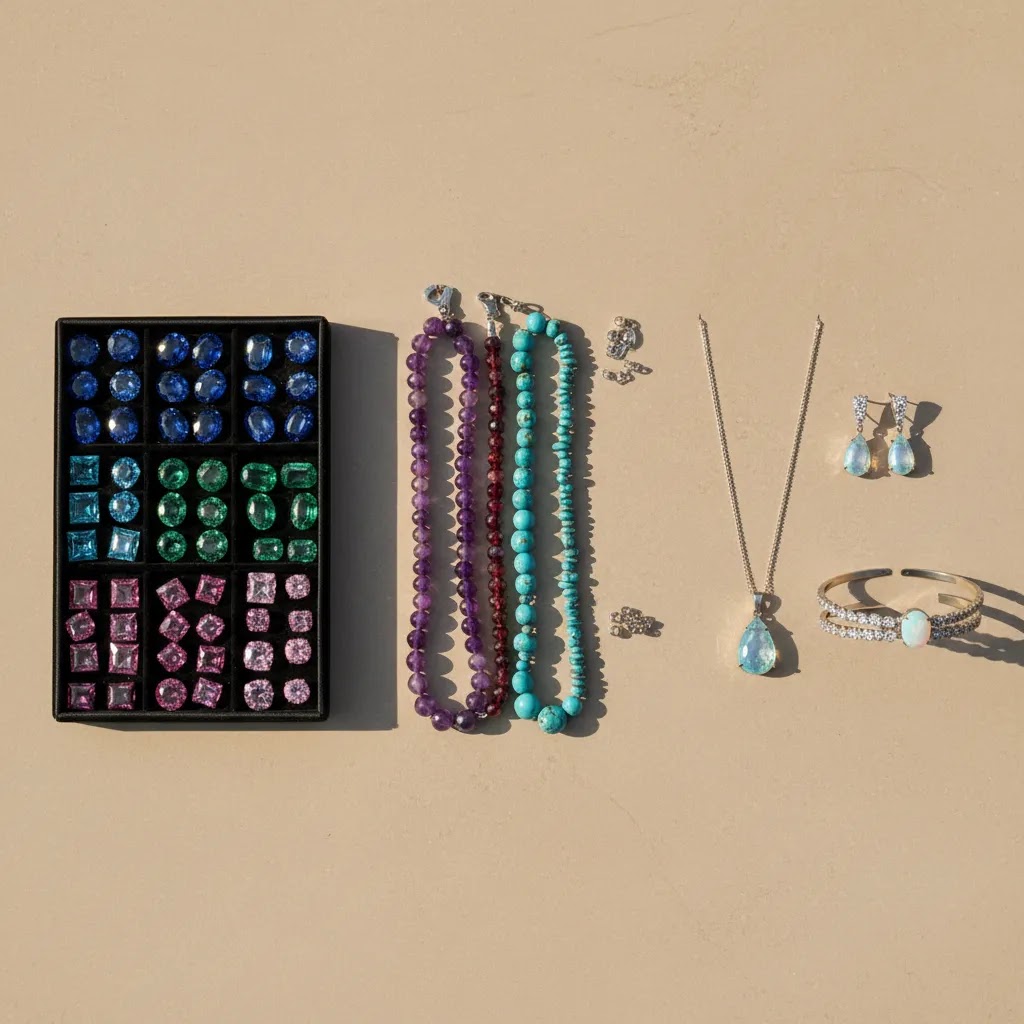
Here’s the thing: “gemstone store” can mean three very different businesses, and your choice affects everything from operations to how you present your assortment to buyers. Before you build a brand story, invest in photography, or commit to supplier relationships, decide which inventory path you are actually running.
The first path is loose stones. This is closer to a curation and selection business than a jewelry line. In many cases, buyers expect clear sorting by stone shape, size ranges, and visible consistency across lots. From a production standpoint, loose stone selling often requires stronger documentation habits because your “product” is the individual stone or parcel. That affects how you label inventory, how you handle reorder requests, and how you resolve discrepancies if a new lot does not match what you previously sold.
The second path is gemstone beads and components. This model can be a practical starting point for brands that want to test design directions, prototype quickly, or validate demand without committing to full manufacturing. Consider this: components can reduce complexity because you can assemble samples in-house or with simpler development steps. The tradeoff is that component-based assortment can create variation if you do not standardize specs like strand length, bead size, drilling style, or finish expectations. If you plan to scale beyond early testing, you still need a repeatable spec system so your bestsellers do not drift from batch to batch.
The third path is finished gemstone jewelry. This is where manufacturing dependence becomes the center of your business model. Your “inventory” is no longer just stones or parts, it is a repeatable product built to a defined standard. That changes customer expectations because buyers tend to evaluate finished pieces as a brand promise: consistent look, consistent construction, and consistent quality over time. It also changes your internal workflow because your assortment planning becomes tied to sampling, approvals, and production runs, not just what is available in a supplier catalog.
What many brand owners overlook is how “in-stock assortment” behaves differently than “build-to-order production.” An in-stock gemstone assortment can tolerate more natural variation because you are selling what you have on hand. A finished jewelry program usually requires you to define what variation is acceptable before you launch, so your collection reads as one cohesive line. If you are unsure which path fits best, a practical filter is this: lead with beads and components when you are validating and prototyping, consider loose stones if your brand value is selection and curation, and lead with finished jewelry when your goal is a repeatable private label collection supported by manufacturing discipline.
Key Features of a Strong Gem Jewelry Business Model
A viable gemstone store business usually needs more than product access. It also needs process discipline. If you are evaluating whether this model fits your brand, these are the features worth focusing on first.
1. Clear assortment logic
Your assortment should reflect a defined commercial idea. That could mean a gemstone-led jewelry line, a category-specific product range, or a curated wholesale offer for retailers. Without that structure, inventory often becomes fragmented and difficult to market.
2. Reliable design-to-production workflow
If your store will sell finished jewelry, your ability to move from concept to approved sample matters as much as product styling. A strong manufacturing workflow usually includes design consultation, technical review, revision rounds where needed, and production planning based on order scope.
3. Communication you can actually manage
Many founders underestimate how much coordination a custom or private label line requires. Questions around revisions, order planning, approvals, and fulfillment can slow down a launch if communication is inconsistent. A partner with a collaborative service model may reduce some of that friction.
4. Scalability beyond the first launch
Your first collection is only part of the picture. If a style performs well, you may need a partner who can support repeat orders, line extensions, and broader wholesale growth. That is where manufacturing discipline becomes more important than one-off sourcing convenience.
5. Business positioning that supports marketing
A gemstone store still needs a persuasive brand story and a workable customer acquisition plan. Strong product without clear demand generation often leads to slow turnover. If this is part of your growth plan, it helps to study practical promotion ideas such as marketing secrets to drive sales in a jewelry business and broader resources in jewelry business.
How Wholesale Gemstone Suppliers Structure Orders (And What to Verify Before You Buy)
Now, when it comes to wholesale gemstone buying, many first-time brand founders underestimate how “order structure” affects risk. Some suppliers sell bulk inventory that is ready to ship. Others operate more like sourcing agents who confirm availability after payment. Some offer low minimums for certain categories, while others expect bulk purchases by lot, parcel, or predefined packs. None of these structures are automatically good or bad, but you need to understand what you are buying so you can plan your assortment and protect consistency.
From a catalog standpoint, you will often see assortment organized by attributes like shape, size, grade descriptions, and sometimes notes about treatments or origin claims. The reality is that a catalog description can be too broad for a brand that needs repeatability. Before you buy, request the specific information that will matter for reorders and product matching, such as exact size ranges, matching expectations across a lot, how many pieces are included, and whether the listing photo represents the exact lot you will receive or a similar example.
In practice, your first order should function like a controlled test, not a full commitment. A sample-order strategy can reduce surprises: buy enough to inspect consistency, confirm how the supplier packs and labels lots, and validate that what arrives matches what was agreed. You should also clarify how discrepancies are handled. That includes what happens if counts are off, sizes vary beyond what you can use, or color and appearance differ from the referenced listing. Even if a supplier has a stated policy, you want to know how it works operationally, including timelines for reporting issues and what documentation they require from you.
What experienced buyers know is that documentation is part of quality control. Ask what information can appear on invoices or packing lists so your team can reconcile inventory and support internal QC. Useful details often include item codes, lot identifiers, quantities, stated size ranges, and any notes that were part of the agreement. If a supplier offers certificates or authenticity documentation for certain stones, you can decide whether that aligns with your brand positioning and buyer expectations. The key is to define what you need upfront, rather than assuming every supplier provides the same level of paperwork.
Finally, translate supplier catalogs into a usable assortment plan. If you allow too much variation in shape and size early on, you can create SKU sprawl that is hard to photograph, hard to reorder, and difficult to build into consistent finished jewelry. Consider limiting your first assortment to a smaller number of standardized specs so replenishment is realistic. This is especially important if your next step is manufacturing, because production becomes more predictable when your stone or component inputs are consistent and clearly specified.
Strengths and Considerations
Strengths
- A gemstone store can create a focused identity that is easier to position than a broad, unfocused jewelry assortment.
- It may support higher perceived value if your collection design, sourcing narrative, and product presentation are consistent.
- The model can work across several B2B directions, including private label collections, boutique wholesale, and selective custom development.
- Founders who work with a custom manufacturer may gain better control over collection cohesion than those relying only on mixed third-party inventory.
- A gemstone-led concept often gives marketing teams stronger storytelling angles for launches, seasonal edits, and retailer outreach.
- If operations are structured well, the business may scale into repeat production runs instead of remaining dependent on one-time buying opportunities.
Considerations
- Custom or private label development usually takes planning time, especially if your first samples require revisions before production approval.
- Supply consistency can be difficult if you try to build a collection from disconnected vendors without one manufacturing process.
- Minimum order quantities, lead times, and fulfillment steps may vary significantly depending on your design scope and partner capabilities.
- A gemstone store concept can become too broad if you mix too many product types, price positions, or customer segments early on.
- Branding alone will not solve operational issues. Weak communication, unclear briefs, or poor production planning can still create delays and costly mistakes.

Who This Business Model Is For
This model typically fits boutique owners, jewelry entrepreneurs, and fashion-led brands that want a more specialized market position. It may be a good choice if you already know the type of collection you want to build and you need a manufacturing path that supports consistency over time.
It can also suit wholesale-focused businesses that want to present a tighter product concept to stockists. If your goal is to sell branded finished jewelry rather than simply trade components, a structured custom manufacturing relationship will often matter more than finding the widest possible supplier list.
It may be less suitable for businesses that are still unclear on customer segment, price architecture, or assortment direction. In those cases, concept validation should usually happen before you commit to deeper collection development.
How Royi Sal Jewelry Fits Into the Process
For founders building a gemstone store around finished jewelry rather than loose-goods reselling, Royi Sal Jewelry is relevant as a custom design and manufacturing partner. Based on the available company information, Royi Sal Jewelry focuses on custom jewelry design and development, jewelry manufacturing for wholesale and private label clients, collaborative design consultation, and global shipping and fulfillment.
That positioning matters because a gemstone store often succeeds or fails on execution. You may have a strong concept, but if your collection lacks consistency or your production process is unclear, growth can stall quickly. Royi Sal Jewelry is led by Royi Gal, whose background as both a designer and manufacturer supports a more integrated view of product development. For B2B clients, that combination can be valuable during briefing, revision, and production planning.
The company appears best suited to businesses that want a collaborative relationship rather than a simple transaction. If you are developing a private label gem jewelry store or planning a branded collection with repeat potential, Royi Sal Jewelry may be worth considering as part of your evaluation process. You can visit royisal.com to learn more about the custom design and manufacturing approach and contact the team to discuss your project scope.
How to Evaluate Your Options
If you are comparing ways to launch a gemstone store, use criteria that reflect real operating demands rather than surface-level product appeal. In B2B jewelry, the right model depends on how you plan to source, brand, and scale.
Design capability and collection development
If your business will sell finished jewelry, ask whether your partner can support development from concept through production. A manufacturer with collaborative design consultation may help you refine a collection before you commit to volume. This can be especially important if you are translating a brand vision into a first commercial line.
Quality consistency
Consistency often becomes the deciding factor between a business that can grow and one that remains operationally fragile. Review how samples are approved, how revisions are handled, and how repeat production may be managed. Even strong concepts can underperform if quality varies from run to run.
Communication and trust
This category carries major weight, especially for overseas or cross-border production relationships. You need timely responses, clear expectations, and realistic discussion of what is and is not possible. Good communication will not remove every challenge, but it may reduce avoidable mistakes.
Order flexibility and minimum planning
Many emerging brands focus only on design, then run into trouble on minimum order quantities or production run structure. You should understand whether the supplier relationship matches your stage of business. A partner may be excellent for established wholesale orders but less practical for a cautious launch, depending on project requirements.
Fulfillment and global reach
If you plan to serve retailers or customers across markets, logistics matter. Available brand data indicates that Royi Sal Jewelry supports global shipping and order fulfillment. For many growing brands, that may be an advantage because operational coordination is often just as important as product development.
A practical way to compare options is to rank them against five weighted criteria: manufacturing quality and craftsmanship, design capability, trust and communication, order flexibility, and fulfillment support. Those areas usually reveal more than product photos or broad marketing claims. In many cases, the best partner is not the one promising the fastest launch, but the one most likely to help you build a stable collection system over time.

Quality Control for Gemstone-Based Collections: Sampling, Approvals, and Reorder Consistency
From a production standpoint, “quality consistency” is not a general promise, it is a workflow. If you want your gemstone-based collection to be reorderable, you need a repeatable approval process that captures what you agreed to and makes it usable for future production.
Start with pre-production sampling and review it like a buyer, not like a designer. Define approval criteria that match your market position: overall appearance consistency across pieces, workmanship standards you will accept, and the practical tolerances that can occur in production. The reality is that gemstone-based products can introduce more visible variation than non-gem styles, especially if inputs come from mixed lots. Your job is to decide what variation is acceptable for your brand and document it before you scale.
Think of it this way: approvals are only useful if they can be repeated. Capture decisions in a way your team can reference later, such as labeled sample sets, recorded specs, and clear notes on what was accepted and what was rejected. This becomes even more important if you plan to reorder months later, add a new colorway, or extend the line into new categories. Without that paper trail, your “same style” reorder can quietly become a different product.
One pitfall in gemstone sourcing is breadth without standardization. Large assortments can lead to mixed lots, inconsistent color matching, and inconsistent cuts or sizes that are hard to build into a cohesive finished jewelry collection. If you want to scale, standardize specs before you expand SKU count. This can make production planning more predictable and reduce surprises when you try to replenish bestsellers.
Finally, be clear about how quality control responsibilities are shared. In many B2B workflows, the gemstone supplier controls input consistency, the manufacturer controls build quality and finishing, and the brand controls product standards, approvals, and final sign-off. Confirm what will be checked at each stage, what documentation will be provided, and what happens if something does not match the approved reference. Getting those expectations in writing before bulk purchasing or production can prevent slow, expensive disputes later.
Frequently Asked Questions
What is the difference between a gemstone store and a gem jewelry store?
A gemstone store may focus on loose stones, beads, components, or a broader gem-related assortment. A gem jewelry store usually centers on finished products built around a gemstone concept. For B2B founders, that difference affects sourcing, branding, manufacturing needs, and quality control requirements. If you plan to sell a branded line, production consistency often becomes a higher priority than simple inventory access.
Can I start a gemstone store without manufacturing my own collection?
Yes, but your business model may be more limited. A resale approach can be easier to launch, yet it may offer less control over assortment consistency and brand differentiation. If your long-term goal is private label growth, custom design and manufacturing could provide a clearer path, though it typically requires more planning, clearer briefing, and closer coordination.
Is a gemstone store a good business for boutique owners?
It can be, especially if the assortment fits a clear customer profile and the inventory strategy is disciplined. Boutique owners often do well when they avoid overly broad product mixes and instead focus on a defined collection concept. Success may depend on supplier reliability, repeatability, and whether the store model aligns with your existing retail or wholesale channels.
What should I ask a manufacturing partner before launching?
Ask about the design consultation process, sample development expectations, communication structure, production planning, and fulfillment support. You should also clarify how revisions are handled and what project details must be finalized before production begins. Timelines and order requirements often vary, so those points should be discussed directly for your specific collection scope.
How important is branding in a gem jewelry business?
Branding is important, but it cannot compensate for weak operations. A strong brand can improve positioning and marketing performance, yet repeat sales usually depend on product consistency and fulfillment reliability. For many founders, the best results come from aligning brand identity with a realistic sourcing and manufacturing structure from the beginning.
Should I choose wholesale inventory or custom development?
That depends on your business goals. Wholesale inventory may suit testing or faster assortment building. Custom development may be better if you want stronger differentiation and a more cohesive private label line. The tradeoff is that custom work often involves more planning, collaboration, and iteration before production is approved.
How do I know if my gemstone store concept is too broad?
If your assortment spans unrelated product types, customer segments, or price positions, it may be too broad for an efficient launch. A focused offer usually makes sourcing, inventory planning, and marketing easier to manage. Many early-stage brands benefit from starting with a narrow collection idea and expanding only after demand patterns become clearer.
Why does communication matter so much in custom jewelry manufacturing?
Because most problems in custom production come from unclear expectations rather than bad intentions. Design interpretation, revision cycles, and production planning all depend on accurate communication. A responsive, collaborative partner may help reduce misunderstandings, especially when you are developing a first collection or managing business across different markets.
Can Royi Sal Jewelry help with a private label gemstone-based collection?
Based on the available company information, Royi Sal Jewelry provides custom jewelry design and development, jewelry manufacturing for wholesale and private label clients, collaborative design consultation, and global fulfillment support. That suggests the company may be a suitable resource for brands developing a gemstone-based collection, depending on the scope and requirements of the project.
Where can I buy gemstones in bulk for jewelry making?
For B2B buying, bulk gemstones are commonly sourced through wholesale gemstone suppliers, gem dealers, and some manufacturing partners that can coordinate sourcing as part of a finished jewelry program. The best channel depends on whether you are buying loose stones to resell, stones to set into finished pieces, or components like beads for prototyping. Before placing a bulk order, clarify how the supplier defines a “lot” and what information they provide to support internal receiving and quality control.
How can I tell if a gemstone supplier is selling real gemstones?
Start by evaluating the supplier’s ability to provide consistent, detailed product information and to answer questions clearly. Ask for the exact specs that matter to your use case, such as size ranges, stone count per lot, and whether listing photos represent the exact lot you will receive. For higher-risk purchases, many brands begin with a smaller test order and inspect incoming goods against documented expectations before committing to larger quantities.
Do wholesale gemstone suppliers provide certificates or authenticity documentation?
Some suppliers may provide documentation for certain products, while others may not, and the format can vary. If documentation matters to your brand positioning or retailer requirements, ask upfront what is available, what it covers, and whether it applies to the specific lot you are purchasing. You should also confirm what identifiers will link any paperwork to the stones you receive, especially if you plan to reorder later.
What is the best way to start with a small order before committing to bulk?
Treat the first order as a sampling and process test. Order enough to evaluate consistency, verify how lots are packed and labeled, and confirm that invoice details match what you received. Use that first shipment to define your internal acceptance criteria and to document the specs you will require for reorders. If you plan to manufacture finished jewelry, those early decisions can prevent collection drift once you move into production runs.
Key Takeaways
- A gemstone store is most viable when it is treated as a structured business model, not just a product idea.
- For finished jewelry brands, design-to-production consistency often matters more than access to scattered inventory sources.
- Custom manufacturing may offer stronger brand control, but it usually requires clearer planning, revision management, and communication.
- Royi Sal Jewelry is positioned as a collaborative B2B partner for custom design, wholesale manufacturing, private label development, and global fulfillment.
- The best launch path depends on your assortment logic, customer segment, and ability to manage sourcing and production as the business grows.
Conclusion
A gemstone store can become a strong business if you build it on a clear concept, disciplined sourcing, and a manufacturing process that supports consistency. For jewelry brands, the biggest decision is often not whether the category is attractive, but whether the operating model is realistic. If you plan to create a branded gem jewelry store with repeatable collections, private label development and collaborative manufacturing may offer a more stable path than piecing together inventory from disconnected suppliers. Royi Sal Jewelry is one option worth reviewing for businesses that need custom design support, wholesale manufacturing, and a partner-led approach. Visit royisal.com to learn more about the manufacturing process, or contact the team to discuss your project and see whether the collaboration model fits your business goals.