Wholesale Diamond Jewelry Guide for B2B (2026)

What Wholesale Diamond Jewelry Means in B2B
For a business buyer, wholesale diamond jewelry is not simply about finding inventory at lower unit cost. It is about building a supply chain that can support your assortment strategy, brand positioning, and reorder planning. Depending on your model, you may be buying ready-to-sell designs, developing private label pieces, or pursuing custom diamond jewelry through a collaborative manufacturing partner.
The right path depends on your stage of growth. A boutique adding a small diamond jewelry category may prioritize manageable minimum order quantities and dependable communication. A fashion brand building a signature line may care more about design development, sampling accuracy, and the ability to scale future production runs. In both cases, supplier fit matters more than broad promises.
Royi Sal Jewelry operates in the B2B custom jewelry design and manufacturing space, with services centered on custom jewelry design and development, jewelry manufacturing for wholesale and private label clients, collaborative design consultation, and global shipping and order fulfillment. That makes their process relevant for buyers who are comparing general wholesale jewelry sourcing against a more collaborative manufacturing relationship.
Stock Wholesale vs Private Label vs Custom Manufacturing: Which Model Matches Your Assortment Strategy?
Before you evaluate any supplier, clarify what sourcing model you are actually selecting. Wholesale diamond jewelry can mean very different things depending on whether you want ready-to-ship inventory, a private label adaptation of an existing design, or fully custom development. Think of it this way, you are not only choosing product, you are choosing your level of control, your speed to market, and how differentiated your assortment can realistically be.
Stock wholesale (ready designs)
This path is typically best when speed and operational simplicity matter most. You choose from existing designs, confirm availability and order terms, then focus your team on merchandising and selling. For some boutiques and multi-category retailers, stock wholesale can be a practical way to test whether diamond jewelry fits your customer base before you invest in development cycles. The tradeoff is that you usually have less control over product details and differentiation, and you may see similar pieces across the market.
Private label (modifications to existing designs)
Private label often sits between stock and fully custom. Depending on what a supplier supports, you may be able to adjust certain design details, standardize your assortment, or align pieces more closely with your brand identity without starting from zero. This can be a good fit if you want more brand consistency than a catalog-only approach, but you also want to keep development time and approvals more manageable than a fully custom project. The reality is, you need to define up front what changes are acceptable, and which details must remain standard for the supplier to produce consistently.
Custom manufacturing (full development)
Custom manufacturing is usually justified when your brand positioning depends on a specific aesthetic, a signature setting style, or a cohesive collection story that stock designs cannot deliver. In practice, custom development requires tighter briefs, more sampling discipline, and clearer sign-offs. It can provide stronger differentiation, but it also places more responsibility on your team to manage approvals and keep the project aligned with your launch calendar.
What many brand owners overlook is that you do not have to commit to full customization across a large assortment on day one. Risk is often lower when you pilot a tight SKU set, validate demand through initial sell-through and reorders, then expand into deeper customization once you know what customers respond to. That approach also makes supplier evaluation easier, because you are testing communication, sampling accuracy, and production consistency with a controlled scope rather than an entire collection at once.

What to Evaluate in a Supplier
A strong wholesale diamond jewelry supplier should be evaluated on process, not only on catalog depth or sample photos. In many cases, B2B issues appear after the first conversation, when specifications need to be translated into production requirements, revisions need to be documented, and timelines need to stay realistic.
1. Design and development support
If you are creating custom diamond jewelry or adapting existing concepts, ask how the supplier handles collaborative design consultation. Royi Sal Jewelry specifically positions collaboration as part of its service model, which is important for brands that need guidance refining ideas into production-ready pieces. This can be especially useful if your team is strong on branding but less experienced in manufacturing documentation.
2. Production readiness and quality consistency
Diamond jewelry tends to require tighter quality control than simpler fashion categories because specification errors may affect appearance, durability, and margin. A supplier should be able to explain how design files, approvals, and production runs are managed. Even if a manufacturer does excellent work, outcomes may still depend on how clearly your brief is prepared and how thoroughly samples are reviewed.
3. Communication discipline
Many sourcing problems come from fragmented communication. Ask who manages your account, how changes are confirmed, and how production updates are shared. If you are sourcing overseas, communication quality often has a direct effect on launch timing. Practical sourcing also involves understanding cost-effective excellence in optimizing jewelry production, since poor coordination can increase revision costs and delay fulfillment.
4. Wholesale and private label fit
Not every supplier is structured for private label clients. Some are better suited to standard wholesale jewelry orders, while others can support collection development and repeat production. Royi Sal Jewelry presents itself as a partner for wholesale and private label jewelry businesses, which may be a better fit if you want more than a one-time transaction.
5. Fulfillment and international reach
If you sell across markets, ask how global shipping and order fulfillment are handled. This is rarely the most visible part of supplier selection, but it often affects reorder reliability and operational workload after production is complete. Royi Sal Jewelry describes itself as a global partner, which suggests an international service orientation for B2B clients.
How to Specify Diamond Details in a B2B Purchase Order (Without Miscommunication)
In diamond wholesale, many problems start before sampling begins. The issue is not that a supplier cannot produce the piece, it is that the brand brief leaves room for interpretation. From a production standpoint, your purchase order and tech brief should read like a controlled document, not a mood board.
A practical specification checklist to document before sampling
Consider this, you are asking a workshop to reproduce the same product multiple times. That only works if you define the variables. Before you approve a first sample, it helps to document details such as the stone type you are sourcing, whether lab grown is acceptable for your assortment, the shapes you want, and your target size range per stone position. If the piece has multiple stones, clarify which positions can vary within a range and which positions must be exact.
You also want to lock in the setting style and any non-negotiable visual cues, because small changes can alter how a piece looks on product photos and on the hand. For example, specify whether your priority is a minimal look, a more protective setting profile, or a particular silhouette that supports your brand identity. Then define tolerance expectations in plain language, including what you consider acceptable variation from piece to piece in a production run.
Finally, document substitution rules. If a specified stone is unavailable at a certain moment, do you allow substitutions, and if so, what is the approval path? Many bulk-order disappointments happen when substitutions are treated as an operational detail instead of a brand decision. Align in writing on who is allowed to approve any substitution and what evidence is required before it is accepted.
Certificates, grading language, and verification in a wholesale context
Brands often ask about certificates and grading reports, but the reality is that documentation practices can differ by supplier, order size, and sourcing channel. Instead of assuming every supplier offers the same paperwork, ask what documentation options are available for your specific project and what is realistic at your scale.
In many cases, your goal is to create a repeatable verification habit, not to collect documents for their own sake. Ask what grading language the supplier uses internally, how they verify stones before setting, and what form of documentation they can provide upon request. If third-party reports are important to your merchandising strategy, bring that up early so the supplier can confirm whether they can accommodate it and how it affects planning and workflow. A manufacturer that communicates clearly about what they can and cannot provide is usually safer than one that gives vague yes answers without operational details.
Align your internal teams so the supplier brief and product listings stay consistent
What experienced buyers know is that misalignment can happen inside your business, not only with the supplier. Your merchandising team may define the product differently than marketing, and ecommerce may publish a listing that is not consistent with what was approved in sampling. That drift creates risk, especially if a reorder is placed months later based on what the website says rather than what the tech brief specifies.
To reduce that risk, keep one approved product spec as the source document and ensure your merchandising, marketing, and ecommerce teams build from that same reference. If you change the product story, such as how you describe lab grown diamond jewelry in your assortment, update the brief and confirm how that impacts production requirements and documentation requests. This is one area where working with a collaborative partner can help, because the feedback loop between design intent, manufacturing reality, and the final product listing tends to be tighter when the process is structured.
Who This Sourcing Model Fits
Wholesale diamond jewelry sourcing is usually best for businesses that already know where diamond jewelry fits inside their assortment strategy. That may include boutiques testing higher-value categories, jewelry retailers expanding private label lines, or fashion brands developing a signature collection with stronger perceived value.
This model tends to fit buyers who are prepared to manage approvals, sampling, and production communication with discipline. It may be less suitable for businesses looking for instant retail-style purchasing with no iteration, because custom or semi-custom development often involves revisions and planning. If your priority is long-term differentiation rather than quick commodity buying, a collaborative manufacturing partner may offer more strategic value than a basic supplier directory.

Royi Sal Jewelry as a Resource
For B2B buyers comparing sourcing paths, Royi Sal Jewelry is best viewed as a custom design and manufacturing resource rather than a simple inventory vendor. The company is led by Royi Gal, whose background as both a jewelry designer and manufacturer strengthens the practical side of project development. That dual perspective matters when a brand needs ideas translated into a manufacturable brief rather than only discussed at a concept level.
The business focuses on custom jewelry design and development, manufacturing for wholesale and private label clients, collaborative consultation, and global shipping support. For brands evaluating jewelry sourcing options, that structure may be useful if you want a partner that can help shape the process from concept through production. If your business is exploring a diamond jewelry line and needs a more consultative route, you can explore Royi Sal Jewelry’s approach at royisal.com and reach out to discuss your collection goals, projected volumes, and development requirements.
How to Compare Your Options
When you compare wholesale diamond jewelry suppliers, use criteria that reflect real operational risk. A polished presentation is helpful, but it should not outweigh process clarity. A practical evaluation framework usually includes the following five areas.
Manufacturing quality and craftsmanship
This should carry the most weight. Review how the supplier handles sample approvals, repeat production consistency, and quality checks before shipment. Ask what information they need from your side to reduce errors. A good supplier will usually explain that product outcomes depend on clear briefs, realistic timelines, and documented approvals.
Design capability and service range
If you need custom diamond jewelry or plan to expand later, ask whether the supplier can support concept development, revision cycles, and private label manufacturing. Royi Sal Jewelry’s service model suggests support beyond order fulfillment alone, which may be useful if your brand is still shaping its assortment identity.
Trust, reliability, and communication
Trust is often built through small process signals: timely replies, organized documentation, honest discussion of limitations, and clear handling of changes. Be cautious of suppliers who promise everything immediately but provide little structure. In many cases, reliable communication is a better sign of future success than aggressive sales language.
Order flexibility and minimums
Even though exact minimum order quantities may vary by supplier and project, you should still ask how order planning works for first runs, repeat orders, and assortment testing. A strong B2B partner will usually discuss feasibility in context, rather than giving a one-size-fits-all answer. This is especially important if you are balancing margin goals with cautious inventory investment.
Lead times and fulfillment support
Do not focus only on the production window. Ask how long design review, sampling, approval, and shipping may take. For brands selling on a launch calendar, total project timing matters more than workshop timing alone. If your business expects international orders, fulfillment capability should be part of the evaluation from the start.
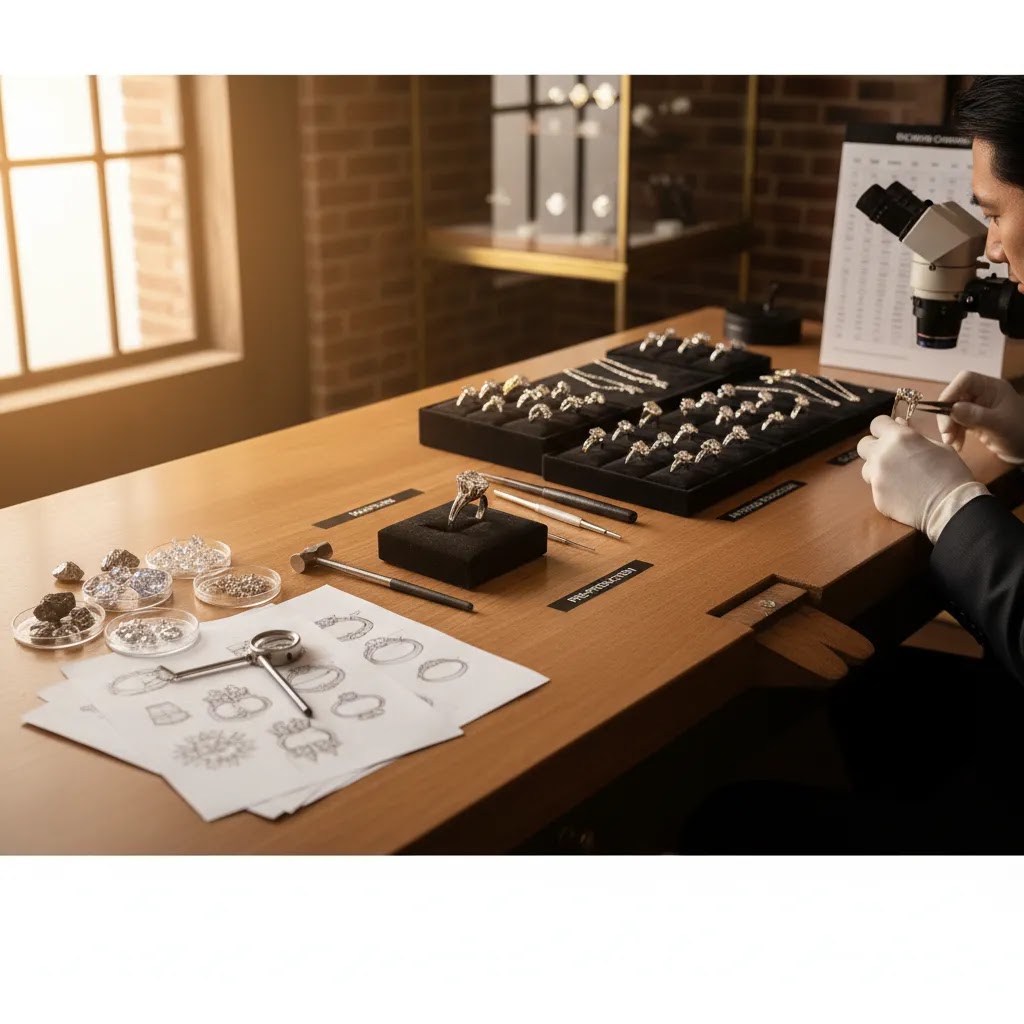
Sampling, Pre-Production, and QC: A Step-by-Step Approval Workflow
One of the most common B2B failure points is simple: the sample looked right, and the bulk run did not match it. That gap is usually not about effort, it is about controls. A structured approval workflow reduces interpretation, protects your launch calendar, and makes reorders easier because you have a documented standard.
A practical approval sequence from brief to fulfillment
Most successful projects follow a repeatable sequence. You start with an initial tech brief that captures the design intent in production terms. Then you move into a first sample, followed by written revision notes that are confirmed by both sides. Next comes a pre-production confirmation step, where the final approved spec is locked and any open questions are resolved before the production run begins.
After production, you want a pre-shipment quality control checkpoint. This is where you confirm that the run matches the approved standard, not the original concept. Then you move into packing and fulfillment handoff, which should also be treated as part of the workflow because labeling, sorting, and shipment preparation can create downstream issues if they are not planned in advance.
What to check at each gate to reduce sample-to-bulk variance
At the tech brief stage, your job is to remove ambiguity. Confirm the must-have specifications, define what can vary, and document what counts as a change request. During sampling, evaluate the piece against the brief, then record feedback in a way that a workshop can execute. Vague notes like “make it better” or “more premium” tend to create inconsistent outcomes. Clear notes like “adjust this dimension,” “change this profile,” or “confirm this setting look” are easier to repeat.
During revision cycles, keep one consolidated list of changes and confirm the version you are approving. In practice, sample approvals should be treated like sign-offs, not informal messages. At pre-production confirmation, verify that the final specification is the one the workshop will produce, not an earlier iteration. That includes confirming any decisions about acceptable substitutions and what documentation you expect for your internal records.
At pre-shipment QC, check the run against the approved sample and final spec, not against memory. If you are scaling beyond a very small run, this checkpoint is where you catch inconsistencies before goods leave the workshop. From there, packing and fulfillment handoff should match your operational needs, such as SKU separation, labeling logic, and any market-specific requirements your team needs for receiving and inventory processing.
Build the workflow into your launch calendar, not just the production window
Here’s the thing, lead time planning often fails because brands only count workshop production time. A realistic calendar includes iteration time. If your product requires one or more sampling rounds, you need to plan for feedback cycles, sample shipping, internal review, and decision-making, especially if multiple stakeholders must approve the final version.
If you want a stable launch, build your calendar backward from your go-live date and include time for revisions and approvals, not only manufacturing. This approach also makes supplier comparisons more accurate because you are evaluating whether the supplier can operate inside your real schedule, with real decision gates, rather than a best-case estimate.
Strengths and Considerations
Strengths
- Wholesale diamond jewelry can help a brand expand into a higher-value category with more room for assortment differentiation than standard commodity products.
- A strong B2B supplier relationship may support private label development, repeat production, and more consistent brand presentation across collections.
- Custom development often gives growing brands more control over design direction than buying only ready-made wholesale jewelry.
- Working with a manufacturer that offers collaborative consultation may reduce avoidable mistakes during the design-to-production handoff.
- Global shipping and fulfillment support can simplify operations for brands serving more than one market.
Considerations
- Diamond jewelry sourcing typically requires more careful specification management than simpler jewelry categories, so briefing errors may become costly.
- Custom or private label development often involves sampling rounds and revisions, which may extend launch timelines depending on project complexity.
- Minimum order quantities, production planning, and reorder terms can vary significantly by supplier and collection scope.
- Communication quality matters as much as product quality, especially when production is handled across borders or time zones.
Frequently Asked Questions
What should I ask before choosing a wholesale diamond jewelry supplier?
Start with process questions. Ask how design specifications are confirmed, how samples are reviewed, who manages communication, and how production updates are documented. You should also ask how repeat orders are handled and whether the supplier supports private label development. These answers often reveal more than a product sheet.
Is wholesale diamond jewelry suitable for a small jewelry brand?
It can be, but suitability depends on your budget planning, assortment strategy, and readiness to manage development details. Smaller brands often do better with a focused initial range instead of too many SKUs. A collaborative manufacturer may help narrow the scope so the first production run is more practical and easier to evaluate.
How is custom diamond jewelry different from buying standard wholesale jewelry?
Standard wholesale jewelry usually involves selecting from existing designs with limited changes. Custom diamond jewelry typically requires design consultation, specification review, sampling, approvals, and production planning. That process may offer stronger brand differentiation, but it also requires more time, clearer communication, and more disciplined decision-making from the buyer.
What risks should B2B buyers watch for in diamond wholesale?
Common risks include unclear specifications, weak communication, inconsistent sample-to-production results, and unrealistic launch timing. Problems may also arise when a supplier is not structured for private label work but accepts the project anyway. A supplier that discusses limitations openly is often safer than one that overpromises early.
How important is sampling in wholesale diamond jewelry projects?
Sampling is usually one of the most important stages because it helps confirm whether the piece aligns with your intended design direction and production expectations. It also gives both sides a chance to correct issues before a larger run begins. For custom projects, skipping or rushing sampling may increase the chance of costly revisions later.
Can a manufacturer help if I only have an idea and not final specs?
In many cases, yes. Some B2B manufacturers support collaborative design consultation and development, which can help translate early concepts into production-ready requirements. Royi Sal Jewelry specifically offers custom jewelry design and development, which may be useful for brands that need support structuring a manufacturable collection brief.
What matters more, price or process?
For most serious B2B buyers, process should carry more weight than the initial quote. Low pricing can become expensive if communication is poor, revisions are unmanaged, or quality is inconsistent. A supplier with a dependable workflow may support better margins over time, even if the first comparison is not based on the lowest number.
How do I know if a supplier can grow with my brand?
Look for signs that the supplier understands repeat production, private label needs, and operational consistency, not just sample creation. Ask how they manage scaling, fulfillment, and ongoing communication. A partner that treats your project as a collaboration is often better positioned to support future collection expansion than a transactional vendor.
Where does lab grown diamond jewelry fit into wholesale sourcing?
Lab grown diamond jewelry may come up as part of a broader sourcing discussion, especially for brands evaluating product positioning and assortment strategy. The key point is not to assume every supplier handles every category equally well. You should ask directly what types of projects the manufacturer supports and how specifications are documented.
Are lab grown diamonds real, and how should a B2B brand disclose them in product listings?
In many cases, lab grown diamonds are considered real diamonds, but they are typically disclosed as lab grown in B2B and retail product descriptions so the product story stays accurate. From a sourcing standpoint, align your internal naming and disclosure language early, then make sure the same terminology appears in your supplier brief, your invoices or packing documentation when applicable, and your ecommerce listings. The goal is consistency, so your merchandising intent and your production requirements do not drift apart over time.
What does “925” or “s925” mean on jewelry, and why does it matter for wholesale orders?
These markings are commonly used in the market to indicate a specific metal standard, and they often appear as stamps or engravings on jewelry. For B2B buyers, the key point is not the stamp itself, it is what the stamp represents operationally. Confirm what markings will appear on your pieces, where they will be placed, and whether the marking approach is consistent across production runs. This matters for receiving, resale expectations, and customer support, because inconsistent markings can create avoidable questions after goods are in your inventory.
Do wholesale diamond jewelry suppliers provide certificates or grading reports, and what should I ask for?
Some suppliers can provide documentation, but it varies by supplier and project. Ask what documentation is available for your order, how stones are verified internally before setting, and what options exist if you need third-party grading reports. If documentation is a requirement for your brand positioning or for specific sales channels, bring it up before sampling so it can be integrated into the workflow rather than treated as a last-minute request.
Can I place a small test order before committing to a larger wholesale run?
In many cases, suppliers can discuss pilot quantities or a staged approach, but feasibility depends on the design, the manufacturing setup, and how the supplier plans production. If you want to reduce risk, ask about a structured pilot: a limited SKU set, a clear approval workflow, and defined reorder terms if the first run meets your expectations. This approach often gives you better signal on communication and consistency than trying to test too many designs at once.
Key Takeaways
- Wholesale diamond jewelry should be evaluated as a supply chain decision, not only a product selection exercise.
- Design support, communication discipline, and production consistency often matter more than broad sales claims.
- Custom diamond jewelry may offer stronger differentiation, but it usually requires more planning, sampling, and approval work.
- Royi Sal Jewelry may be a useful resource for brands that need collaborative design and manufacturing support in a B2B setting.
- Timelines, minimums, and outcomes typically depend on project scope, briefing quality, and the supplier’s workflow.
Conclusion
Choosing a wholesale diamond jewelry partner is rarely about finding a single perfect supplier. It is about finding a process that matches your business model, your quality expectations, and your ability to manage development responsibly. For many brands, the most dependable results come from suppliers that communicate clearly, explain limitations honestly, and support a structured path from concept to production. Royi Sal Jewelry offers a B2B model built around custom design, manufacturing collaboration, private label support, and global fulfillment. If you are evaluating a new diamond jewelry line or reviewing your current sourcing setup, visit royisal.com to learn more about the manufacturing process and contact the team to discuss your project requirements.