

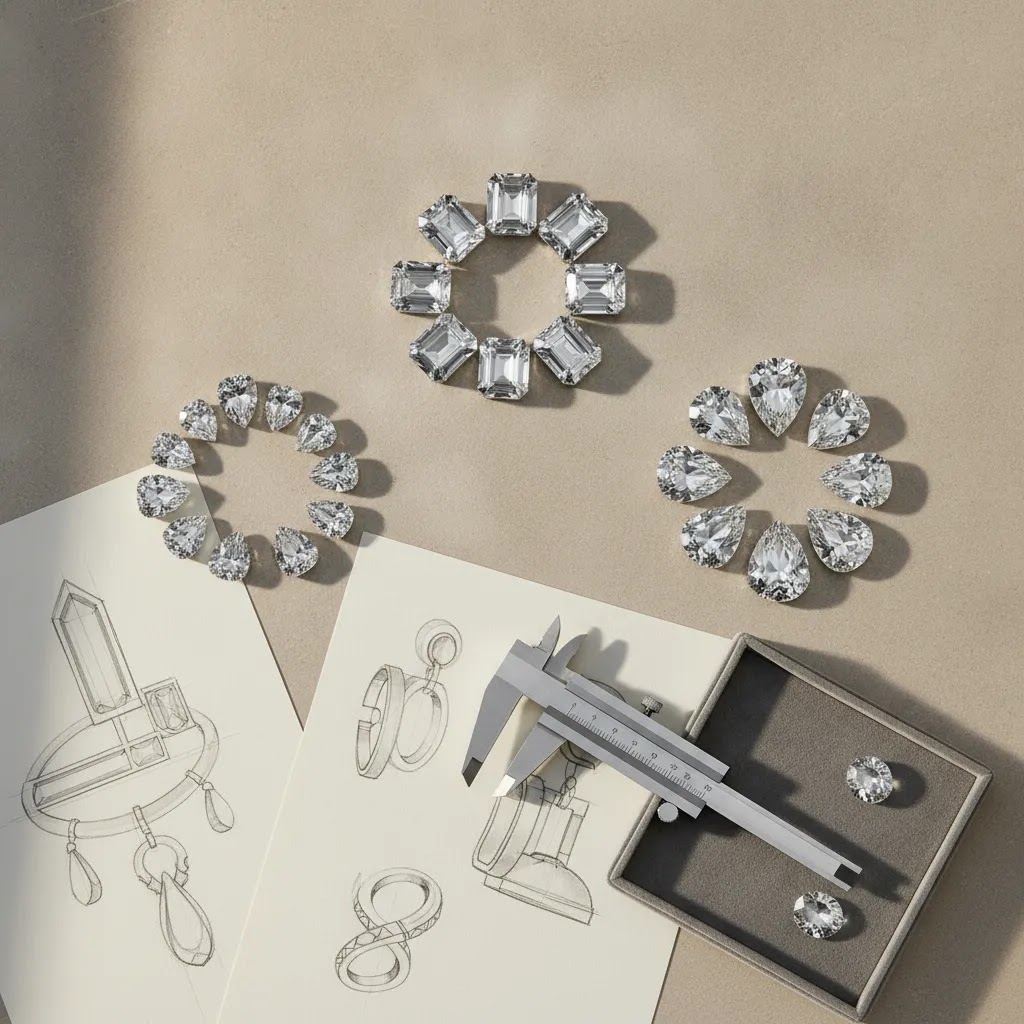
What This Choice Actually Means for a Jewelry Brand
A brand founder may ask whether moissanite or diamond is the right choice for the next jewelry design. However, the commercial issue goes deeper. You are choosing a product category with its own rules for naming, merchandising, buyer education, and margin planning.
Moissanite may appeal when your collection needs a distinct stone category that your team can present clearly and consistently. Diamond, including lab diamond where suitable for the line, may fit better when your assortment depends on category familiarity or a more traditional product story. However, neither route works well if the positioning stays vague.
In many cases, confusion starts when a brand treats these options as interchangeable. They may look close in some design concepts, but they do not always work the same way commercially. If your team is still shaping product visuals, a structured 3d jewelry design program process may help you test proportions, style direction, and collection consistency before sampling.
How Brands Make the Moissanite Diamond Right Choice
The most reliable selection process starts with the collection brief, not the stone alone. First, a manufacturer or development partner needs to understand the intended category, target buyer, assortment role, and expected production path.
1. Start with the collection role
Ask whether the design will serve as an anchor SKU, a brand-entry style, a bridal-inspired item, or part of a broader capsule. A hero product may justify a different stone choice than a style built to widen assortment breadth.
2. Define moissanite diamond right choice selling language early
Your team should know exactly how it will describe the product across wholesale linesheets, product pages, and retail training. If your messaging may drift, treat that as a warning sign before production begins.
3. Match the stone category to the design intent
Some concepts depend on category identity. Others rely on silhouette, sparkle profile, or price ladder planning. In practice, the right answer depends on which of those matters most in the collection.
4. Review development complexity
Custom work may involve CAD review, sample revisions, and repeated approvals. If you are exploring a stone-forward line, custom moissanite jewelry development may be useful to study because it shows how category-specific planning can shape the finished assortment.
Key attributes to assess before approval:
- Category clarity for your sales channels
- Fit with your current assortment architecture
- How much explanation the product needs at point of sale
- Sampling and revision tolerance within your launch schedule
- Potential for consistent reorders and future line extension
Why This Decision Affects More Than Stone Appearance

The moissanite versus diamond decision can shape whether your line feels deliberate or patched together. Wholesale buyers often respond well to assortments with a clear internal logic. If one collection mixes categories without a clean reason, reorder confidence may weaken.
This choice also influences internal operations. Your product team, marketing team, and retail partners need consistent naming and a stable story. Otherwise, returns, objections, or sales hesitation may increase.
For private label and custom development, the selection may also affect how the manufacturer reads your brief. A precise category decision usually reduces ambiguity in approvals. As a result, custom projects can move with fewer revision rounds and clearer expectations during sampling and production planning.
Moissanite vs Diamond vs Lab Diamond
Many emerging brands blur these terms too early in the product planning stage. As a result, design evaluation becomes harder than it needs to be.
Moissanite
Moissanite is its own stone category. For a brand, it can function as a deliberate assortment choice rather than a substitute narrative. That distinction matters in sales training and collection storytelling.
Diamond
Diamond carries strong market recognition. In business terms, that may reduce explanation at the point of sale. However, it may also raise expectations around positioning, documentation, and product comparison across your line.
Lab diamond
Lab diamond belongs in the diamond category, not the moissanite category. A brand that treats them as near-synonyms risks avoidable confusion in merchandising. If your team needs an entry-level educational resource for category framing, diamond rings vs moissanite can help establish the baseline difference before you move into collection planning.
| Stone option | Category position stated in this article | Commercial note stated in this article |
|---|---|---|
| Moissanite | Its own stone category | Can support a distinct product story and clear category separation |
| Diamond | Diamond category | Often brings market recognition and a more traditional product story |
| Lab diamond | Belongs in the diamond category | Should not be merchandised as the same category as moissanite |
Glossary
- Private label: Jewelry produced by a manufacturer for sale under your brand.
- Sampling: The pre-production stage where a design is reviewed and adjusted before a full production run.
- Production run: The approved batch manufactured after design and sample sign-off.
- Assortment architecture: The way products are structured across categories, price points, and merchandising roles.
Answering Common Objections: “Is Moissanite Real or Fake?”
In wholesale and merchandising, “real” rarely means what a shopper thinks it means. Retail conversations often use “real” as a proxy for “diamond.” As a result, category confusion can start before your product even gets tried on.
The clean way to handle this issue is to keep the language specific. Moissanite is a distinct gemstone category, and your team should present it that way. A moissanite SKU becomes risky when a brand positions it as a “fake diamond” or describes it in a way that implies it is diamond.
Use precise category language
For your business, the risk is not only reputational. It is also operational. Ambiguous product naming can lead to mismatched expectations, returns, or wholesale pushback if staff feels unsure about what they are selling.
It can also create avoidable compliance issues on marketplaces and ad platforms that are sensitive to misleading category claims. If you decide moissanite is part of your assortment, keep the language consistent across line sheets, purchase orders, product data, product pages, and training materials. For category standards and accepted terminology, the Gemological Institute of America is a widely recognized reference.
Build a repeatable naming framework
Standardize a naming framework your team can repeat without improvising. Many brands keep it simple and literal: “Moissanite” as the stone category, then the style descriptor. If you carry more than one stone category in adjacent designs, avoid hybrid labels that combine category terms in a single product name.
Keep “diamond” language reserved for diamond category SKUs. In addition, build separate templates for moissanite copy so your team does not borrow phrasing that creates unintended equivalency.
Train staff before launch
Staff training should follow the same discipline. Write a short internal script that answers the question directly and then redirects to what you want the customer to evaluate: the design, the look on the hand, and the category story you are actually selling.
If your wholesale accounts receive training materials, include a one-paragraph positioning note that explains what the stone is, how your brand names it, and which comparisons staff should avoid. That small investment can reduce inconsistent sales talk across locations and channels. For broader disclosure guidance in advertising, the FTC Jewelry Guides also provide a useful compliance reference.
Where Each Option Tends to Work Best
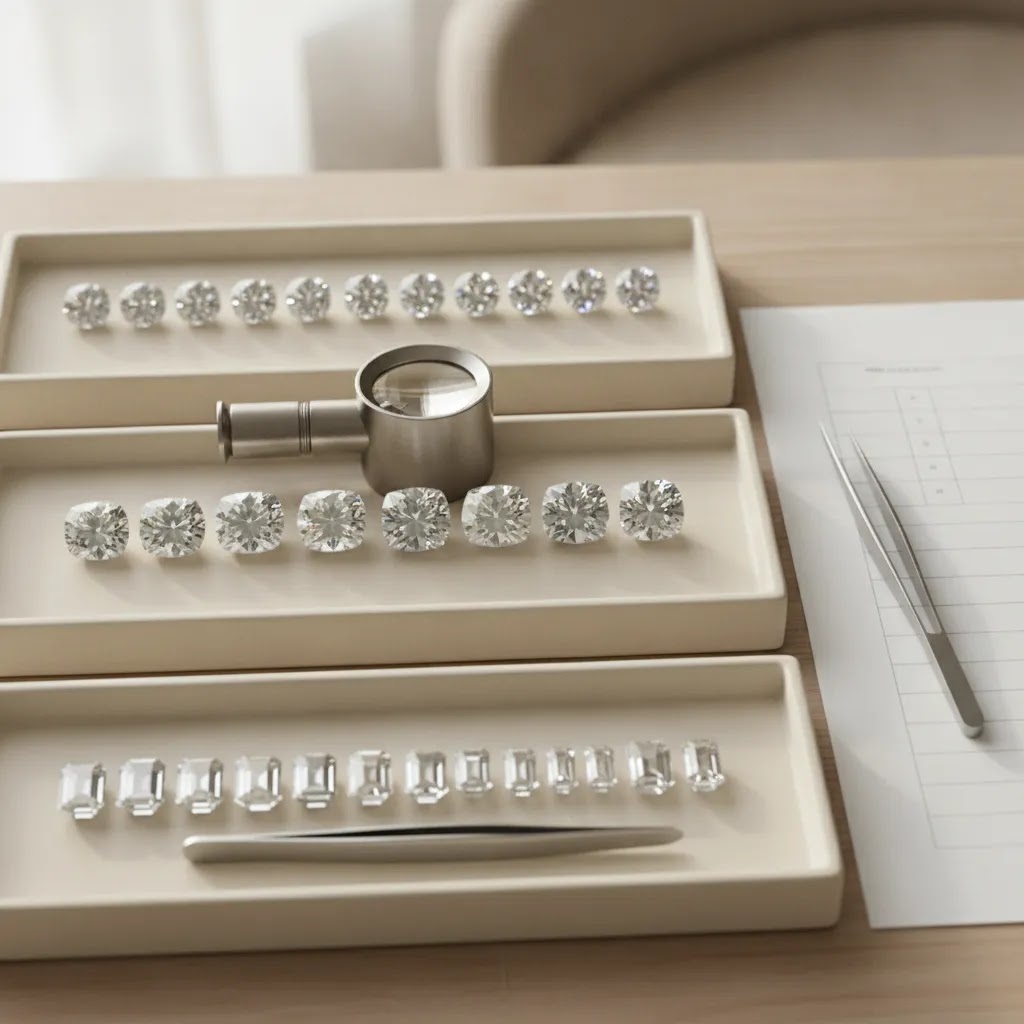
Moissanite often fits brands that want a clearly defined stone category with room for distinctive product storytelling. It may also suit collections where the goal is to offer visual impact while keeping category messaging separate from diamond.
Diamond, including lab diamond where appropriate to the line, may work better for brands that rely on category familiarity, bridal-adjacent demand, or traditional product naming conventions. However, the commercial advantage is not automatic. It depends on whether your target accounts and end market already understand how the product fits.
If you are building a mixed assortment, separation matters. In many cases, the cleanest approach is to group product families intentionally rather than blending moissanite and diamond concepts without a channel-specific reason.
Moissanite vs Diamond vs Cubic Zirconia: Why Buyers Confuse Them, and How Brands Prevent It
At retail, many shoppers and even some sales associates group multiple “diamond alternative” options into one mental bucket. That is not only a product education problem. It is also a merchandising and expectation problem.
If a customer hears “alternative” and sees sparkle, they may assume similar performance, category story, and pricing logic across stones that brands and suppliers manage very differently. Cubic zirconia is one of the most common reference points in these conversations because it is widely known and often used as a baseline for “simulant” language.
If your brand is selling moissanite, you do not want the product introduced in a way that triggers a cubic zirconia expectation. If your brand sells both moissanite and cubic zirconia across an entry price ladder, you need a plan for how the two sit next to each other without collapsing into one generic category in the customer’s mind.
The simplest prevention strategy is assortment separation paired with disciplined naming. Keep moissanite and cubic zirconia in different product families, different collection pages, or different sections of a line sheet, even when the silhouettes are similar.
If you sell through wholesale accounts, provide a channel-ready category map that shows where each stone option belongs in the assortment and what the intended selling language is. That helps buyers place the product confidently. It also helps store teams avoid substituting their own terminology.
In your internal product spec, include a short “category identity” field, not just measurements and style details. That field should state the intended stone category name, the approved shorthand your staff can use, and the disallowed phrasing that causes the most confusion. This becomes more important as you scale because the first person to write a product description is rarely the last person to reuse it across channels.
A Practical Manufacturing Resource
For brands evaluating the next stage of custom development, Royi Sal Jewelry offers a B2B model centered on jewelry manufacturing, collaborative design consultation, custom jewelry design and development, and global shipping support. The company is led by Royi Gal, whose background as both a designer and manufacturer supports a process-minded approach to product development.
That combination may be especially useful if your business is still translating a concept into a manufacturable brief. Instead of treating custom work like a retail purchase, the process is framed as a partnership with room for review, refinement, and production planning. If you are comparing stone directions within a broader product line, you can also explore the gemstones & moissanite category to map related topics before starting a project discussion.
How to Evaluate the Right Option for Your Next Design
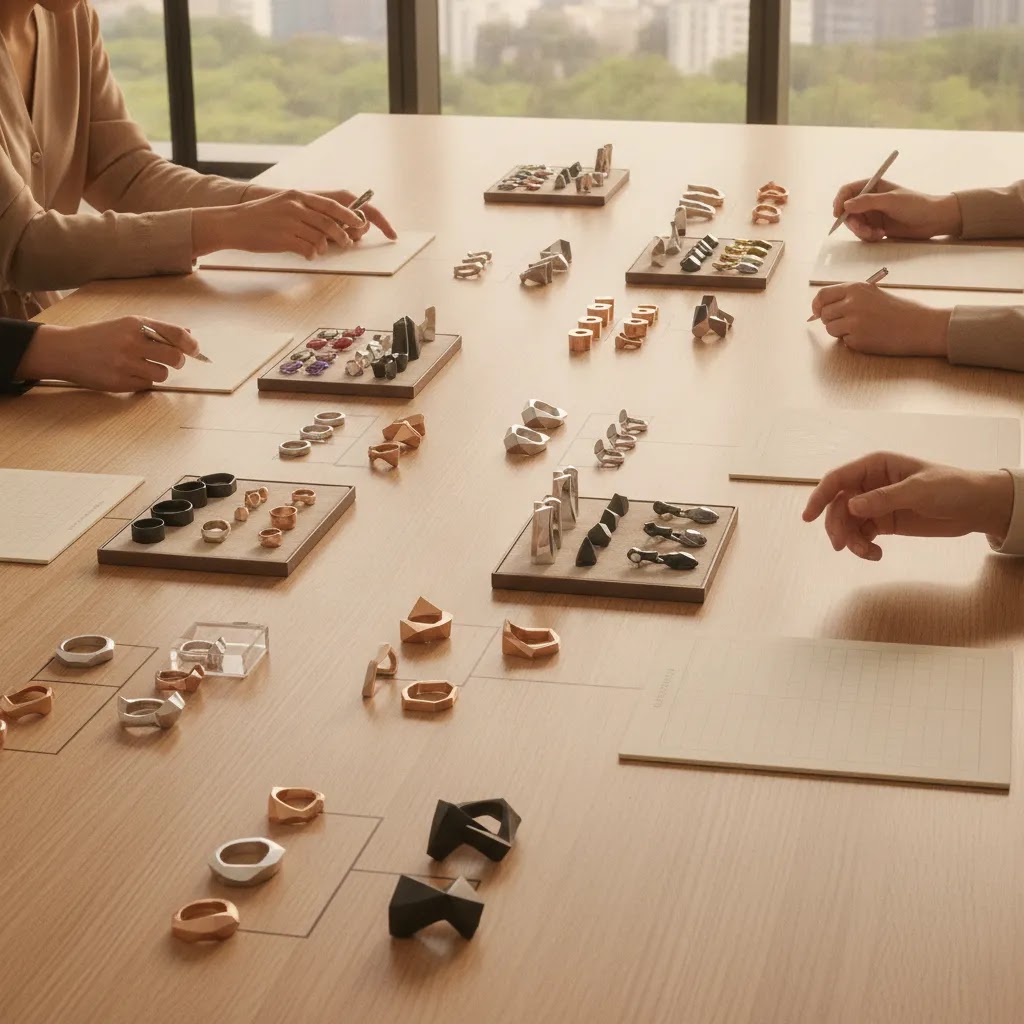
A useful evaluation framework should connect the stone decision to the way your business actually sells, sources, and scales.
Design fit
Look at how the stone category supports the visual identity of the collection. If the product concept depends on a classic category signal, diamond may align more naturally. If the line is built around distinctive presentation and clear differentiation, moissanite may be a better strategic fit.
Communication burden
Some products need very little explanation. Others require staff training, strong copy, and disciplined naming. If your retail partners or internal team may struggle to explain category differences, choose the option that your business can present consistently.
Manufacturing workflow
Custom jewelry projects usually move through briefing, design development, sample review, revision, and production approval. A category decision that is unclear in the brief can slow multiple stages. Therefore, clearer direction may shorten revision loops and reduce misalignment during development.
Reorder logic
Ask whether the design can become part of a stable family of products. A one-off concept may create operational friction if it does not connect to future SKUs. The stronger option is often the one that can support repeatable extensions such as matching silhouettes, coordinated drops, or future updates.
Wholesale readiness
For boutique owners and brand managers selling to accounts, product clarity matters. Buyers often need to understand where the item sits in the assortment without a long explanation. The right stone choice may be the one that helps a buyer grasp the category quickly and place it with confidence.
If you want to formalize this review process, the jewelry manufacturing process concept creation guide can help connect concept planning to production decisions. You may also review ethical diamond sourcing if your assortment discussion includes diamond or lab diamond positioning.
Moissanite Diamond Right Choice Strengths and Considerations
Strengths
- A deliberate moissanite or diamond choice can strengthen collection identity and reduce mixed messaging.
- Clear stone-category planning may improve communication between brand, manufacturer, and sales channels.
- The decision can support cleaner assortment architecture, especially for private label or wholesale lines.
- Early clarity often helps custom development stay more organized through sampling and approval.
- A defined category strategy may make future reorders and collection extensions easier to plan.
Considerations
- Custom development still requires revision time, and a clear category choice does not remove sampling complexity.
- Wholesale teams may need training if your assortment includes multiple adjacent stone categories.
- Launch timing could be affected if the original brief leaves too much room for interpretation.
- A stone choice that looks strong in isolation may not fit the rest of the collection commercially.
Value Retention and Buyback Questions: How to Handle “Is Moissanite Worth Anything?”
This question shows up often because shoppers are used to treating certain jewelry categories like an “asset” conversation. For a brand, that framing can create trouble, especially if your product is positioned as fashion-forward, design-led, or giftable rather than investment-driven.
The safest approach is to treat value as a combination of category transparency, design, craftsmanship, and customer experience, not a promise about resale outcomes. Sales teams need a consistent way to respond without sounding defensive.
The response can be straightforward: moissanite is a defined stone category, the piece is priced and positioned within that category, and the value proposition is the design and wear experience. If the conversation drifts into buyback or resale, redirect to what your brand can actually control, such as category clarity, after-sale support, and the product’s role in the customer’s wardrobe.
Avoid language that suggests guaranteed future value. Also avoid implying equivalency to diamond markets if your SKU is not in the diamond category.
Before launch, decide internally how you want to handle “upgrade” and “trade-in” conversations, even if you do not offer a program. Retail partners and customers will ask, and inconsistent answers create friction.
Align on return policy implications, especially for customized orders, and decide what documentation or product details your team will provide so that buyers feel informed at purchase. A clear internal policy often reduces escalations later because the customer experience matches the merchandising story from the start.
Frequently Asked Questions
Is moissanite or diamond usually the better choice for a new jewelry brand?
There is no universal answer. The better option depends on your assortment strategy, target accounts, and how clearly your team can present the category. A new brand often benefits more from clarity than from chasing a category it cannot explain consistently. The strongest choice is usually the one that fits your product story and reorder plan.
Should a private label collection mix moissanite and diamond in the same launch?
It may, but only if the collection structure is deliberate. If the two categories are mixed without a clear merchandising logic, buyers may struggle to understand the line. Many brands do better when product families are separated by category, purpose, or target customer profile rather than blended loosely in one launch.
Does this decision affect the custom design process?
Yes, it often does. Stone category choices can influence briefing clarity, sample review expectations, and how the final collection is positioned. In custom work, uncertainty at the concept stage may create extra revision rounds later. A manufacturer typically works more efficiently when the category direction is defined before development moves forward.
Is lab diamond the same category as moissanite for merchandising purposes?
No. Lab diamond belongs in the diamond category, while moissanite is a separate category. Treating them as interchangeable can create confusion in sales materials and product education. For business planning, it is usually better to decide whether your line is using diamond naming, moissanite naming, or a structured mix with clear separation.
How can a brand test the right option before committing to production?
Most brands benefit from structured development steps such as concept refinement, CAD review, sample evaluation, and internal merchandising review. Those stages may reveal whether the product works in the broader assortment. Testing should focus on category clarity, line consistency, and whether the design still makes sense once sales and production teams review it together.
What is the biggest commercial risk in this decision?
One major risk is unclear positioning. A product may look attractive, yet still be difficult to sell if its category story is inconsistent across channels. That can affect buyer confidence, internal training, and future reorders. The risk is usually not the stone itself, but the lack of a disciplined plan for how the category will be presented.
Can a manufacturer help shape the decision, or should the brand decide alone?
A good manufacturing partner may help you pressure-test the decision against design practicality, development workflow, and collection structure. The final commercial call remains yours, but informed feedback can reduce preventable errors. This is especially useful for younger brands that are still building systems for briefs, approvals, and line planning.
Why does collection architecture matter so much here?
Because the stone decision rarely stands alone. It affects naming, product grouping, launch sequencing, and future SKU expansion. If the design does not connect logically to the rest of your assortment, it may become harder to merchandise or reorder. Strong collection architecture usually supports stronger wholesale conversations and cleaner internal planning.
Why don’t jewelers like moissanite?
Some jewelers and retail teams are cautious because moissanite can create category confusion if it is sold with unclear language, or if it is treated as interchangeable with diamond. For a brand, this is a training and merchandising issue more than a stone issue. If your wholesale materials name the category clearly, avoid diamond-implying phrasing, and give store teams a simple way to explain the product, moissanite can sit in an assortment without ongoing friction.
Is moissanite the next best thing to a diamond?
That phrasing tends to create more problems than it solves because it frames moissanite as a ranking under diamond rather than as its own category choice. In B2B terms, the better question is whether moissanite fits the role you need it to play in your assortment. If your brand story, product naming, and channel education are built around moissanite as a defined category, it can perform well commercially without relying on “next best” language.
Do wealthy people wear moissanite?
Customers with different budgets wear different categories for different reasons, and your brand does not need to stereotype the buyer to sell the product well. What matters commercially is whether your assortment is positioned with clarity and confidence. If your product is designed well, priced consistently within its category, and explained transparently, it can be worn by customers across a range of income levels without the conversation turning into status signaling.
Is a moissanite diamond real or fake?
Moissanite is a real stone category, and diamond is a separate category. The phrase “moissanite diamond” tends to create confusion because it blends two different category names into one. For a brand, the clean approach is to name the product by its actual stone category and train sales teams to avoid suggesting it is diamond. Clear naming reduces misunderstandings and helps wholesale accounts present the product consistently.
Key Takeaways
- Choosing between moissanite, diamond, and lab diamond is a business decision, not only a visual one.
- The strongest option is usually the category your team can position, explain, and scale consistently.
- Clear briefing may reduce confusion during custom design development and sample approvals.
- Diamond, lab diamond, and moissanite should be treated as distinct merchandising categories.
- A collaborative manufacturing partner can help test whether the concept works beyond the sketch stage.
Conclusion
The right stone choice for your next design should support the way your business actually operates, not just the way a concept looks on paper. If the product needs to sit inside a larger assortment, sell through wholesale channels, and hold up through custom development, clarity matters more than shortcuts. Royi Sal Jewelry approaches custom jewelry design and manufacturing as a collaborative B2B process led by founder Royi Gal’s designer-manufacturer perspective. If you are weighing moissanite, diamond, or lab diamond direction for an upcoming collection, visit royisal.com to review the process and contact the team to discuss your custom jewelry brief.