
Why B2B Customers in Europe Prioritize Transparency in Jewelry Production


Why Transparency Carries Commercial Value
European B2B buyers often work in tighter margin environments than new founders expect. A missed launch window, an approval misunderstanding, or an unclear production update can affect retail delivery dates, campaign planning, and reorders. Transparency helps reduce those risks because it gives your team usable information early enough to act on it.
In jewelry, transparency is rarely about one single document. It usually shows up as a pattern: clear communication during quotation, realistic discussion of sampling, version control on design files, defined approval steps, and candid updates if a project changes shape. Buyers in jewelry sourcing roles may place high value on this because they are responsible not only for buying product, but also for protecting timelines, internal budgets, and brand reputation.
This becomes even more relevant when production is outsourced across borders. Teams comparing a bangkok jewelry factory, a regional supplier network, or another overseas partner are often evaluating more than manufacturing capability. They are testing whether the supplier can explain the process in a way that supports business planning. A factory that communicates well may still face delays or revisions, but a transparent factory is more likely to surface issues early, which gives you room to respond rather than react.
What Transparent Jewelry Production Looks Like in Practice
Transparency sounds attractive, but B2B buyers need observable signals. In many cases, the most useful indicators appear before you place the first order.
- Clear scope definition: The supplier explains what is included in design development, sampling, revisions, production preparation, and fulfillment.
- Visible communication ownership: You know who is handling your account and how feedback should be submitted.
- Realistic production language: The manufacturer does not imply that every design moves directly from idea to finished run without iteration.
- Approval discipline: Sample review, design confirmation, and production sign-off are treated as separate decision points.
- Change disclosure: If a design detail, schedule assumption, or execution step may shift, the supplier flags it instead of burying it.
European buyers comparing options in jewelry manufacturing often ask for this level of visibility because their downstream obligations are strict. A distributor, boutique chain, or private label brand may need to coordinate photography, inventory intake, retail launch sequencing, and sales commitments around production timing. Without transparent process communication, those decisions are built on guesswork.
Material-related expectations also tend to raise transparency demands. If you are reviewing topics such as wholesale gold plated jewelry manufacturers, custom brass jewelry manufacturer options, or 18k gold jewelry ethical sourcing brands, the business issue is often not only the category itself. It is whether the supplier can explain process limitations, sourcing realities, and production implications with enough clarity for a professional buyer to make a sound decision.
Supply Chain Transparency vs Production Transparency (And What You Can Realistically Verify)

“Transparency” can mean two different things in a B2B jewelry conversation, and mixing them up often creates frustration later. One supplier may be excellent at production visibility, while another may be better positioned for supply chain traceability. Both matter, but they are not the same promise.
Production transparency is usually about process visibility. It includes how your brief is interpreted, how approvals are documented, how changes are communicated, and how progress is reported from sampling through manufacturing and fulfillment. This is the transparency that protects timelines and internal coordination because it tells you what is happening, who owns the next step, and what decisions are required from your side.
Supply chain transparency is closer to traceability. It typically refers to where inputs originate, who handled them at each stage, and what documentation exists to support chain-of-custody claims. Depending on the project, this may involve multiple upstream parties. Buyers should not assume that a supplier offering good production updates automatically provides full origin documentation. Those are different record systems, often held by different entities.
You can ask for practical verification steps without turning your sourcing process into a formal compliance audit. A few examples that are realistic in many B2B relationships include requesting a simple documentation flow that explains what records exist at quotation, sampling, and production, whether batches or lots are referenced internally for key inputs, and who owns those records at each stage. Even when full traceability is not available, a supplier’s willingness to explain what they can and cannot verify is itself a transparency signal.
The most important move is to set expectations in writing, early. At quotation, you typically want clarity on what the quote assumes, what is still to be confirmed during sampling, and what will trigger a revision or a requote. During sampling, you want to know what will be documented as the approved reference, for example photos, measurements, or agreed spec notes, so your team can approve a “known standard” rather than a vague concept. Before production begins, you want confirmation of what will be held constant, what tolerances or variation may be expected, and how changes will be handled if something is discovered mid-run. These details protect your launch planning because they reduce surprise decisions after you have already built a calendar around the first ship date.
Strengths and Considerations
Strengths
- Transparent suppliers may help your team forecast launches more accurately because milestones and dependencies are discussed earlier.
- Clear process communication often reduces avoidable revision cycles, especially when multiple stakeholders approve designs.
- Better visibility into sampling and production steps can support cleaner handoffs between buying, design, marketing, and operations teams.
- Transparent production discussions usually make it easier to compare suppliers on real capability rather than sales language alone.
- Honest communication about challenges can strengthen trust over time, which matters if you expect repeat orders or line expansion.
Considerations
- Transparency does not eliminate production risk. Complex projects may still require revisions, longer sampling, or adjusted timelines.
- Some buyers interpret frequent updates as a guarantee of speed, but process visibility and fast turnaround are not the same thing.
- Suppliers with detailed communication standards may expect your team to provide organized briefs, consolidated feedback, and timely approvals.
- More structured approval workflows can feel slower at first, even though they may reduce downstream mistakes.
Transparency That Protects Quality: Where QC Fits Into a Visible Process
Many buyers talk about transparency as a communication preference, but experienced teams treat it as a quality tool. The more visible the process, the earlier you can catch problems that would otherwise show up as surprises at delivery. This does not guarantee defect-free outcomes, but it often improves your ability to manage risk with the supplier instead of discovering issues after everything is already packed.
In practice, you can think about transparency and quality control as connected checkpoints. First is pre-production confirmation. This is where the supplier confirms the approved reference and the production-ready interpretation, which could include the finalized design files, the agreed sample, and any written specs that matter to your brand. Visibility here looks like clear acknowledgement of what is being produced, plus documentation that your team can store internally as the agreed baseline.
Next is in-process checks. Not every supplier runs the same internal routines, but you can still ask what gets checked during production and how the team flags deviations. Visibility at this stage looks like updates that are specific, not generic, and a clear path for decision-making if something is off. Small issues tend to compound. A slight drift in a key dimension, an interpretation change in how a detail is finished, or a silent substitution of “close enough” can become a repeat issue across units if nobody catches it early.
Then there is pre-shipment review. This is your last practical moment to align on expectations before product leaves the facility. Visibility here looks like confirmation of what is being shipped, what the final checks covered, and what exceptions exist if any issues were found and resolved. If your supplier cannot explain how final checks are handled, you have less control over what quality standard the shipment is actually meeting.
Transparency helps catch common failure points earlier, including specification drift between the approved sample and production output, finishing inconsistencies across units, unclear tolerances that lead to “interpretation,” and uncontrolled changes that happen because a detail was not documented as a hard requirement. None of these are rare in custom manufacturing. The difference is whether your partner surfaces them early, explains options clearly, and asks for approval before making decisions that affect your brand.
If you want to evaluate a supplier’s QC communication habits, ask how issues are reported, for example whether you will receive photos, measurements, or written notes, and who is authorized to propose corrective actions. Ask how corrective actions are approved, and whether your approval is required before work continues when a deviation affects the agreed reference. If you expect repeat orders, ask what gets saved from the first run, such as specs, photos, or revision history, so that reorders follow the same standard instead of being treated like a fresh interpretation.
Who Should Care Most About This Issue

Transparency matters to nearly every B2B jewelry buyer, but it becomes especially valuable for businesses operating with narrow launch windows or limited room for inventory mistakes. If you are building a private label collection, entering a new wholesale market, or managing overseas production for the first time, unclear communication may create costs that are harder to absorb.
This issue also matters if your organization has more than one decision-maker. A founder-led brand, fashion label, or retail group often needs design, sourcing, and commercial teams aligned before production begins. Transparent suppliers tend to make that coordination easier because they define the process in terms a buying team can use internally.
A Practical B2B Reference Point
Royi Sal Jewelry is positioned as a custom jewelry design and manufacturing partner for wholesale and private label clients. The company’s service model centers on custom jewelry design and development, jewelry manufacturing, collaborative design consultation, and global shipping and fulfillment. That structure may appeal to B2B buyers who want one partner involved across the project rather than a fragmented handoff between design and production.
The business is led by Royi Gal, whose background as both a jewelry designer and manufacturer supports a more process-aware conversation with clients. For B2B buyers, that matters because transparency is often strongest when the person guiding the project understands both the creative brief and the production realities behind it.
If you are comparing manufacturing partners and want a collaborative discussion rather than a transactional quote exchange, Royi Sal Jewelry may be a useful reference point to explore. You can review the broader manufacturing and design approach at royisal.com and contact the team to discuss how a custom project could be scoped, sampled, and managed based on your business goals.
How to Evaluate Suppliers for Production Transparency
A useful evaluation process usually looks beyond polished presentations. The strongest transparency signals tend to appear in how a supplier handles ordinary project details.
1. Assess communication structure, not just responsiveness
Fast replies are helpful, but they do not always mean the process is clear. Ask how briefs are submitted, who consolidates feedback, how revisions are tracked, and how production updates are communicated. A supplier that answers quickly but vaguely may still create confusion later.
2. Ask how approvals are separated
Design approval, sample approval, and production approval should generally be distinct checkpoints. If those stages are blurred together, responsibility can become unclear once changes arise. European B2B teams often need documented approvals because they must answer to internal stakeholders, retail partners, or distributors.
3. Test how the supplier discusses constraints
One of the best transparency checks is to ask where delays, revisions, or misunderstandings usually happen. A credible manufacturing partner will usually acknowledge complexity rather than pretend every project moves in a straight line. Honest answers here may be more valuable than a perfect sales presentation.
4. Review whether the supplier supports scaling logic
If your brand plans to grow, the supplier should be able to explain how they handle repeat orders, collection extensions, and operational coordination. Transparency is not only about the first order. It is also about whether the relationship can remain manageable as your SKU count or order volume increases.
5. Check alignment between sourcing, design, and fulfillment
Many production problems happen between stages rather than within them. If one team handles design, another handles production, and another manages shipping, ask how those handoffs work. Royi Sal Jewelry presents itself as a collaborative end-to-end partner, which may reduce friction for businesses that want more continuity across development and fulfillment.
Transparency for Brand Protection: Design Ownership, Version Control, and Repeatability
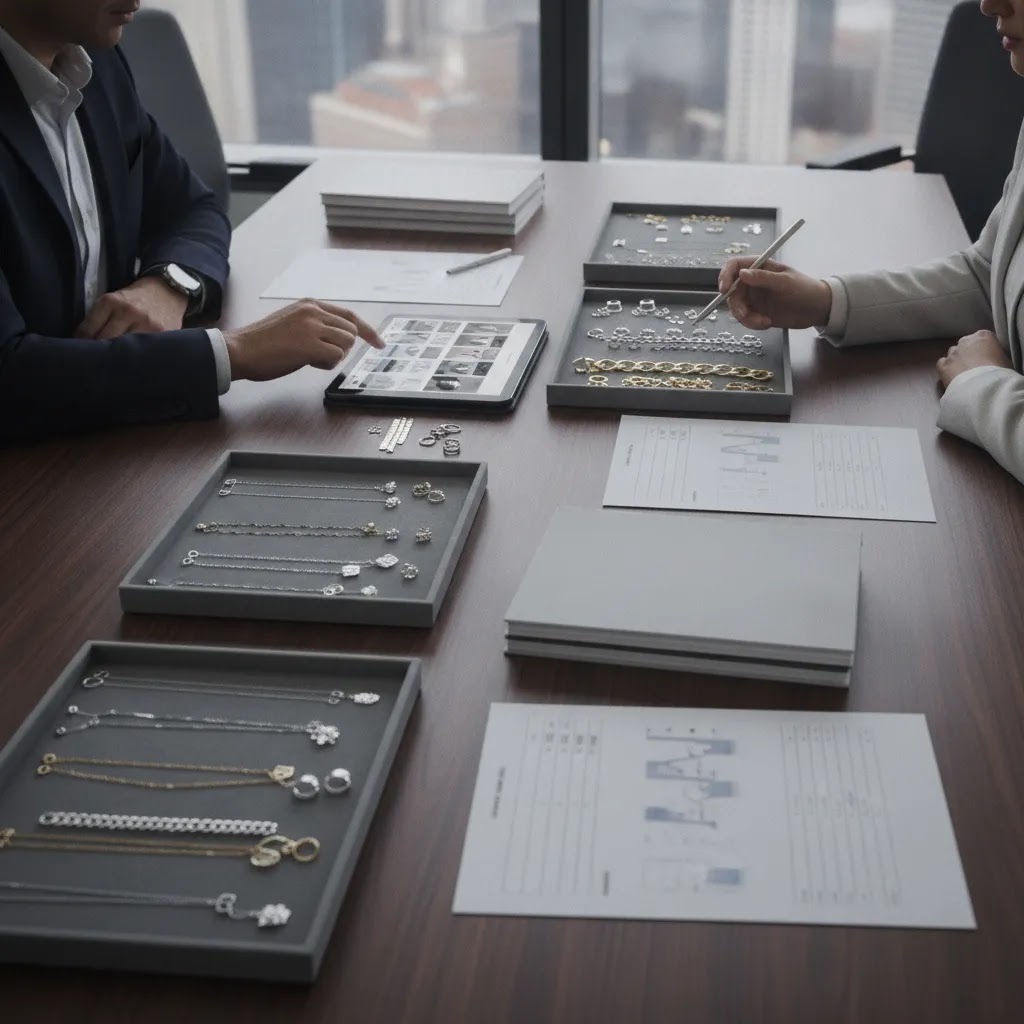
Transparency is also brand protection. If you are building a private label line, the biggest operational risks are often not dramatic. They are quiet risks, like using the wrong file version, losing track of what was approved, or discovering that a “minor adjustment” was never documented and now shows up differently across SKUs.
A transparent partner typically treats design information like a controlled system, not a casual back-and-forth. That means design files are named and stored consistently, revision history is tracked, and approvals are recorded in a way your team can reference later. The goal is simple: a single source of truth that everyone uses, including your internal stakeholders and the supplier’s production team. When this is missing, you can get conflicting interpretations depending on who is answering emails that week.
From a brand protection standpoint, many buyers document expectations that reduce replication and misuse risk. That could include clarifying who has access to your design files, how files are shared, and who is allowed to authorize changes. It also includes setting the rule that any production-affecting change requires explicit written approval, even if the change is presented as an “improvement.” This is not about assuming bad intent. It is about making sure your product identity does not drift because of undocumented decisions.
Transparency becomes even more valuable when you scale. Capacity matters, but repeatability is what keeps a growing assortment profitable. If you plan to extend a collection, reorder best sellers, or run multiple SKUs with shared design language, you need a partner that can reproduce specifications consistently across time. That usually depends on what gets recorded after sampling and the first run, such as approved references, spec notes, and any controlled adjustments. When the relationship is documented well, reorders tend to be simpler to manage because the supplier is not rebuilding the interpretation from memory.
If you are evaluating manufacturing partners, ask how they manage version control, how long approval records are kept, and what documentation is used to keep repeat orders aligned with the original reference. Clear answers here usually indicate that the supplier thinks like a production partner, not only like a vendor shipping a one-time order.
Frequently Asked Questions
Why do European B2B jewelry buyers focus so much on transparency?
Many European buyers work with planned launch calendars, retail delivery commitments, and stricter internal approval processes. Transparent production communication may help them manage risk earlier. They often need visibility into design development, sampling, revisions, and fulfillment planning so that inventory, marketing, and wholesale commitments stay aligned.
Does transparency mean a supplier is automatically better?
No. Transparency is one major evaluation factor, but it should be considered alongside craftsmanship, communication quality, design capability, and operational fit. A supplier may communicate clearly and still not match your brand’s product direction or production needs. The goal is to evaluate the full partnership, not one trait in isolation.
How can I test transparency before placing an order?
You can ask detailed questions about process stages, revision handling, account management, and production updates. Pay attention to whether answers are specific, consistent, and realistic. Early calls and quotations often reveal whether a supplier explains the workflow clearly or leaves too much open to assumption.
Why is transparency especially important in overseas jewelry production?
Overseas manufacturing may involve time-zone gaps, language differences, shipping coordination, and longer decision cycles. If communication is unclear, small misunderstandings can become expensive later in the process. Transparent suppliers usually make it easier to manage approvals and changes before they affect your launch plan or reorder schedule.
Is transparency only relevant for custom jewelry projects?
No. It matters in both custom development and wholesale sourcing. Even if you are buying from an established product category, you still need clarity around order handling, timeline assumptions, fulfillment steps, and any changes that could affect your business. Custom projects simply make the need more visible because there are more moving parts.
What are common warning signs of poor production transparency?
Warning signs may include vague answers on process steps, changing information from different contacts, unclear revision rules, unrealistic timeline language, and no obvious approval structure. Another red flag is a supplier who avoids discussing constraints. In custom manufacturing, credible partners usually explain complexity rather than hide it.
How does Royi Sal Jewelry fit into this discussion?
Royi Sal Jewelry operates as a B2B custom jewelry design and manufacturing company serving wholesale and private label clients. Its positioning emphasizes collaboration, custom development, manufacturing support, and global fulfillment. For buyers prioritizing transparency, that collaborative model may be useful because it frames the relationship as a managed production partnership.
Can transparency help with quality control?
It may help indirectly. Transparency does not guarantee product outcomes, but it often improves decision quality during development. If specifications, approvals, and changes are documented clearly, there is usually less room for preventable confusion. That can support stronger quality consistency across sampling, production preparation, and reorder planning.
What is B2B in jewelry?
B2B in jewelry means business-to-business buying and selling. Instead of selling directly to the end customer, you are sourcing or manufacturing jewelry for a business purpose, such as stocking a retail store, building a private label collection, supplying a wholesale program, or supporting a fashion brand’s assortment. Because the buyer is a business, the priorities tend to include consistency, documentation, repeatability, lead times, and how reliably a supplier supports ongoing orders.
Which European country is famous for jewelry?
Several European countries are well known for jewelry, typically because of long-standing craft traditions, design houses, and manufacturing ecosystems. The best answer depends on what you mean by “famous,” whether it is heritage craftsmanship, contemporary design influence, or established production capacity. As a B2B buyer, it is usually more useful to evaluate specific suppliers and production partners than to rely on country reputation alone.
What countries are best for jewelry making?
There is no single best country for jewelry making for every business model. Different countries and regions may be strong in different areas, such as design development support, manufacturing infrastructure, production scale, or specialized techniques. Your best fit depends on your product category, the level of customization, your target price positioning, minimum order requirements, and how much process visibility you need. Many experienced buyers shortlist partners based on proven capability and communication standards, then validate fit through sampling and documented approvals.
What demographic buys the most jewelry?
This can vary by market, category, and price tier, and it also changes over time. From a B2B perspective, what matters more than any single demographic is how well your assortment matches your specific customer base and channel, for example boutique retail, online brand, or wholesale distribution. If your supplier is transparent about development and production, it is typically easier to test, refine, and reorder winning products as you learn what performs best for your audience.
Key Takeaways
- European B2B jewelry buyers often prioritize transparency because it supports planning, accountability, and margin protection.
- Transparent production usually shows up through clear scope definition, structured approvals, realistic communication, and early disclosure of issues.
- Process visibility does not remove manufacturing risk, but it may reduce avoidable mistakes and improve internal coordination.
- Royi Sal Jewelry presents a collaborative custom design and manufacturing model that may suit brands looking for an end-to-end B2B partner.
- Supplier evaluation should cover communication structure, approval flow, operational honesty, and scalability, not just quoted capability.
Conclusion
Transparency in jewelry production is not a soft preference. For many European B2B buyers, it is a commercial safeguard. It helps teams plan launches, manage internal approvals, reduce preventable revision costs, and build supplier relationships that can support growth over time. If you are evaluating manufacturing partners, look closely at how they explain process, handle change, and define responsibility across design, sampling, production, and fulfillment. Royi Sal Jewelry offers a collaborative B2B model built around custom design, manufacturing, and ongoing client communication. If you want to explore how your collection could be developed through a more structured partnership, visit royisal.com or contact the team to discuss your project requirements.