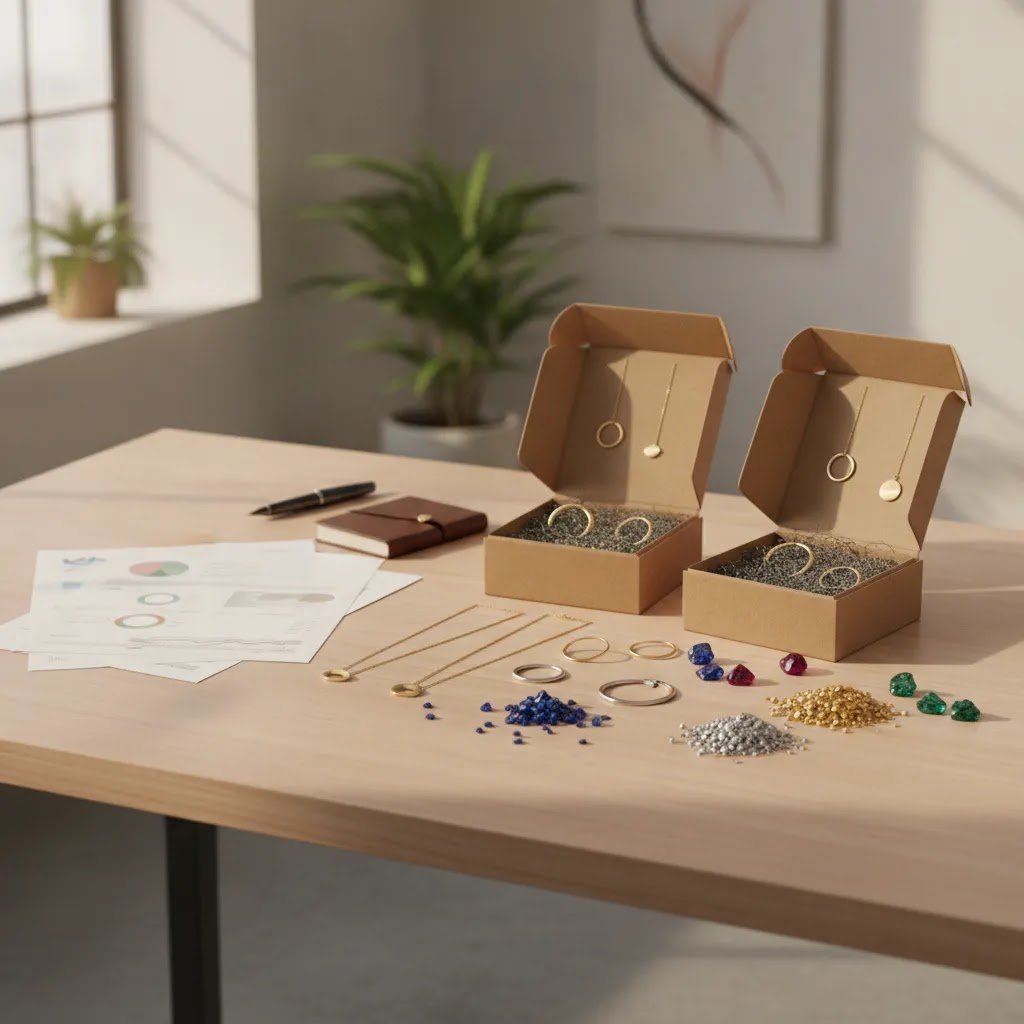
What Sustainable OEM Jewelry Really Means for a Brand
Sustainable OEM jewelry usually refers to custom or private label manufacturing where a brand wants environmental or ethical considerations reflected in product development, sourcing language, production planning, or packaging decisions. In practice, the term can mean very different things from one supplier to another.
Some manufacturers may use the word sustainable to describe a narrower sourcing choice. Others may use it to describe a broader production approach that includes documentation, supplier coordination, and tighter claim control. For a buyer, that difference matters. A vague sustainability promise may create downstream problems if your team later needs support for wholesale presentations, retailer questions, or internal compliance review.
OEM projects also add another layer of complexity because the product is being made to your brand brief rather than selected from a ready-made catalog. That means design files, sample approvals, specification alignment, and revision history all affect whether the final product supports the claim you want to make. If your team is still building a foundational understanding of sustainable jewelry brands, it helps to separate brand messaging from manufacturing proof before supplier selection begins.
For many growing labels, the real goal is not to appear perfect. It is to work with a manufacturer that communicates clearly, flags limitations early, and helps prevent unsupported statements from entering your assortment plan.
What “Sustainable” Claims Typically Require in OEM (and How to Validate Them)
In OEM development, the word sustainable is often used as a shortcut for several different claim categories. If you do not separate those categories early, you can end up with marketing language that is difficult to defend once wholesale buyers, retailers, or internal reviewers ask what the claim actually covers.
In many B2B jewelry programs, sustainability claims tend to fall into a few common buckets. Some are sourcing-related, meaning the claim is tied to how certain inputs are selected and documented. Others are production-related, meaning the claim is tied to how manufacturing is managed, such as process controls, waste reduction efforts, or traceability practices. Packaging-related claims are also common, but they often live outside the core product spec, which increases the risk of inconsistency at scale. Then there is process transparency, which is less about a single claim and more about whether your supplier can consistently show you what changed, when it changed, and who approved it.
Validation usually starts with a simple question: what proof can the supplier provide repeatedly, not only once, and not only during sampling. Depending on the project, buyers may request supplier declarations, purchase or batch records, basic traceability notes, process documentation, or other forms of support that can be referenced later if a retailer asks for clarification. The goal is not paperwork for its own sake. The goal is to make sure your internal product copy matches what the OEM workflow can actually maintain through production and reorders.
Your marketing team may want broad language, but your factory can only control what is defined in the spec and what is confirmed in writing during development. A practical approach is to draft claim language in tiers, starting with what you can substantiate with the least friction, then building upward only if your supplier can support the added specificity. That also makes it easier to keep wholesale decks, line sheets, and retailer FAQs aligned with the same boundaries.
Red flags are often visible early if you know what to look for. Watch for vague references to certifications without clear scope, a “trust us” approach instead of clear documentation, missing revision history on specs or samples, and unclear visibility into upstream suppliers when your claim requires it. A reliable OEM partner does not need to claim perfection. They need to explain what they can support, how they track it, and what happens when conditions change.
Five Checks Before You Approve a Supplier
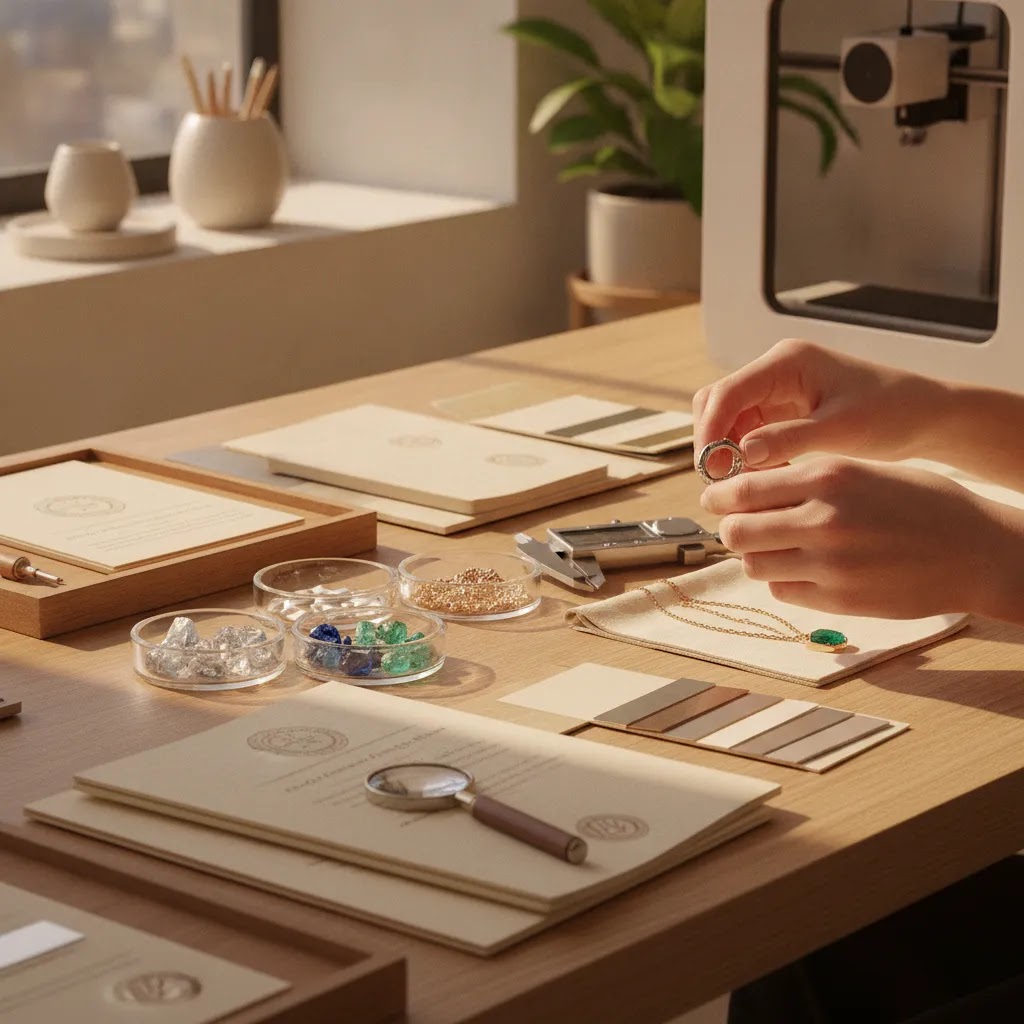
A focused evaluation process may save substantial time later in development. These five checks are especially useful for private label founders, boutique owners, and brand managers reviewing sustainable OEM jewelry options.
1. Claim clarity
Ask the supplier what sustainability-related claims they can actually support within the scope of your project. General marketing language is not enough. You need to know what the supplier can explain consistently in product development, order approval, and reorders.
2. Design control
Sustainable positioning does not replace the need for accurate product development. If your concept requires custom shapes, construction details, or brand-specific adjustments, the manufacturer should be able to work through a structured design process. Foundational knowledge of 3d jewelry design often helps brands understand how a concept becomes a production-ready item.
3. Documentation discipline
A credible supplier should be able to explain how project specs, revisions, approvals, and production references are managed. That does not guarantee every sustainability objective will be easy to achieve, but it does reduce the chance of confusion between development stages.
4. Communication under uncertainty
Many sustainability-related decisions involve limitations, substitutions, or changing availability. Strong communication matters most when the answer is not simple. Suppliers that explain constraints early are often easier to work with than suppliers that promise broad flexibility but clarify details too late.
5. Reorder consistency
One successful sample is not the same as a stable manufacturing relationship. Ask how the supplier handles repeat production, spec control, and order continuity. This is especially relevant if your sustainability story depends on consistency across multiple launches or wholesale seasons. You may also want to review broader sourcing considerations around sustainable jewelry brands ethical sourcing before approving final messaging.
How Sustainability Affects the OEM Workflow
Sustainable OEM jewelry is often discussed as a sourcing topic, but the workflow impact starts much earlier. It begins at brief stage, where your team needs to define which sustainability requirements are mandatory, which are preferred, and which are still exploratory. If everything is labeled essential, the project may become harder to manage and slower to approve.
Next comes design translation. In OEM manufacturing, custom concepts usually need technical interpretation before sampling. That is one reason many brands review 3d jewelry modeling as part of the development conversation. Clear digital development can help reduce avoidable revisions and may improve alignment between concept intent and sample review.
Sampling is another pressure point. If the project includes sustainability-sensitive requirements, sample feedback may need more internal review than a standard fashion assortment. Brand teams sometimes need extra time for claim checks, packaging alignment, or wholesale positioning review before sign-off.
Production planning follows. A supplier may be able to manufacture the product, but your team still needs confidence that repeat orders can be handled with the same level of clarity. That is where process maturity becomes more important than broad promises.
For readers comparing supplier models, a discussion of the role of an oem jewelry manufacturer can help clarify how responsibility is typically shared between the brand and the factory during development and production.
OEM-Specific Sustainability Risk Controls (Quality, Reorders, and Change Management)
Sustainability-sensitive requirements can fail quietly, not because a supplier is acting in bad faith, but because OEM production changes over time. If you want your claim language to survive scale, you need controls that keep the approved product definition stable across production runs and across seasons.
Start with spec lock. Once a sample is approved, the spec should be treated as the single source of truth for production, and it should be clear which version is approved. Approved reference samples should be labeled, stored, and used consistently as the physical benchmark for future production. This is not only about aesthetics. It is about keeping your product description and sustainability messaging tied to a stable, approved definition.
Revision control is the next layer. In practice, a structured project has a revision history that shows what changed, why it changed, and who approved it. That matters for sustainable OEM jewelry because a small change can create a large messaging problem if your brand continues using language written for an older version. A simple change log can prevent that mismatch and makes internal handoffs easier between design, sourcing, marketing, and wholesale teams.
Change management, it helps to have a basic playbook before something shifts. Availability changes, substitutions get proposed, packaging options shift, or a construction detail needs adjustment for manufacturability. The disciplined approach is to pause, document the proposed change, assess whether it affects claim language, and approve it in writing before production proceeds. If the change impacts what you can credibly say, the safest move is to update your copy and sales materials to match the new approved spec, not to stretch the old claim to fit the new reality.
Quality control touchpoints also intersect with sustainability messaging, even if you avoid material-specific promises. Incoming checks can verify that what arrives matches the approved documentation for the run. In-process checks help catch drift before it becomes a full-batch issue. Pre-shipment checks help confirm that finishing, labeling, and packing match the approved spec and the approved claim boundaries. The goal is consistency. Consistency is what keeps both wholesale confidence and internal compliance stress under control over time.
Strengths and Considerations
Strengths
- Brand differentiation may improve if your sustainability positioning is specific, supportable, and aligned with your target wholesale audience.
- OEM development gives your business more control over design direction than relying only on generic open-stock products.
- A structured supplier relationship may help your team document revisions and approvals more carefully, which supports consistency across launches.
- Sustainability criteria often force stronger internal decision-making around briefs, claim language, and assortment planning.
- For growth-stage brands, sustainable OEM jewelry can create a clearer product story for retail partners who ask detailed sourcing questions.
Considerations
- Development may take longer if the project includes added review layers for sourcing language, design revisions, or claim verification.
- Not every supplier uses the term sustainable in the same way, so comparison can be difficult unless you standardize your questions.
- Some desired claims may not be practical for every project scope, volume level, or product concept.
- Internal brand teams may need stronger documentation habits to avoid mismatches between what marketing wants to say and what manufacturing can support.
Packaging and Logistics: Where Sustainability Claims Commonly Break Down for Wholesale Brands
Packaging is often treated as a final detail, but for wholesale brands it is frequently where sustainability positioning breaks down. A product may be developed with careful claim boundaries, then those boundaries get diluted by inconsistent packaging, inconsistent labeling, or unclear document handoffs between the factory, your internal team, and your downstream retail partners.
Packaging and logistics sit at the intersection of operations and sales. Retailers may see cartons, labels, inserts, and compliance documents before they read your product page copy. If those elements do not match your claim language, you can create confusion that is hard to clean up after goods are in distribution.
It helps to clarify early what your OEM partner owns and what your brand owns. Who is responsible for sourcing packaging components, confirming packaging specifications, and managing artwork versions. Who approves print files and who signs off on final packaging samples. If you are operating private label, you also want clarity on brand assets, spec ownership, and how packaging changes are handled during reorders so you do not end up with mixed versions in the market.
From a B2B readiness standpoint, align your claims across every surface where a buyer might encounter them. That includes product pages, line sheets, wholesale decks, retailer onboarding documents, and carton-level labeling if applicable. If your sustainability statement relies on a narrow scope, keep the wording consistent across all channels so a retailer is not forced to reconcile conflicting descriptions. This is also where disciplined documentation pays off, because it makes it easier to keep packaging language tied to the same approved product definition used for manufacturing.
Who This Model Fits Best
Sustainable OEM jewelry usually fits brands that want more control than off-the-shelf sourcing can offer, but still need a manufacturing partner to execute development and production. This may include boutique retail labels building a more distinct private label assortment, fashion brands adding jewelry under their own name, and entrepreneurs preparing a collection with specific sourcing or positioning requirements.
It tends to suit teams that are willing to brief carefully, review samples closely, and make decisions with realistic timelines in mind. It may be less suitable for businesses looking for the fastest possible launch with minimal collaboration, or for brands that want broad sustainability claims without doing the internal work needed to define and support those claims.
Where Royi Sal Jewelry May Fit

Royi Sal Jewelry approaches custom jewelry as a B2B collaboration rather than a simple transaction. The company focuses on jewelry manufacturing, custom jewelry design and development, collaborative design consultation, and global shipping and fulfillment for business clients. That makes the team relevant for brands that need a manufacturing partner able to work through design intent, sampling, and production planning with a practical mindset.
Founder Royi Gal brings experience as both a jewelry designer and manufacturer, which is valuable for projects where design decisions and production realities need to stay aligned. For brands exploring sustainable OEM jewelry, that kind of dual perspective may help during early brief discussions, especially if your concept still needs refinement before production can move forward cleanly.
If your brand is evaluating sustainability-sensitive sourcing and custom development together, Royi Sal Jewelry may be a useful resource to consult about process fit, communication expectations, and how a project could be structured before approvals begin.
How to Compare Your Options
Supplier selection gets easier when you compare partners against the same business criteria. A useful scorecard for sustainable OEM jewelry should go beyond aesthetics.
Manufacturing quality and craftsmanship
Start with core production capability. Sustainability language does not compensate for weak execution. Ask how the manufacturer manages sampling, production references, and quality consistency from first approval through reorder.
Design capability and service range
Custom OEM programs work best when design and production are connected. If your collection includes original forms or adjusted brand details, the manufacturer should be comfortable supporting development rather than only quoting finished concepts. Royi Sal Jewelry’s work across custom design and manufacturing may be relevant here for brands seeking a more collaborative path.
Trust, reliability, and communication
This category matters even more for sustainability-focused projects because unclear language can create expensive revisions later. Ask suppliers how they handle changes, limitations, and approvals. Review how directly they answer difficult questions.
Order flexibility and minimum planning
Even without published minimum order quantities, you should ask how production planning affects feasibility. Many custom programs depend on order volume, assortment complexity, and revision count. A responsible partner will usually explain those limits rather than blur them.
Lead times and fulfillment support
Production timelines often depend on sampling cycles, design refinement, and the level of documentation review needed. Global brands may also need support beyond manufacturing itself. Royi Sal Jewelry’s broader positioning includes fulfillment and international service, which may help businesses that need a partner thinking beyond the factory floor. Readers looking deeper into sourcing strategy can also review jewelry sourcing as part of their wider decision framework.
The strongest choice is usually the supplier whose process matches your team’s operating discipline. That may not always be the supplier with the broadest claims. It is often the one that can explain the work, document the decisions, and maintain alignment from concept through reorder.
Frequently Asked Questions
Does sustainable OEM jewelry mean a manufacturer is fully sustainable?
No. The term may refer to only part of the project scope, such as selected sourcing criteria, documentation practices, or a narrower production objective. A brand should ask which claims are supported and which are not, rather than assuming the term applies to every part of the manufacturing operation.
What should I ask an OEM supplier before using sustainability language in marketing?
Ask what the supplier can support consistently in development, sampling, production, and reorder stages. You should also ask how revisions are documented and whether any claim limitations need to be reflected in your internal approvals. Clear claim boundaries may reduce future sales and compliance issues.
Can a growing brand pursue sustainable OEM jewelry without a large internal team?
Yes, in many cases, but the process usually works better when the brand is disciplined about briefs, feedback, and approvals. Smaller teams often succeed by narrowing the claim scope first, then choosing a manufacturing partner that communicates clearly and helps structure the development process.
Why does design workflow matter in sustainable OEM jewelry?
Because unsupported or poorly controlled design revisions can affect product consistency, documentation accuracy, and sample approval timing. In custom manufacturing, sustainability goals still depend on strong product development habits. Design workflow is often where brand intention first meets production reality.
Is sustainable OEM jewelry the same as private label jewelry?
Not exactly. Private label describes the business model where products are sold under your brand. Sustainable OEM jewelry describes a custom manufacturing approach with sustainability-related objectives layered into that model. A project can be private label without being sustainability-focused, and vice versa.
How can I compare two suppliers that both use similar sustainability language?
Use a structured checklist. Compare how each supplier explains claim support, sample control, revision handling, production consistency, and communication during uncertainty. The supplier with clearer answers and better process discipline may be the safer choice, even if the marketing language looks similar at first glance.
Should sustainability goals be defined before I request samples?
Usually yes. Early clarity helps prevent sample rounds from drifting into avoidable revisions. Your team should identify which requirements are essential, which are negotiable, and which still need internal review. That approach may save time and reduce confusion once development starts.
What role does global fulfillment play in this evaluation?
For some brands, fulfillment matters because sustainable positioning can be weakened by inconsistent delivery execution, poor documentation handoff, or fragmented supplier communication. A partner that understands both manufacturing and broader order handling may support smoother scaling, depending on your distribution model.
What does OEM mean in jewelry?
OEM means original equipment manufacturing. In jewelry, it typically refers to a model where a manufacturer produces pieces for your brand based on your brief, specifications, and approvals, then you sell the finished goods under your own brand name. The brand usually owns the product direction and claim language, while the factory executes development steps like sampling and production based on the agreed spec and approval process.
What are the most sustainable jewelry brands?
There is no universal ranking that applies to every market or product category, because sustainability can be defined and substantiated in different ways. From a B2B buyer perspective, a more useful approach is to evaluate how a brand defines its claims, what scope those claims cover, and whether the brand can show consistent documentation and process discipline across collections and reorders.
What jeweler is the most ethical?
Ethical positioning is hard to compare across businesses without a shared definition, shared scope, and verifiable support for the claims being made. If you are building or sourcing for a brand, focus on what can be validated in your specific supply chain: clear claim boundaries, documented approvals, traceability expectations where applicable, and a manufacturer that communicates constraints early instead of relying on vague assurances.
Is Tiffany & Co ethical?
This depends on which ethical criteria you are using and what scope you are evaluating, such as sourcing, production, labor practices, and transparency. For a brand building an OEM program, the more actionable takeaway is to set your own definition, document what you will and will not claim, then choose manufacturing partners whose processes can consistently support that definition through sampling, production, packaging, and reorders.
Key Takeaways
- Sustainable OEM jewelry should be evaluated as a manufacturing and process decision, not only a brand message.
- Clear claim boundaries, controlled design development, and disciplined documentation are central to supplier selection.
- Sampling and approvals may take longer when sustainability-related reviews are part of the project scope.
- OEM partners should be judged on communication quality, production consistency, and long-term reorder reliability.
- Royi Sal Jewelry may be a useful collaborative resource for brands that need custom design and manufacturing support with global B2B service.
Conclusion
Sustainable OEM jewelry can be a strong business move for brands that want distinct product development and a more credible sourcing story, but it only works well when the manufacturing process supports the claim. The right evaluation focuses on clarity, documentation, sample control, and realistic production planning. Royi Sal Jewelry brings a collaborative B2B approach shaped by custom design, manufacturing experience, and global service capability. If you are refining a collection brief or reviewing potential supplier models, visit royisal.com to learn more about the process or contact the team to discuss how your project requirements could be approached.
Share this post