
8 Best Types Of Jewelry Clasps

Why Clasp Selection Is a Business Decision
Jewelry findings clasps affect more than opening and closing. In a B2B setting, they influence assembly steps, perceived quality, design consistency across a collection, and how easily a piece can be reordered later. A clasp that works well on a sample may become harder to scale if tolerances are tight, if the design requires extra manual handling, or if the end user experience is less intuitive than expected.
For many brands, clasp choice also intersects with category planning. A lightweight everyday necklace may call for a different closure strategy than a heavier statement bracelet or a layered collection. If your assortment includes adjacent products such as sterling silver rings wholesale programs or wholesale silver stud earrings, the clasp may help define whether your line feels entry-level, premium, minimal, or fashion-forward.
That is why experienced product teams usually review clasp types early, often alongside chain selection, length strategy, and CAD planning. Brands exploring digital development workflows often evaluate closure mechanics in the same planning cycle as best 3d modeling software for jewelry design options and other design-stage decisions.
Quick Picks for Different Product Strategies
- Best all-around commercial choice: Lobster clasp
- Best for delicate, lightweight styles: Spring ring clasp
- Best for ease of wear: Magnetic clasp
- Best for visible design impact: Toggle clasp
- Best for more formal or structured pieces: Box clasp
- Best for handmade or artisanal positioning: Hook and eye clasp
- Best for multi-strand organization: Slide lock clasp
- Best for compact, discreet closure appearance: Barrel clasp
No clasp is universally best. The strongest option usually depends on product weight, intended use, target customer handling preferences, and the consistency your manufacturer can maintain across repeat orders.
Clasp Comparison Table
| Clasp Type | Best For | Main Advantage | Primary Concern |
|---|---|---|---|
| Lobster clasp | Broad commercial use | Versatile and widely accepted | May feel standard rather than distinctive |
| Spring ring clasp | Fine, lightweight pieces | Compact appearance | Can be less convenient to operate |
| Magnetic clasp | Ease-focused products | Fast closure experience | May not suit every wear scenario |
| Toggle clasp | Design-led necklaces and bracelets | Becomes part of the visual concept | Needs good proportioning to stay secure |
| Box clasp | Structured, premium-feel pieces | Clean integrated look | Can add production complexity |
| Hook and eye clasp | Artisanal or organic styles | Simple visual character | Security depends heavily on design balance |
| Slide lock clasp | Multi-strand jewelry | Keeps strands organized | Less flexible for minimalist ranges |
| Barrel clasp | Discreet closures | Blends into the line of the piece | Can be slower to use |
Which Jewelry Clasp Is Most Secure, and What “Secure” Means in Production
Brands often ask which jewelry clasp is most secure, but “secure” is not one single property. From a production standpoint, security means reducing the most common failure modes that turn into retailer complaints, repairs, or returns. A clasp can look fine on a bench sample and still create issues once it is worn, handled quickly in-store, or repeatedly opened and closed over time.
A useful B2B definition of security: the clasp should stay closed during normal movement, engage fully and consistently, and keep its alignment from unit to unit. In sampling, watch for accidental opening, partial engagement that feels closed but is not fully seated, deformation or loosening that changes how parts meet, and component mismatch between the clasp and the rings or end caps it connects to. Those are the issues that tend to show up as “it keeps coming undone” claims even when the underlying cause is small tolerance variation or assembly inconsistency.
When matching security needs to product realities, the use case matters. Bracelets usually experience more movement and more incidental contact than necklaces, so your security threshold may need to be higher. A heavier-looking design concept can also put more stress on the closure system, especially if the clasp becomes the handling point during fastening. By contrast, low-movement pieces or lightweight concepts may allow you to prioritize a more discreet clasp appearance or faster fastening experience, as long as the sample proves consistent.
Experienced buyers understand that you can only approve security by handling, not by type name alone. During sample approval, request and verify the engagement feel, the repeatability of alignment, and how sensitive the clasp is to small dimensional variation. In practice, that means opening and closing it many times, checking whether it still seats cleanly, and making sure the two ends meet naturally without forcing. If your team is reviewing multiple SKUs, test the clasp across the range because a closure that behaves well on one chain thickness or end-ring size may behave differently on another.

1. Lobster Clasp
Lobster clasps remain one of the safest commercial choices for many jewelry lines. They are familiar to buyers, adaptable across necklaces and bracelets, and usually compatible with a wide range of styling directions. For brands developing clasps for necklaces that need broad market acceptance, this type often provides a reliable starting point.
Why it stands out: It balances everyday usability with broad manufacturing practicality.
- Works across many collection types without dominating the visual design.
- Often suits reorders because specifications are relatively straightforward to document.
- Can support commercial consistency across multiple SKUs in one line.
- Usually feels familiar to retail staff and end customers, which may reduce usability friction.
Considerations:
- It may not create enough distinction for design-led collections that want the closure to be part of the story.
- Smaller versions can be harder for some users to handle.
- Quality differences between suppliers can show up in spring feel and closure precision.
Who it fits: Brands building dependable core lines, private label basics, or scalable everyday assortments.
2. Spring Ring Clasp
Spring ring clasps are commonly considered for delicate chains and lighter product concepts. Their compact profile can support a refined appearance, especially where the brand wants the chain or pendant to remain visually dominant.
Why it stands out: It offers a smaller visual footprint than many alternatives.
- Useful for finer-looking products where large hardware would feel visually heavy.
- Can work well in lightweight programs with simple silhouettes.
- Supports a discreet finish on minimalist styles.
- May be easier to standardize if the product family stays narrow in weight and format.
Considerations:
- Operation may be less convenient than larger clasp types.
- It is not always the best fit for heavier necklaces or bracelets.
- Small dimensional changes can affect handling comfort.
Who it fits: Brands producing lighter, finer-profile necklaces or entry-level chain programs.
3. Magnetic Clasp
Magnetic jewelry clasps are often chosen for ease of wear. They can be attractive for brands that prioritize accessibility or want a simpler on-off experience. In some collections, that user convenience may create a meaningful selling point. In others, it may introduce performance questions that need careful review during sampling.
Why it stands out: It can significantly improve ease of handling.
- Helps create a fast, intuitive closure experience.
- Can support accessibility-focused product planning.
- May add modern appeal in contemporary assortments.
- Useful for teams testing differentiated closure options during concept development, including digital workflows supported by 3d jewelry design software free exploration and early concept modeling.
Considerations:
- Suitability may vary based on piece weight and intended use.
- Some brands may need extra testing to assess confidence in daily wear scenarios.
- It may not align with every market segment or product position.
Who it fits: Brands exploring convenience-driven products, gift-oriented assortments, or accessibility-conscious designs.
Clasp Selection for Accessibility: What to Consider for Customers Who Struggle With Fine Motor Tasks
Some brands build around an explicit “easy to wear” promise, which is often connected to customers who struggle with fine motor tasks. If you are planning a line for that audience, clasp choice becomes part of product positioning, not just hardware selection. The goal is not only to close securely, but to make the steps obvious and comfortable: less pinching, less searching for alignment, and fewer small parts that require precise fingertip control.
Ease is created by geometry and motion. Larger touch points can be easier for customers to grasp, closures that require fewer sequential actions can reduce friction, and an intuitive orientation can make fastening feel more natural. In many cases, the clasp should guide the user into the correct position without needing them to “aim” two tiny components together. That is why some brands test magnetic styles, larger-format lobster options, or other closures that offer a clearer open-close action in hand.
One factor that often gets underestimated is tradeoff planning. A clasp that is very easy to operate may change the look of the piece, feel less discreet, or create a different perception at retail depending on your target segment. Ease can also compete with a premium minimal aesthetic, especially if the design language relies on very fine proportions. The way to manage this is to validate early: internal wear testing, retail staff feedback, and trying the clasp on the body, not only on a tabletop, should all be part of sample review before you commit across a collection.
From a merchandising standpoint, accessibility is easier to sell when it is easy to demonstrate. Retail partners benefit when staff can show the closure quickly without special explanation, and when packaging or product cards clearly communicate “easy to wear” without overpromising performance in every scenario. If accessibility is a primary driver for your brand, build that into your sampling brief so the manufacturer understands that closure feel and handling are approval criteria, not secondary details.
4. Toggle Clasp
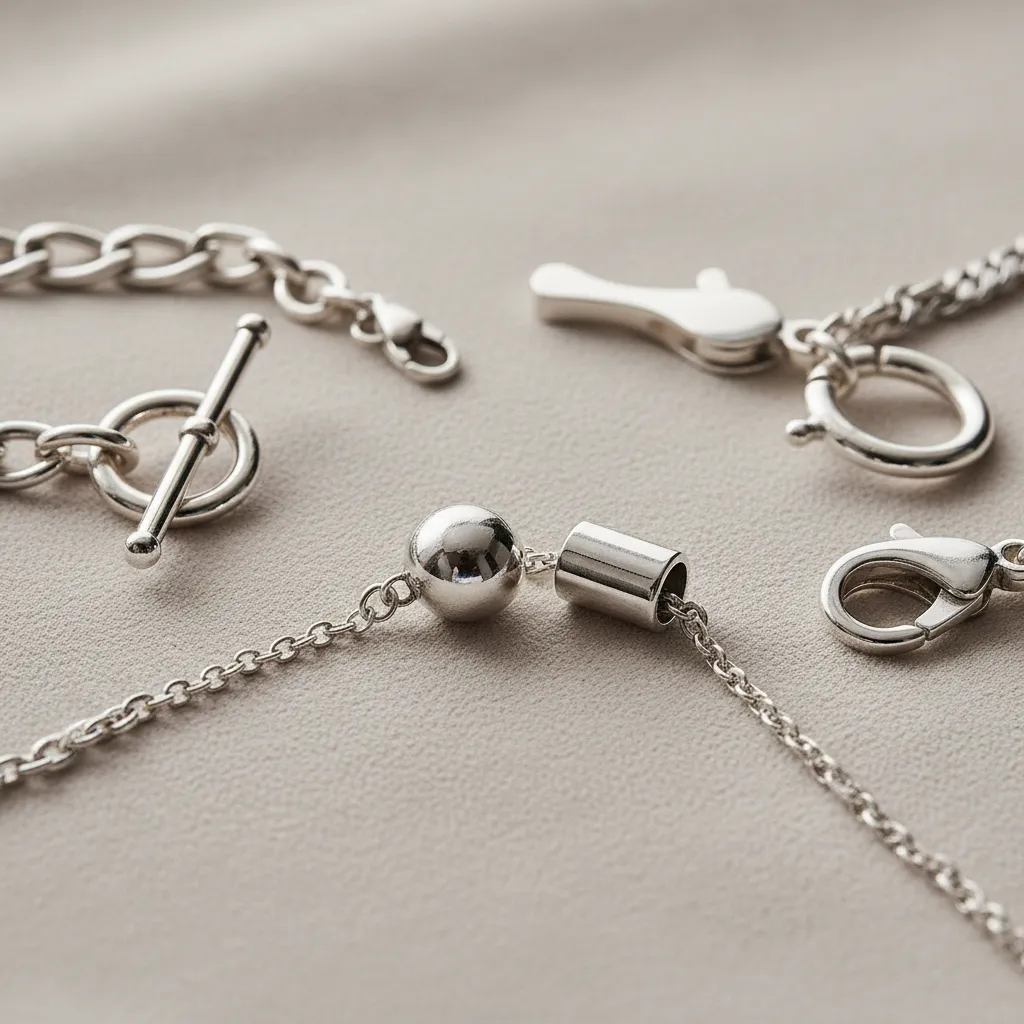
Toggle clasps can function as both closure and design element. They are especially relevant when the brand wants the clasp to be visible, intentional, and integrated into the style language of the collection.
Why it stands out: It can transform a functional part into a defining visual feature.
- Works well for fashion-oriented necklaces and bracelets.
- Can help a collection feel more distinctive without changing the full product architecture.
- Useful in styles where front-facing or side-visible closure placement is part of the concept.
- May support stronger merchandising stories because the closure is easier to communicate visually.
Considerations:
- Security often depends on correct proportion between bar, ring, and overall piece weight.
- It may not suit every minimal or fine-jewelry-inspired concept.
- Visible closures can expose inconsistencies more readily if finishing is uneven.
Who it fits: Brands that want visible hardware and a stronger styling signature.
5. Box Clasp
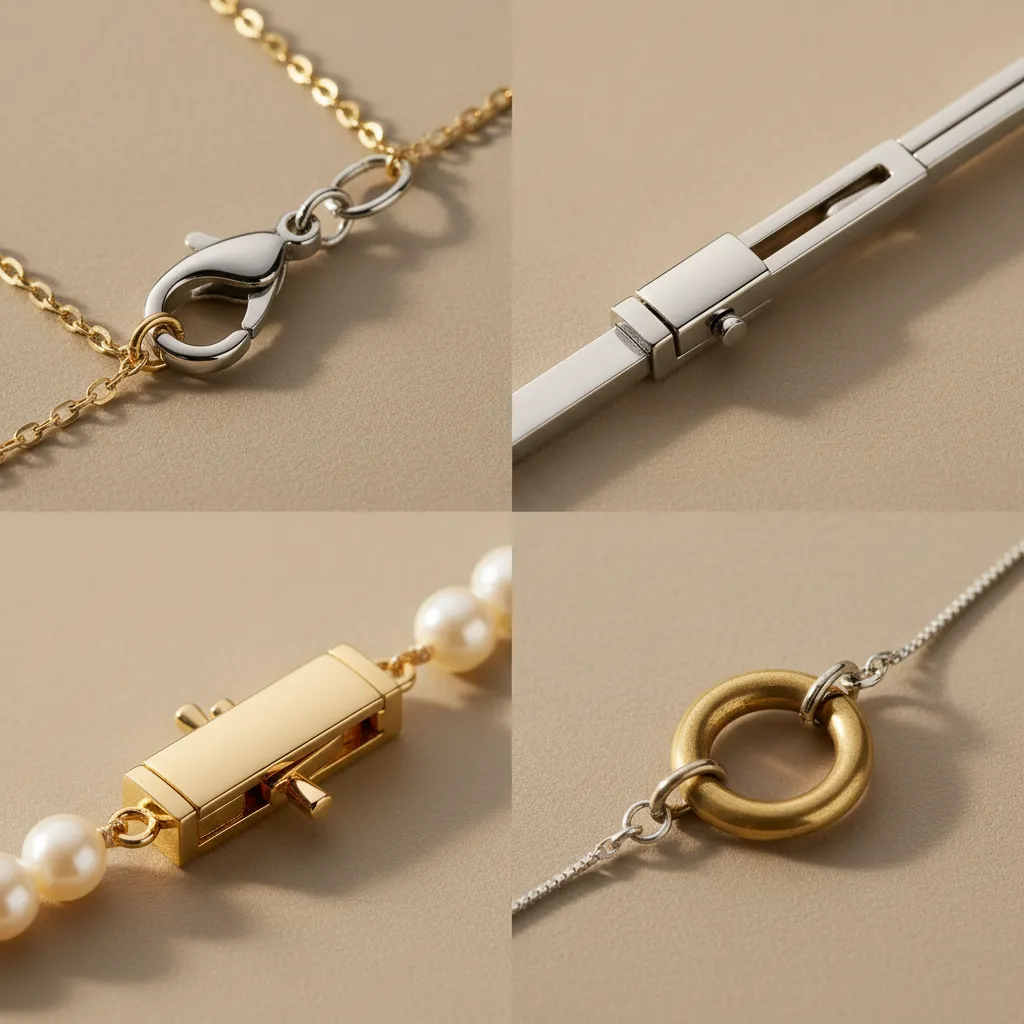
Box clasps are often associated with more structured pieces and a cleaner integrated finish. They can help a necklace or bracelet feel more composed, especially where the design calls for a closure that blends into the line of the piece rather than hanging from it.
Why it stands out: It can support a more refined, engineered appearance.
- Creates a neat closure profile that may suit premium-positioned collections.
- Can feel more intentional in formal or statement product categories.
- Often complements structured layouts better than looser clasp styles.
- May offer stronger aesthetic integration for pieces where hardware visibility should stay low.
Considerations:
- Production and assembly may be more exacting than simpler clasp types.
- Sampling should review opening feel, closure alignment, and finishing consistency.
- It may be excessive for simple everyday basics.
Who it fits: Brands developing formal, structured, or elevated statement styles.
6. Hook and Eye Clasp
Hook and eye clasps often suit collections with an artisanal, organic, or hand-crafted design language. They may look intentionally simple, which can work well for brands that want less mechanical-looking hardware.
Why it stands out: It offers a relaxed, design-forward closure style with visible character.
- Supports more organic visual narratives.
- Can align well with handcrafted or boutique-style product positioning.
- Usually easy to understand visually in product photography and sample reviews.
- May help distinguish a line from more standardized commercial hardware.
Considerations:
- Security depends heavily on geometry and tension design.
- It may not suit high-movement or heavier product concepts without careful engineering.
- Some retailers may see it as more niche than universal.
Who it fits: Boutique brands, artisanal concepts, and collections where closure visibility adds character.
7. Slide Lock Clasp
Slide lock clasps are particularly useful for multi-strand designs because they can keep strands aligned and reduce tangling at the closure point. For brands planning layered looks as a coordinated range, this clasp type can solve practical merchandising and wear issues at the same time.
Why it stands out: It supports organization in more complex necklace or bracelet structures.
- Useful for multi-row designs that need better strand management.
- Can improve presentation consistency across layered products.
- Helps maintain cleaner structure at the back of the piece.
- May simplify the customer experience compared with improvised multi-closure designs.
Considerations:
- Less relevant for single-strand core basics.
- Can narrow design flexibility if future line extensions move toward minimal products.
- Needs careful planning so the clasp dimensions match strand spacing and overall balance.
Who it fits: Brands offering layered necklaces, multi-strand bracelets, or coordinated fashion sets.
8. Barrel Clasp
Barrel clasps are often selected when the goal is a compact, less visually disruptive closure. They can blend into the profile of the piece and help keep the attention on the main design.
Why it stands out: It is discreet and can support cleaner visual continuity.
- Works well when visible hardware should be minimized.
- Can complement streamlined necklaces or bracelet concepts.
- May help a piece look visually uninterrupted from a distance.
- Useful for brands that want closure function without a prominent hardware statement.
Considerations:
- Operation may be slower or less intuitive than some other clasp types.
- It is not always ideal where quick fastening is a key user requirement.
- Very compact hardware should still be assessed carefully during sample approval.
Who it fits: Brands prioritizing a subtle finish and discreet closure appearance.
Strengths and Considerations
Strengths
- A well-matched clasp may improve perceived quality without requiring a full design overhaul.
- Standardizing clasp choice across a collection can support more consistent production planning.
- The right closure can reduce usability friction and help retail teams explain product benefits more clearly.
- Clasp selection often helps define whether a line feels basic, fashion-led, structured, or artisanal.
- Early closure decisions can make CAD reviews, sample rounds, and reorder documentation more efficient.
Considerations
- Even a strong clasp type can underperform if sizing, tolerances, or assembly quality are inconsistent.
- Sampling may reveal that a clasp works on one SKU but not across the full collection.
- Different target markets may value convenience, security, or visible design detail differently.
- Over-customizing findings too early can add complexity before product-market fit is clear.
How Brands Should Choose Between Clasp Types
Start with the product category, not the finding itself. A clasp that suits a lightweight necklace may be a weak fit for a bracelet with more movement or a layered piece with more structural demands. Product weight, silhouette, and wear context should guide the shortlist first.
Next, assess user handling. Some closures look refined in a concept sheet but become frustrating during wear. If your customer profile values speed and ease, magnetic or larger-format options may deserve testing. If your brand emphasizes discretion or minimalism, spring ring or barrel styles may align better, provided sample feedback supports the choice.
Then review production consistency. This is where many first-time founders underestimate the issue. A clasp is only as dependable as the repeatability of the specification, the quality control applied during manufacturing, and the clarity of the approved sample. If you are building a broader line that may later include categories such as wholesale sterling silver nose rings, your manufacturer should be able to document small-component requirements with the same discipline used for more visible design elements.
Another key factor is collection language. Visible toggle or hook closures can strengthen design identity. Discreet lobster, spring ring, or barrel styles can help keep the focus elsewhere. Neither approach is automatically better. The better choice is the one that supports your merchandising strategy and reorder plan.
Finally, check scalability. Ask whether the clasp type could remain practical if your best-selling SKU needs replenishment, line extension, or adaptation into related products. Brands that build with growth in mind usually make stronger clasp decisions than brands that choose only by sample appearance.
Less Common Clasp Terms You May Hear From Buyers and Suppliers (Including “Gabriella Clasp”)
As your brand grows, you may hear clasp names that are not part of the standard findings vocabulary, including terms like “Gabriella clasp.” Some of these names are regional, vintage, or even supplier-specific labels, and the same mechanism can be described differently across factories, markets, or buyer groups. If you rely on the name alone, it is easy to approve the wrong component, especially when multiple clasp styles share similar silhouettes in photos.
The practical fix is to spec the function, not just the term. Ask for drawings, measurements, and a clear description of how the clasp opens, how it locks, and what parts mate together. In practice, a functional description such as “push-in with side release,” “threaded screw-style closure,” or “bar through ring with gravity hold” tends to reduce confusion more than a label that may not translate cleanly between suppliers.
For reorders, treat the clasp like any other critical component in your tech pack. Include reference photos of the approved sample from multiple angles, key measurements that affect fit, a short mechanism description, and notes on the mating components such as rings, end caps, and jump ring sizes. You can also document acceptable variation, for example small differences in feel that are still within your brand standard, so your supplier has clearer guardrails and your retail partners see more consistent results over time.
How Royi Sal Jewelry Approaches Development
For B2B clients evaluating custom jewelry development, Royi Sal Jewelry positions itself as a collaborative manufacturing partner rather than a simple order taker. The company focuses on custom jewelry design and manufacturing, collaborative consultation, wholesale and private label support, and global shipping and fulfillment. That can be especially useful when small components such as clasps need to be reviewed in the context of the whole product, not treated as isolated parts.
Royi Sal Jewelry is led by Royi Gal, whose background combines design and manufacturing experience. That dual perspective matters in projects where aesthetic intent, user handling, and production practicality need to be balanced early. Brands that are still shaping a collection concept can explore Royi Sal Jewelry’s broader approach to Jewelry Design and Jewelry Manufacturing to understand how design development and production planning may connect. If you are preparing a private label line or refining jewelry findings clasps for a new collection, visiting royisal.com to discuss your brief could help clarify what is realistic for sampling, revisions, and production.
Frequently Asked Questions
Which clasp type is usually the safest starting point for a new jewelry brand?
Lobster clasps are often the easiest starting point because they tend to be broadly accepted, visually familiar, and commercially flexible. That does not make them the best choice for every line. If your collection relies on delicate styling, visible hardware, or accessibility-focused use, another clasp type may serve the product better once samples are reviewed.
Are magnetic jewelry clasps a good option for wholesale collections?
They can be, especially where ease of wear is part of the product value. Still, they usually need careful evaluation during development because suitability may vary by piece weight, movement, and intended use. Brands should test them in realistic prototypes rather than approving them based only on concept drawings or supplier descriptions.
Do clasp choices affect perceived product quality?
Yes, often more than new brands expect. Buyers and end customers interact directly with the clasp, so closure feel can influence how polished the piece seems. A visually attractive design may still feel underdeveloped if the clasp is awkward, inconsistent, or mismatched to the product category. Sample handling is important before scaling.
Should the clasp be visible or hidden in a jewelry collection?
That depends on your design language. Some brands want the clasp to disappear so the main motif stays dominant. Others use closures such as toggles as part of the visual identity. The stronger choice is the one that supports your collection story, target market expectations, and production consistency across the range.
How early should clasp decisions be made in the design process?
Ideally, quite early. Waiting until late-stage sampling may create avoidable revisions if the chosen clasp changes balance, usability, or assembly requirements. Closure selection often works best when reviewed alongside chain style, length planning, and digital concept development rather than after the main design appears finished.
Are spring ring clasps still relevant for modern private label jewelry?
Yes, especially for lighter and more delicate-looking products. Their compact size can support a clean finish. They are less ideal where ease of operation is a major selling point or where the piece carries more weight. Relevance depends less on trend and more on whether the closure fits the product architecture well.
What should buyers ask a manufacturer about clasps during sampling?
Ask how the clasp choice affects assembly, consistency, sample revisions, and future reorders. You should also review how the closure performs in handling, whether the proportions suit the piece, and whether the approved specification can be repeated reliably. Clear documentation usually matters as much as the clasp type itself.
Can one clasp type be used across an entire jewelry line?
Sometimes, but not always. Using one closure across multiple SKUs may simplify purchasing and brand consistency. Even so, different categories can place different demands on the clasp. A closure that works well for everyday necklaces may not be ideal for layered bracelets or more structured statement pieces.
Do clasp decisions matter for merchandising and retail sell-through?
They can. A clasp may influence how easy a product is to explain, how premium it feels in hand, and whether the closure becomes a visible design benefit. Retailers often value products that are not only attractive but also easy to understand, demonstrate, and reorder without avoidable component changes.
What is the best type of jewelry clasp?
For many commercial jewelry programs, a lobster clasp is often the most practical starting point because it is widely accepted and adaptable across product categories. Still, “best” depends on your line strategy. If your product is designed around delicate minimalism, spring ring or barrel styles may be a better visual fit. If your positioning is ease-first, magnetic options may be worth testing, with approval based on realistic prototypes and handling feedback.
Which clasp is most secure?
Security depends on the specific design, proportions, and production consistency, not only the clasp category name. In B2B terms, the most secure clasp for your line is typically the one that shows consistent full engagement in sampling, maintains alignment from unit to unit, and stays dependable after repeated open-close cycles. If security is a top priority, build a clear test routine into sample approval and document the clasp and mating components in detail for reorders.
What is a Gabriella clasp?
“Gabriella clasp” is a term that may be used inconsistently, depending on the supplier, region, or buyer. In many cases, it is better to treat it as a label rather than a technical standard. To avoid sourcing mistakes, ask for reference images, measurements, and a functional description of how it opens and locks, then include those details in your clasp spec so future production matches the approved sample.
What is the best necklace clasp for seniors?
For brands designing for customers who want an easier fastening experience, the “best” option is usually the clasp that requires the least precise fingertip control and the fewest steps to close. Many lines test magnetic closures for that reason, and some also consider larger, easier-to-grip clasp formats depending on the design. The smart approach is to validate with wear testing and retailer feedback during sampling, then communicate “easy to wear” in a way that is clear but does not overpromise performance for every use case.
Methodology
This ranking uses a B2B evaluation lens rather than a retail style lens. The key criteria are manufacturing quality and craftsmanship, design capability and service range, trust and communication, order flexibility, lead-time impact, and global production practicality. Those factors matter because clasp selection affects not only appearance, but also sample approval, assembly reliability, and how confidently a product can move into repeat production.
The list favors clasp types that commonly map to real collection-planning decisions: broad commercial use, delicate styling, accessibility, visible design intent, structured construction, artisanal character, multi-strand organization, and discreet closure needs. Each entry includes benefits and tradeoffs because no jewelry finding is universally correct. The strongest clasp is usually the one that best supports your brand position, customer use case, and production workflow.
Key Takeaways
- Lobster clasps are often the most broadly practical option for commercial jewelry programs.
- Magnetic, toggle, and slide lock styles can add strong functional or design advantages, but they usually need more context-specific evaluation.
- Clasp choice should be reviewed alongside product weight, user handling, collection identity, and repeat production planning.
- Sample approval matters because a clasp that looks right on paper may behave differently in real handling.
- Brands benefit from working with a manufacturer that can discuss design intent and production realities together.
Conclusion
The best types of jewelry clasps are not simply the ones most often seen in the market. They are the ones that support your brand’s product strategy, user experience goals, and manufacturing requirements with the fewest avoidable compromises. For some collections, that may mean staying with dependable lobster clasps. For others, it may mean using toggle, magnetic, or box closures to reinforce a clearer product identity. If you are developing a new range and want help evaluating closure choices within a broader custom collection plan, Royi Sal Jewelry offers collaborative design and manufacturing support for B2B clients. Visit royisal.com to learn more about the process or contact the team to discuss your custom jewelry brief.