

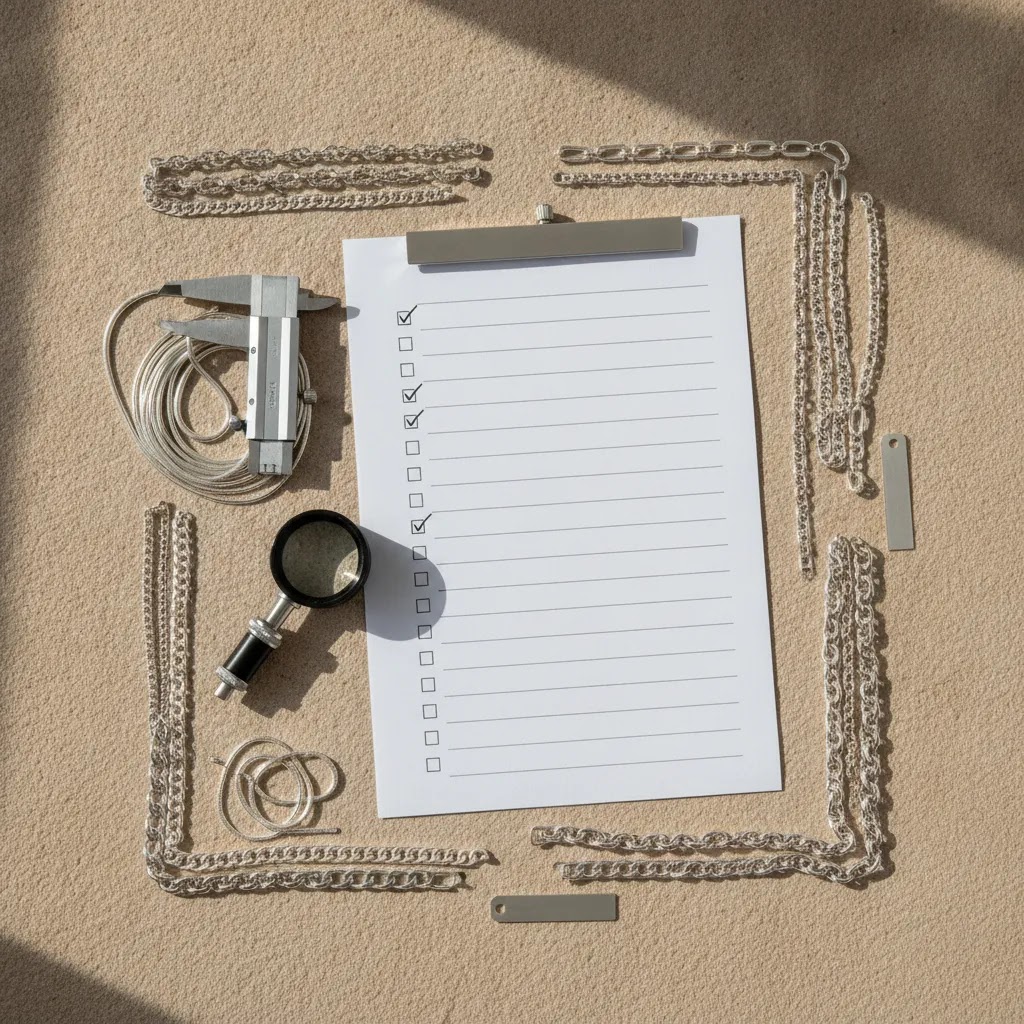
Tips Choosing Sterling Silver Chains: The Full Checklist
- Confirm that the chain is specified as 925 sterling silver for the exact SKU, not assumed at collection level.
- Match chain style to the pendant weight, intended use, and customer profile before approving development.
- Check the chain gauge, link structure, and overall strength for repeat wholesale use.
- Verify the chain length strategy across your collection so sizing feels commercially consistent.
- Review clasp type and end findings for ease of use and production reliability.
- Assess how tarnish expectations, storage, and after-sale care will affect your business operations.
- Compare standalone chain demand versus chain-and-pendant demand in your assortment plan.
- Check whether the chain design aligns with neighboring categories such as wholesale sterling silver necklaces and coordinated sets.
- Request sample review criteria in writing, including finish consistency, solder points, and movement.
- Confirm order minimums, production planning, and restock practicality before final approval.
- Test whether the chosen chain supports cross-selling with wholesale sterling silver bracelets or ring-led collections.
- Document chain specifications clearly so your team can repeat the same standard across future production runs, including related items like wholesale 925 silver rings.
Printable version: copy this list into your buying sheet, development brief, or supplier approval form before your next sterling silver chain order.
Why Tips Choosing Sterling Silver Chains Matter in B2B
Business buyers often start with appearance and then discover that harder questions come later. A chain that photographs well may still create problems if it twists easily, feels too light for the pendant, uses a weak clasp, or fails to repeat consistently in production. The strongest buying decision usually comes from treating chain selection as a product specification issue, not only a styling choice.
For private label and wholesale programs, chain decisions ripple into margin planning, returns risk, quality control, and collection coherence. Royi Sal Jewelry operates as a custom jewelry design and manufacturing partner for B2B clients, with Royi Gal leading the business as both a jewelry designer and manufacturer. As a result, chain selection rarely stands alone. It sits inside a larger development conversation that may include design consultation, prototype review, production planning, and global fulfillment for brand owners building a collection rather than buying a single item.
If you are planning a broader sourcing initiative, related categories such as jewelry manufacturing, jewelry sourcing, and wholesale silver jewelry can help frame how chain choices fit the rest of your wholesale program.
Tips Choosing Sterling Silver Chains: Each Item Explained
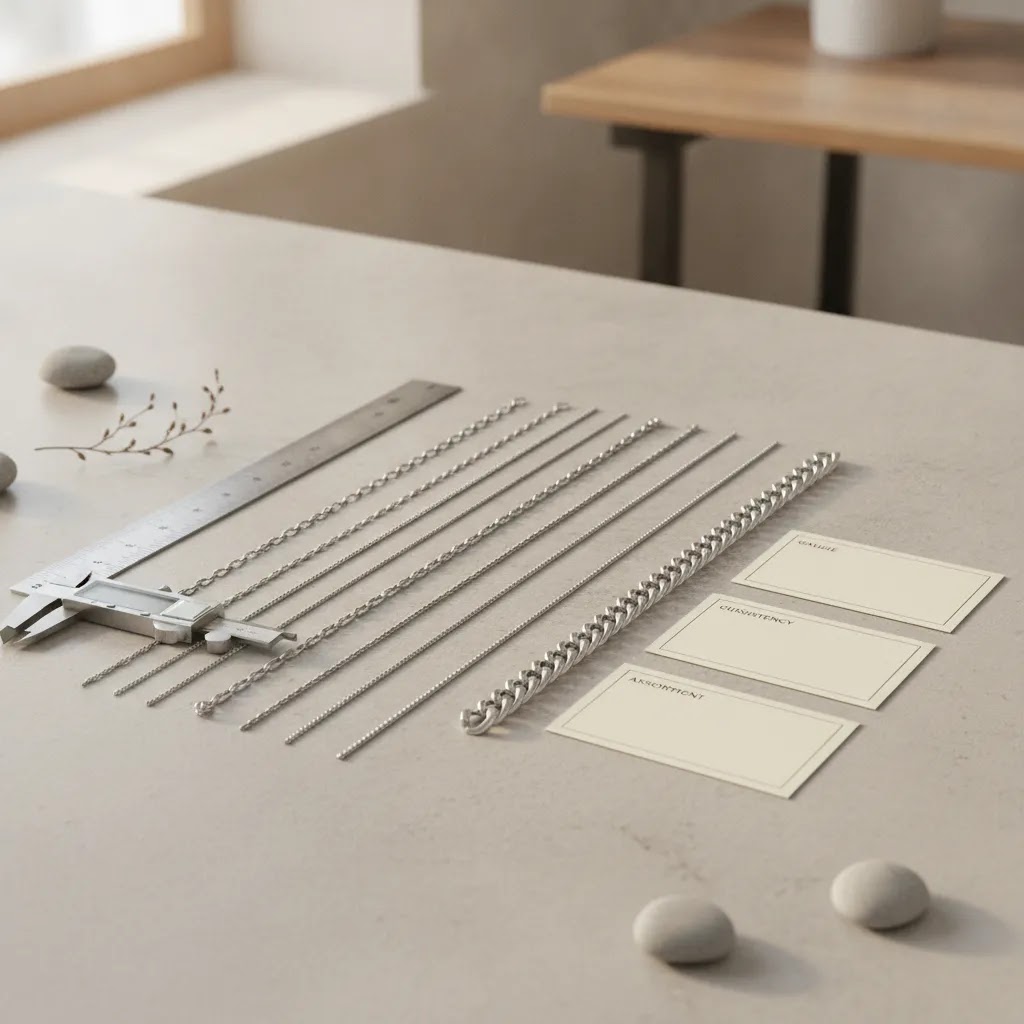
Confirm the 925 sterling silver chain specification
What it means: Your chain specification should state 925 sterling silver at the SKU level. Do not rely on a category label or a general sales description.
Why it matters: A clear material designation helps avoid confusion between chain variants during sampling and production. It also supports cleaner product documentation for your internal catalog and sales team.
How to verify it: Include the exact chain code, composition note, and matching findings in your product brief. Ask your supplier to repeat the same wording on sample records and production confirmations.
Common mistake: Approving a pendant or necklace concept without confirming that the supplied chain version matches the intended specification.
Tips Choosing Sterling Silver Chains: Understanding “925” vs “950” vs “999”
In the market, you may see chains described with purity numbers such as 925, 950, or 999. In most B2B programs, teams specify and control chains at an alloy designation level instead of calling them “pure” silver. Your real need is consistent, repeatable input for a wearable component that your team can produce, stock, and reorder to the same standard.
Teams commonly use 925 to indicate sterling silver in labeling and internal SKU documentation. Since your checklist already asks you to confirm 925 at the SKU level, the next step is making sure your team knows how to handle other numbers if they appear in supplier catalogs, inbound quotes, or competitor assortments. A chain program can drift when one person writes “sterling,” another writes “925,” and a third adds a different purity number without a controlled reason.
Keep alloy language consistent across chain records
Some assortments use 950 as a different silver alloy designation. In addition, some suppliers mention 999 as fine or near-pure silver in certain contexts. For chain programs, the commercial risk is not which number sounds better in a marketing sentence. The real risk is mixed language in your spec sheet, because that creates mixed expectations during sampling and production.
If your SKU setup lacks discipline, you can end up with visually similar chains that do not share the same recorded standard. That creates problems for reorders and multi-SKU collections. Therefore, make your documentation unambiguous. Your SKU record should include one approved composition line, one approved chain code, and one approved findings set for that chain variant.
If you decide to offer multiple compositions across your line, treat them as separate chain families with separate SKUs, separate sample approvals, and separate reorder rules. Do not use “sterling” as a catch-all descriptor across different chain variants.
To avoid mix-ups, ask your supplier to repeat the exact same specification language in three places: the quotation, the sample record, and the production confirmation. Your internal approval form should also include SKU-level notes that distinguish near-identical options, for example chain code, gauge, length, and the exact composition wording used in your brief. Then, during sampling, confirm that the physical sample and the recorded chain code match before you approve it for production.
| Designation | How the article says it appears | B2B takeaway for chain programs |
|---|---|---|
| 925 | Commonly used to indicate sterling silver in labeling and internal SKU documentation | Use one approved standard per SKU and keep wording consistent across records |
| 950 | May show up as a different silver alloy designation | Treat it as a separate documented option if your line uses it |
| 999 | May be referenced as fine or near-pure silver in certain contexts | Avoid mixing terms unless your chain records clearly define the variant |
Match sterling silver chain style to product use
What it means: Different chain styles support different commercial goals. A fine minimalist chain serves a different purpose than a more structured statement chain.
Why it matters: The right style affects visual identity, wear performance, and how the piece sits within your assortment. It also influences whether the chain works for everyday core products or seasonal fashion drops.
How to verify it: Review the chain with the intended pendant, or confirm that it is being sold as a standalone chain. Compare style direction across your necklace, bracelet, and ring lines so the collection feels intentional.
Common mistake: Choosing by trend reference alone, without checking how the chain behaves in actual use.
Tips Choosing Sterling Silver Chains by Link Type and Use Case
If you are building a wholesale assortment, chain style should be treated as a functional decision, not only an aesthetic one. Many brands do better when they standardize around a small set of chain families and reuse them across pendant-led SKUs, standalone essentials, and a few higher-visual-impact options. This reduces approval time, helps retailers understand your line, and makes reorders easier to execute.
Use chain families to simplify approvals and reorders
Start by classifying chain styles by how the links behave and how the chain presents. Some link patterns support flexibility and a smooth drape, which can work well for everyday essentials and pendant programs. Other patterns feel more structured and hold their shape more, which can support standalone chain SKUs where the chain itself has to read clearly from a distance on display. You will also encounter styles that are flat or more directional in how they sit, which can look strong in photos but may be less forgiving if the chain tends to twist.
Operationally, chain style changes what you need to watch in quality control. Some chains tangle more easily in handling and packing, which matters if you ship volume or if your retailers unpack multiple units at once. Some styles flip or twist more noticeably when worn, and that often shows up in customer feedback. Meanwhile, some link patterns display consistently on bust forms and trays, while others need more styling attention in photography and merchandising. If your collection is sold through multiple retail partners, prioritize chain styles that present consistently without constant adjustment.
Consistency in reproduction is another commercial factor. Chain styles with more visible pattern definition may show small variations more quickly across batches if gauge, link proportion, or finishing steps drift. If your business depends on repeat wholesale reorders, build your assortment around chain families you can reproduce reliably and document clearly. Then add more complex styles selectively after you prove repeatability through sampling and production.
A practical way to plan a chain family system is to choose a few repeatable styles and set rules for how they are used: one core pendant chain style in a controlled set of lengths, one slightly stronger everyday chain for standalone sales, and one statement option used only on specific SKUs. Then document which pendants pair with which chain family so your line stays consistent as you add new designs. Retailers notice when a collection has internal logic. Your operations team benefits too, because fewer chain variants mean fewer approval points and fewer reorder errors.
Check gauge, link structure, and strength
Gauge and construction shape how durable the finished product may feel. Thin chains can be commercially useful, but only when they suit the intended design and target customer. Link structure also affects movement, drape, and the points most likely to fail under strain.
Ask your manufacturer what sample checks they use for join points, solder consistency, and flexibility. For a brand that expects reorders, the goal is repeatability, not only a good-looking first sample. A chain that is too delicate for its role can create avoidable service issues after launch.
Verify your length strategy for sterling silver chains
Length planning is a merchandising decision as much as a product decision. If your chain lengths vary too widely from one SKU to another, your assortment may feel inconsistent. If every chain uses the same length without a commercial reason, you may limit how customers layer pieces or how retailers present the line.
Use a small, controlled structure. For example, define which lengths belong to core, premium, and pendant-led products. Then keep those rules consistent across development documents and reorder planning.
Review clasp type and end findings
Clasp performance often gets less attention than chain design, even though it affects the daily use experience and return risk. End findings should feel appropriate for the chain weight and style. A mismatch can make the piece feel unbalanced or unreliable.
During sample review, check whether the clasp is easy to operate, visually proportionate, and securely attached. Ask your supplier to keep clasp and finding specifications stable across repeated runs unless a change is approved in writing.
Assess tarnish expectations and care implications
Many business buyers ask, does sterling silver tarnish, and the practical answer is yes, silver can tarnish over time. The B2B issue is how your business plans for that reality. Product storage, packaging choices, handling during fulfillment, and customer care language all affect the end result.
That does not make sterling silver unsuitable. It means your product team should align sourcing, storage, and merchandising decisions early. If your business is selling chains into everyday-wear programs, your care notes and warehouse handling process should support that use case. For a deeper material comparison, see Sterling Silver Vs Pure Silver. You can also review silver care guidance from the Gemological Institute of America.
Compare standalone demand and pendant demand
Some chains work best as supporting components for pendants. Others can carry margin and volume as standalone products. Deciding which role a chain plays affects your SKU plan, replenishment model, and product photography priorities.
If your line has a pendant-heavy focus, prioritize compatibility and balance. If you expect standalone sales, make sure the chain has enough visual character and perceived value on its own.
Check assortment alignment across categories
A chain should fit the commercial logic of the wider collection. If your assortment already includes necklaces, bracelets, and rings, the chain should not feel disconnected in finish direction or market position. Cross-category alignment can strengthen reorder behavior and simplify wholesale presentations.
This is especially useful for B2B clients building capsule assortments where one chain family may support multiple coordinated launches.
Request sample review criteria in writing
Sample approval should not rely on memory or informal comments. Set a written checklist that covers finish consistency, chain movement, link uniformity, clasp function, solder points, and visual balance with any attached element.
This is one area where a collaborative manufacturer matters. Royi Sal Jewelry positions its service around custom design, development, and hands-on collaboration, so business clients can approach sampling as a working approval stage rather than a simple purchase confirmation. If your program includes custom components, 3D jewelry design can also support faster review and clearer approvals.
Confirm minimums and restock practicality
Before a chain enters your line, confirm whether the order structure makes sense for your business model. Minimum order quantities may vary by project scope, design complexity, and production requirements. A chain that looks right but cannot be reordered practically may create problems once sales begin.
Ask early how the item fits future restocks, whether matching findings stay consistent, and what changes might require a fresh approval cycle.
Test cross-selling potential
Good chain choices support more than one product page. They may anchor necklace stories, pair with bracelets, or sit alongside ring collections without feeling like an outlier. A coordinated assortment can improve sales conversations with retailers and make private label lines easier to present.
That is why buying, design, and merchandising teams should review chain selection together when possible.
Document every approved specification
The final task is administrative but essential. Record the approved chain style, length, gauge, findings, finish notes, and sample comments in one place. This helps maintain consistency across production runs and reduces the chance of small unapproved substitutions later.
For any brand planning to scale, clear documentation is one of the strongest forms of quality control.
Tips Choosing Sterling Silver Chains: Verify Authenticity and Documentation

Specification clarity is the starting point, but approval becomes more reliable when your team uses a repeatable verification workflow before adding a chain to production. For B2B buyers, authenticity usually means two practical checks: the physical chain you reviewed matches the recorded specification, and the documentation you will rely on for reorders matches the physical chain.
Start with what is visible and repeatable. Many chains in the market may carry a fineness mark such as “925.” Treat any mark as one data point, not the entire verification process. Your goal is to ensure the sample chain, the chain code in your brief, and the supplier paperwork all match the same SKU-level description. If your sample is tagged, bagged, or coded, confirm that the identifier on the sample packaging matches the identifier in your development record.
Build a simple intake check before chain approval
During sample review and receiving, build a simple intake routine your team can follow without specialized equipment. Check for consistent markings where present, consistent clasp and end findings across units, consistent link pattern definition, and a consistent finish appearance from one chain to the next. If you are reviewing multiple lengths or gauges, confirm that the correct chain variant is in the correct bag, and that your internal SKU notes clearly distinguish those variants.
Confusion is most common when several chains look similar on a table but your documentation records them differently. Any inconsistency should trigger a re-check with the manufacturer before approval. For example, watch for chains in the same SKU group that show different clasp builds, noticeably different link proportions, or mismatched chain codes on the paperwork versus the sample labels. Even if the chain looks acceptable, inconsistency at this stage can turn into reorder errors later, especially when different team members handle buying, receiving, and merchandising.
To make this repeatable, build these checks into your supplier approval form. Include fields for chain code, recorded composition wording, length, gauge, clasp and findings description, and sample sign-off notes. Add a requirement that the supplier repeats the same identifiers on sample records and production confirmations. When you reorder, your team should be able to pull the original approved record and match it directly to the new confirmation, without needing to reinterpret what “the same chain as last time” was supposed to mean. For official guidance on precious metal quality marks in the U.S., see the FTC Jewelry Guides.
How This Fits a Manufacturing Project
Chain selection becomes more useful when you fold it into a structured development process. Royi Sal Jewelry offers custom jewelry design and manufacturing services for wholesale and private label clients, with a collaborative model that centers on direct consultation, design development, manufacturing, and global shipping. For a B2B client, that means you can discuss chain choices within the wider context of brand direction, assortment planning, sample approval, and production repeatability.
Royi Gal’s background as both a jewelry designer and manufacturer is relevant here because chain decisions often sit between aesthetics and production reality. A buyer may want a lighter visual look, while manufacturing review may raise questions about wear performance, clasp suitability, or consistency in repeat runs. Those are exactly the trade-offs teams should surface before production.
If you are still defining your broader business model, the jewelry business category can help you frame the commercial side of assortment planning before you submit a project brief. You may also find value in the jewelry manufacturing process concept creation when planning development steps.
What If You Cannot Tick Every Box?
That is normal. Not every project starts with full clarity. Early-stage brands may know the look they want but still be testing target price position, chain lengths, or category mix. Established retailers may know their volume profile but want support refining chain construction or sample review standards.
The practical next step is to separate non-negotiables from open questions. List the details that must be fixed before sampling, then identify the areas where you want manufacturer input. This creates a more productive consultation and prevents avoidable revision cycles.
If your chain brief is still incomplete, you do not need to delay the conversation indefinitely. A manufacturer with custom development experience can help turn commercial goals into clearer product specifications, provided the project is discussed honestly from the start.
Frequently Asked Questions

How do B2B buyers know if sterling silver chain quality is suitable for wholesale?
Start with specification clarity, then move to sample review. Confirm the 925 designation, chain structure, clasp type, and intended use. Review physical samples for movement, finish consistency, and join-point quality. Wholesale suitability is usually a mix of appearance, repeatability, and how well the chain fits the role it plays in your assortment.
Is sterling silver real for product labeling purposes?
For business buyers, the practical issue is whether the chain is clearly designated and documented as sterling silver within the product specification. Use exact internal records and supplier confirmations for each SKU. Avoid broad assumptions across a whole collection, especially if necklace programs include multiple chain options or revisions over time.
Does sterling silver tarnish, and should that stop a business from using it?
Sterling silver can tarnish over time, so the better question is whether your operations account for it. Storage conditions, packaging, handling, and care guidance all matter. For many brands, sterling silver remains commercially viable because the product strategy includes realistic handling procedures rather than ignoring the issue.
Should chains be sourced as standalone items or only with pendant programs?
That depends on your assortment strategy. If your target customer values layering or core essentials, standalone chains may deserve dedicated SKUs. If your brand focuses on pendant storytelling, chain selection should prioritize compatibility and support. Decide the chain’s commercial role early so development and buying stay aligned.
How detailed should a first inquiry to Royi Sal Jewelry be?
Detailed enough to show business intent, but not perfect. Include your target category, estimated collection scope, intended market position, style direction, and any known requirements for lengths, closures, or sample review. Royi Sal Jewelry works as a collaborative custom design and manufacturing partner, so a clear starting brief helps shape a more useful consultation.
Can chain decisions affect future scaling?
Yes. Small choices at sample stage can affect repeatability, restocking, and quality control later. A chain that is difficult to reproduce consistently or only works in a narrow product context may slow assortment growth. Documented specifications and realistic production planning usually support scaling far better than trend-led decisions made in isolation.
What to look for when buying a sterling silver chain?
For B2B buying, look for a chain that is defined by a clear SKU-level specification and can be repeated consistently. Confirm the recorded 925 designation for the exact chain code, then review samples for consistent link pattern, stable clasp and end findings, uniform finishing, and clean join points. Treat the chain as part of a program, meaning it should fit your length strategy, merchandising plan, and reorder model, not only the initial sample appearance.
Is 925 or 950 sterling silver better?
“Better” depends on what your line is designed to sell and how you control specifications. 925 is commonly used as the standard sterling designation in product documentation and labeling. You may also see 950 referenced as a different silver alloy designation in the market. For wholesale programs, the operational priority is choosing one approved standard per SKU, documenting it clearly, and keeping sample records and production confirmations aligned so the same chain variant is produced and reordered without substitutions.
What is the best sterling silver chain to buy?
The best chain for your business is the one that matches the role it plays in your assortment and stays consistent across production runs. For pendant-led SKUs, prioritize balance with the pendant and a clasp and findings setup that stays consistent. For standalone essentials, choose a chain style that presents well on display and photographs consistently. For any direction, the “best” option should be the one you can specify clearly, approve through sampling, and reorder reliably using documented chain codes and supplier confirmations.
Key Takeaways
- Choose sterling silver chains as product specifications, not only as style elements.
- Confirm 925 designation, chain construction, clasp details, and intended use before approval.
- Use written sample review criteria to reduce inconsistencies across production runs.
- Assess chain choices within the full assortment, including necklaces, bracelets, and ring programs.
- A collaborative manufacturing discussion can help resolve open questions before production begins.
Conclusion
The best sterling silver chain decision is usually the one that stays commercially sound after sample approval. That means checking construction, assortment fit, repeatability, and restock logic as carefully as style. For B2B buyers, a good chain is not simply attractive. It supports your margin structure, quality expectations, and collection planning over time. Royi Sal Jewelry works with business clients on custom jewelry design and manufacturing, with a partnership model shaped by Royi Gal’s experience as both designer and manufacturer. If you are preparing a sterling silver chain program, refining a private label collection, or reviewing sample criteria before production, visit wholesale jewelry resources on royisal.com or contact the team to discuss your project requirements directly.