Wholesale Sterling Silver Earrings (2026 Guide)

What This Supplier Guide Covers
The phrase wholesale sterling silver earrings can refer to several sourcing models. In some cases, you are buying ready-made styles in bulk. In others, you are working with a manufacturing partner that can support custom development, private label production, or collection expansion. Those are very different decisions, even if the product category looks similar on paper.
For B2B buyers, the real evaluation usually comes down to five practical areas: product consistency, design flexibility, communication quality, production planning, and fulfillment capability. A supplier that looks attractive at sample stage may still create problems later if order details are unclear, revisions are poorly managed, or production capacity is not aligned with your growth plans.
This is why many buyers break the category down further, evaluating suppliers for wholesale silver stud earrings, wholesale silver hoop earrings, and related silver jewelry lines separately. A supplier may be strong in one product type but less reliable in another.
Royi Sal Jewelry operates as a B2B custom jewelry design and manufacturing company focused on collaborative development, wholesale production, private label work, and global shipping. Led by Royi Gal, whose background combines jewelry design and manufacturing, the company presents itself as a partner for brands that need more than a simple catalog transaction. If you are weighing stock buying versus a more tailored development route, that distinction matters.
Lead Times and Availability Models: In-Stock Wholesale vs Made-to-Order Manufacturing
Here is the thing, many suppliers market “wholesale” as if it is one straightforward buying experience, but the reality is there are two very different availability models sitting behind the same keyword. One model is in-stock inventory that is ready to ship in bulk. The other is made-to-order production, where your order triggers a production run after approvals. Understanding which model you are evaluating helps you plan cash flow, launch calendars, and replenishment expectations more realistically.
With an in-stock model, you are typically optimizing for speed and simplicity. You are selecting existing styles, confirming availability, and ordering against what a supplier has on hand. That can be useful for testing sell-through quickly, but it also means you are exposed to stock variability. A style you build into your merchandising plan could become unavailable, or the supplier may adjust the design over time. From a business standpoint, you want clear answers on continuity: can the style go out of stock, how restocks are handled, and whether the supplier treats the item as a stable program or a rotating catalog listing.
With a made-to-order manufacturing model, you are typically optimizing for control and repeatability, even if it requires more planning. In practice, this model relies on disciplined approvals, documented specs, and version tracking so a reorder matches what you originally launched. What many brand owners overlook is that “made-to-order” does not automatically mean a guaranteed timeline. Production timing can vary based on order size, complexity, current workload, and how quickly approvals happen. If your launch is tied to a specific date, you should ask how the supplier schedules production, how changes affect timing, and what is realistic at your current stage.
Consider this when choosing a model: if you are still testing market fit, in-stock purchasing can sometimes reduce the commitment level. If you are scaling and need consistent reorders, a manufacturing partner that treats your designs and specs as controlled production assets may align better with your long-term operations. Many brands also use a hybrid approach over time, testing with simpler orders, then moving into more controlled private label production once they know what needs to be repeatable.

What to Evaluate in a Supplier
Product quality consistency should come first. Ask whether the supplier can maintain uniform finishing, dimensions, component quality, and packaging standards across a production run. Sample quality by itself is not enough. You need evidence that repeat orders could remain commercially reliable.
Design and development capability matters if you are building a differentiated line. Some wholesale suppliers mainly offer pre-existing styles. Others can support custom jewelry design, collaborative development, and production planning. If your business depends on a distinctive assortment, a design-capable partner may be a better fit than a catalog-only source.
Communication discipline is one of the most overlooked supplier criteria. Clear approvals, revision tracking, timeline updates, and production confirmations may reduce the risk of expensive misunderstandings. This becomes more important if you are working across time zones or developing pieces with multiple rounds of changes.
Minimum order planning should be discussed early. Even when a supplier does not publish fixed numbers, there are usually practical production thresholds tied to labor efficiency, style complexity, or packaging requirements. If you expect to test several SKUs in small quantities, ask what order structure is realistic before design work begins.
Scalability and fulfillment also matter. A supplier that can handle one launch may not always be prepared for broader seasonal replenishment. Royi Sal Jewelry specifically notes global shipping and order fulfillment as part of its service model, which could be relevant if your brand serves multiple regions or plans to expand beyond a local market.
If your assortment may extend beyond core silver styles into accent categories, it is also useful to plan category adjacency early. For example, a brand that starts with earrings may later evaluate wholesale gemstone jewelry or more specialized earring programs such as 925 sterling silver earrings wholesale sourcing for broader collection depth.
Wholesale Earring Specs to Confirm Before You Order (Sizes, Components, Packaging)
What experienced buyers know is that earrings are one of the easiest categories for small spec gaps to turn into real operational issues. A wholesale listing can look clear, but if you do not confirm unit conventions, measurements, and packaging expectations in writing, you may end up approving a sample that does not match what arrives in bulk. That becomes more painful when you need reorders across multiple SKUs and want consistency between studs, hoops, and other earring types.
Start by confirming the selling unit and how quantities are counted. Are the earrings sold as pairs, or as single units? If your inventory and POS are built around pairs but the supplier counts singles, your ordering math, packaging, and pricing setup can become messy fast. You also want clarity on what is included: backs, extra components, and any small parts that your team will expect to be consistent from order to order.
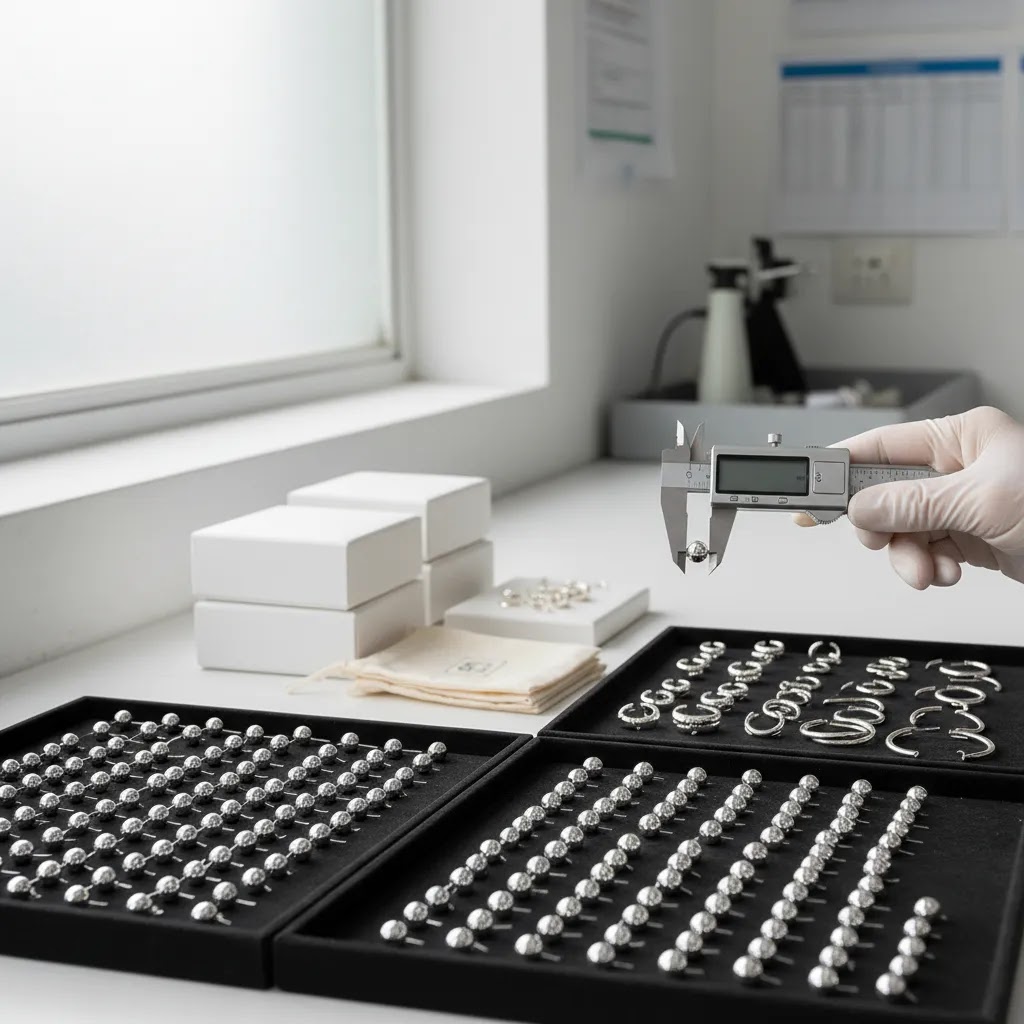
From a production standpoint, measurements should be treated like a spec sheet, not a casual description. Request dimensions in a consistent format, typically in millimeters, and confirm which points are being measured. For studs, that may mean face diameter and total depth. For hoops, it may mean inner diameter, outer diameter, and wire thickness. If the supplier can provide reference photos, drawings, or marked-up images that match those measurements, it usually reduces interpretation errors during production and QC.
Component details also deserve explicit confirmation. For example, post and back style can affect how the product wears, how it is packaged, and how returns are handled. Even if you are sourcing “standard” styles, do not assume the same default components across every factory or every SKU. Ask what tolerances are considered acceptable in production and what finish expectations are being approved, especially if your assortment includes multiple related designs that should look uniform as a set.
Packaging is another frequent friction point because it touches branding, logistics, and customer experience. Confirm your packaging requirements early, including whether items are individually packaged, how pairs are presented, whether labels or style codes are required, and how that packaging needs to remain consistent for reorders. Think of it this way, you are not only buying earrings in bulk, you are buying a repeatable system that your team can receive, count, stock, and replenish without re-learning the product every time.
Who This Guide Is For
This guide is written for jewelry retailers, boutique owners, fashion labels, and founders building or expanding a private label earring category. It is especially relevant if you are comparing overseas and cross-border production options, evaluating whether to work with a custom manufacturer, or trying to reduce sourcing mistakes before a first meaningful order.
It may also help established wholesale buyers that need a more structured way to review suppliers after problems with communication, inconsistent production, or poor reorder experiences. If your business depends on dependable sell-through, margin protection, and cleaner operational planning, supplier selection should be treated as a strategic decision rather than a simple product purchase.
A Useful Manufacturing Resource to Consider
For brands that want more support than a standard wholesale listing provides, Royi Sal Jewelry is worth evaluating as an educational and manufacturing resource. The company focuses on custom jewelry design and manufacturing for B2B clients, with collaborative design consultation, private label orientation, wholesale production support, and global shipping. That model may suit businesses that want to shape a collection more intentionally instead of relying only on open-market inventory.
Because Royi Gal brings experience as both a designer and manufacturer, the business is positioned to understand the gap between a creative brief and production reality. You can explore broader Wholesale Jewelry capabilities or review the company’s approach to jewelry manufacturing if you are assessing custom development alongside standard sourcing options. For many growing brands, that kind of process visibility can be more valuable than a large product list alone.
How to Compare Suppliers Carefully
The best supplier for your business may not be the one with the largest assortment. It is more often the one whose process matches your operating model. A practical comparison framework can help you avoid being swayed by surface-level presentation.
1. Review manufacturing quality, not just sample appeal
Ask how the supplier handles repeat runs, quality checks, approvals, and issue resolution. If a sample looks good but the production system is vague, you may face avoidable inconsistency later. Try to understand how they manage workmanship standards across volume, not just one prototype.
2. Assess design range against your brand strategy
If you only need stock replenishment, a catalog supplier may be enough. If you want original product development, private label differentiation, or coordinated earring families across studs, hoops, and future categories, design support becomes much more important. Clarify whether your supplier is a seller of existing products or a partner in collection building.
3. Test communication before production begins
Many sourcing problems show up early. Slow replies, unclear answers, missing documentation, or inconsistent revision notes are all useful signals. A supplier relationship often works better when approvals, specifications, and timeline updates are handled in a disciplined way from the start.
4. Confirm realistic order structure and production planning
Do not wait until final approval to ask about minimums, style mixing, replenishment logic, or shipping coordination. Even if exact thresholds vary by project, the supplier should be able to explain how order planning typically works. This is especially important if you are trying to launch a broader earring program without overcommitting on inventory.
5. Consider fulfillment and long-term business fit
A good supplier relationship should still make sense six to twelve months from now. Can the partner support collection updates, reorder consistency, and broader manufacturing needs if your line expands? If not, your short-term solution may create a second sourcing project sooner than expected.
These criteria are particularly useful for businesses comparing stock purchases against custom or private label models. In many cases, the better choice depends on your stage, your brand positioning, and whether you need speed, uniqueness, or a balance of both.
Inventory Planning for Wholesale Earrings: SKU Mix, Reorder Strategy, and Assortments
A lot of wholesale marketing emphasizes wide selection and styles for every buyer. That is not automatically a benefit for your business unless you translate it into a SKU plan that is operationally clean. The goal is usually not to carry as many designs as possible, it is to carry a focused assortment you can explain, replenish, and scale without tying up cash flow across too many low-depth SKUs.
Start with a core versus seasonal mindset. Core styles are the items you expect to reorder and keep consistent, and they should be supported by clear style codes, stable specs, and reliable repeat production or availability. Seasonal or trend styles can add merchandising energy, but they often come with higher risk of discontinuation, design changes, or inconsistent restocking. If your supplier cannot support continuity, your seasonal layer may need to be treated as opportunistic rather than foundational.
Assortment planning also matters across earring types. Studs, hoops, and other categories often behave differently in terms of price architecture, display strategy, and replenishment cadence. In practice, you will usually get better results from a tighter set of coordinated families than from over-fragmenting into too many one-off designs. That coordination also helps in MOQ conversations because you can structure an order around a clear group of related SKUs rather than scattering your quantities across an overly complex list.
Reorder readiness is where many wholesale programs either become scalable or become a recurring headache. Before committing to depth, confirm what your supplier needs to repeat the same product later: consistent style codes or SKUs, clear version control for any revisions, and packaging that stays the same between runs. Ask how changes are documented if something needs to be updated after your first production. If you cannot easily identify and reorder the exact same item, your team ends up re-approving basics every time, which creates delays and increases the chance of inconsistency.

Strengths and Considerations
Strengths
- Wholesale sterling silver earrings can give jewelry businesses a proven entry point into a broadly recognized product category.
- The category can support multiple sub-lines, including studs, hoops, and coordinated collection development, which may help merchandising flexibility.
- Suppliers with custom design and manufacturing capability may offer stronger private label differentiation than stock-only sources.
- A collaborative production partner may help translate brand concepts into clearer design briefs and more controlled production planning.
- Global shipping and fulfillment support can be valuable for brands serving more than one market or planning cross-border growth.
- Working with a founder-led manufacturer that understands both design and production may improve communication between creative intent and manufacturing practicality.
Considerations
- Custom or semi-custom earring programs typically require more time than buying existing inventory, especially if sampling or revisions are involved.
- Minimum order quantity expectations may vary by supplier, style complexity, and packaging requirements, so early planning is important.
- Overseas or long-distance manufacturing relationships can create communication challenges if approvals and technical details are not documented clearly.
- Not every supplier that offers earrings in bulk is equipped for broader private label scaling or multi-style collection management.
Frequently Asked Questions
What should I ask before choosing a wholesale sterling silver earrings supplier?
Start with questions about product consistency, design capability, communication process, order structure, and fulfillment. You should also ask how samples are handled, what approvals are required before production, and how reorders typically work. A supplier’s answers may tell you more about long-term fit than the sample assortment alone.
Is a stock supplier better than a custom manufacturer for earrings?
It depends on your business model. A stock supplier may work if you need speed and lower development involvement. A custom manufacturer may be more suitable if brand differentiation, private label positioning, and collection control matter more. Many growing brands eventually need a partner that can support both development discipline and production reliability.
How important is sampling for wholesale earring orders?
Sampling is often important, especially when your order is tied to branding, quality standards, or future reorders. It gives you a chance to review workmanship, dimensions, finishing consistency, and approval accuracy before larger production begins. Sampling does add time, but it may reduce the likelihood of larger-scale problems later.
Should I expect minimum order quantities for wholesale sterling silver earrings?
In many cases, yes. Even when exact minimums are not published, suppliers often work within production thresholds based on efficiency and project scope. The right question is not only whether a minimum exists, but how the order can be structured to support testing, replenishment, and inventory control without creating unnecessary strain on your cash flow.
What makes communication so important in jewelry manufacturing?
Jewelry production often involves specifications, approvals, revisions, and packaging details that can be misunderstood if communication is weak. Clear documentation helps align the sample with the final production run. For businesses working with overseas suppliers, disciplined communication may be one of the biggest factors in reducing operational mistakes.
Can a supplier help me build a private label earring collection?
Some can, and some cannot. A catalog-focused wholesaler may only sell ready-made styles. A manufacturing partner with custom design and development support may be able to help shape a more distinctive collection. If private label is part of your strategy, ask early about design consultation, development workflow, and production coordination.
How do I know if a supplier can scale with my brand?
Look at process maturity rather than promises. Ask how they handle repeat orders, collection expansion, production scheduling, and global shipping. A supplier may be suitable for a small launch but less prepared for broader category growth. Scalability usually shows up in systems, communication, and production planning, not marketing language.
What are common mistakes buyers make with wholesale earrings in bulk?
Common mistakes include focusing only on unit cost, skipping sample review, failing to document approvals, underestimating lead time variability, and placing orders without a realistic SKU strategy. Another frequent issue is choosing a supplier that fits a first order but not the broader direction of the brand.
Why would I work with a collaborative manufacturer instead of only buying ready-made styles?
A collaborative manufacturer may give you more control over brand direction, assortment planning, and product differentiation. That can be useful if you want a collection that reflects your market position rather than a widely available catalog. The tradeoff is that custom development usually requires more planning, communication, and timeline flexibility.
Are wholesale sterling silver earrings sold as pairs or as single earrings?
It depends on the supplier and the product type. Some suppliers sell earrings as pairs by default, while others price and pack them as single units, especially for certain styles. The practical step is to confirm the unit convention in writing before you place an order, then align your SKU setup, receiving process, and packaging expectations to match what will actually be delivered.
What are the most popular types of wholesale sterling silver earrings to stock (studs vs hoops vs other styles)?
Studs and hoops are common foundation categories because they can support repeat purchasing and easy merchandising, but “most popular” depends on your customer profile and how your assortment is positioned. A more useful approach is to define a core mix you can reorder reliably, then layer in secondary styles that fit your brand identity. If you are planning to scale, prioritize the categories your supplier can keep consistent across repeats.
Can I mix different earring styles in one wholesale order to meet minimums?
Sometimes, yes, but it depends on how the supplier sets minimums. Some minimums are per SKU, some are per style family, and others may apply to a production run or packaging format. Ask early whether you can mix studs, hoops, and other designs in one order, and what structure makes production efficient. That conversation is usually easier if you have a clear assortment plan rather than a long list of unrelated one-off SKUs.
How do I verify a supplier’s “925” or sterling silver claims before ordering in bulk?
Start by asking the supplier what documentation, marking conventions, and internal QC steps they use to support material claims, and make sure those details are consistent across samples and production. If your business has specific verification requirements, clarify them before final approval so expectations are aligned. The key is to treat material claims as part of your documented spec and approval process, not as an assumption based on a product title.
Key Takeaways
- Wholesale sterling silver earrings should be evaluated as a sourcing system, not just a product category.
- Quality consistency, communication, design capability, and order planning usually matter more than assortment size alone.
- Brands pursuing private label growth may benefit from a manufacturing partner with collaborative design and production support.
- Sampling, documentation, and realistic MOQ planning can reduce avoidable problems later in production.
- Royi Sal Jewelry may be a useful option for businesses exploring custom development, wholesale production, and global fulfillment support.
Conclusion
Choosing a supplier for wholesale sterling silver earrings is rarely a simple catalog decision for a serious jewelry business. The stronger choice often comes from matching your supplier’s process to your brand’s actual needs, whether that means stock buying, private label development, or a more collaborative production relationship. If your business needs clearer design support, manufacturing visibility, and a partner that understands both creative and production realities, Royi Sal Jewelry is one resource worth exploring. Visit royisal.com to learn more about the company’s wholesale and manufacturing approach, or contact the team to discuss your collection goals, sourcing questions, and custom project requirements.